
Hello. This isKototsuki Design.
While researching SEO for Google Search, I’ve started seeing various terms pop up over the past few years, such as “AI search optimization,” “AEO,” “GEO,” and “LLMO.”In particular, from 2025 through 2026, generative AI will be integrated into Google Search itself, and it’s becoming more common to not only view search results but also to ask the AI questions and receive answers.
This might lead you to wonder, “Does traditional SEO no longer matter?” or “Do we need special strategies to be read by AI?” However, if you follow the updates—primarily through the English documentation on Google Search Central—a slightly different picture emerges.While Google is making significant changes to AI-powered search, it has not stated that the fundamentals of traditional SEO have disappeared. Rather, the company continues to apply the same principles that have always been valued—such as ensuring search engines can understand pages, providing content that is useful to users, offering unique information, and making pages crawlable—to new search experiences, including those powered by generative AI.
Today, based primarily on the English-language documentation from Google Search Central and official Google announcements, I’ll outline what has changed in Google Search in 2026, the extent to which these changes have been implemented in Japan, and what kinds of spam practices should be avoided in SEO. This summary is based on information available as of September 2026.
What’s Happening with Google Search in 2026
First, let’s look at the big picture. Google Search in 2026 is not simply about “AI-generated text now appearing in search results.”AI understands users’ queries, breaks them down into multiple search queries, finds relevant information on the web, combines multiple pieces of information to generate an answer, and presents web pages for users to learn more. All of this is now an integral part of the search experience.
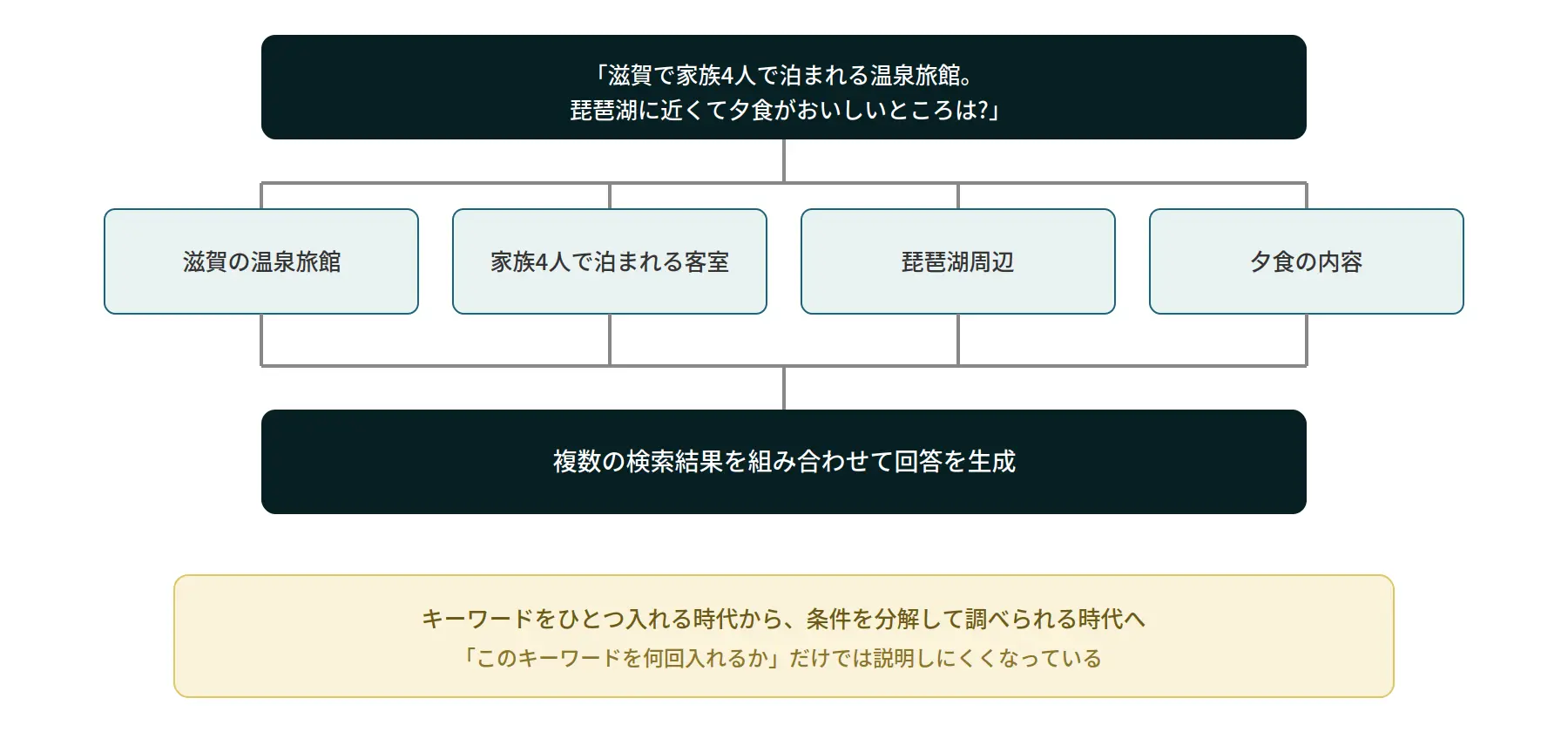
Google explains the concept of “query fan-out” as one such mechanism (Google Search Central). For example, suppose there’s a query like this: “I’m looking for a hot spring inn in Shiga where a family of four can stay. It should be close to Lake Biwa and serve delicious dinner.” With traditional search, the system would look for relevant pages based on the keywords contained in this text.In contrast, AI Mode breaks the question down into multiple subtopics and performs related searches simultaneously, enabling a deeper exploration of the web.Think of it as piecing together an answer by separately investigating the various conditions contained in the question—such as “hot spring inns in Shiga,” “rooms that can accommodate a family of four,” “the Lake Biwa area,” and “dinner options.”
Given these changes, future SEO will become increasingly difficult to explain solely in terms of “how many times a keyword should be included.”
Google itself has stated that “SEO remains effective even with generative AI search.”
This is a crucial point to consider when thinking about SEO in 2026.In the document “Optimizing your website for generative AI features on Google Search” published by Google Search Central, it is explained that SEO best practices remain valid even for generative AI search. This is because generative AI features, such as AI Overviews and AI Mode, are built on Google’s search ranking and quality systems.
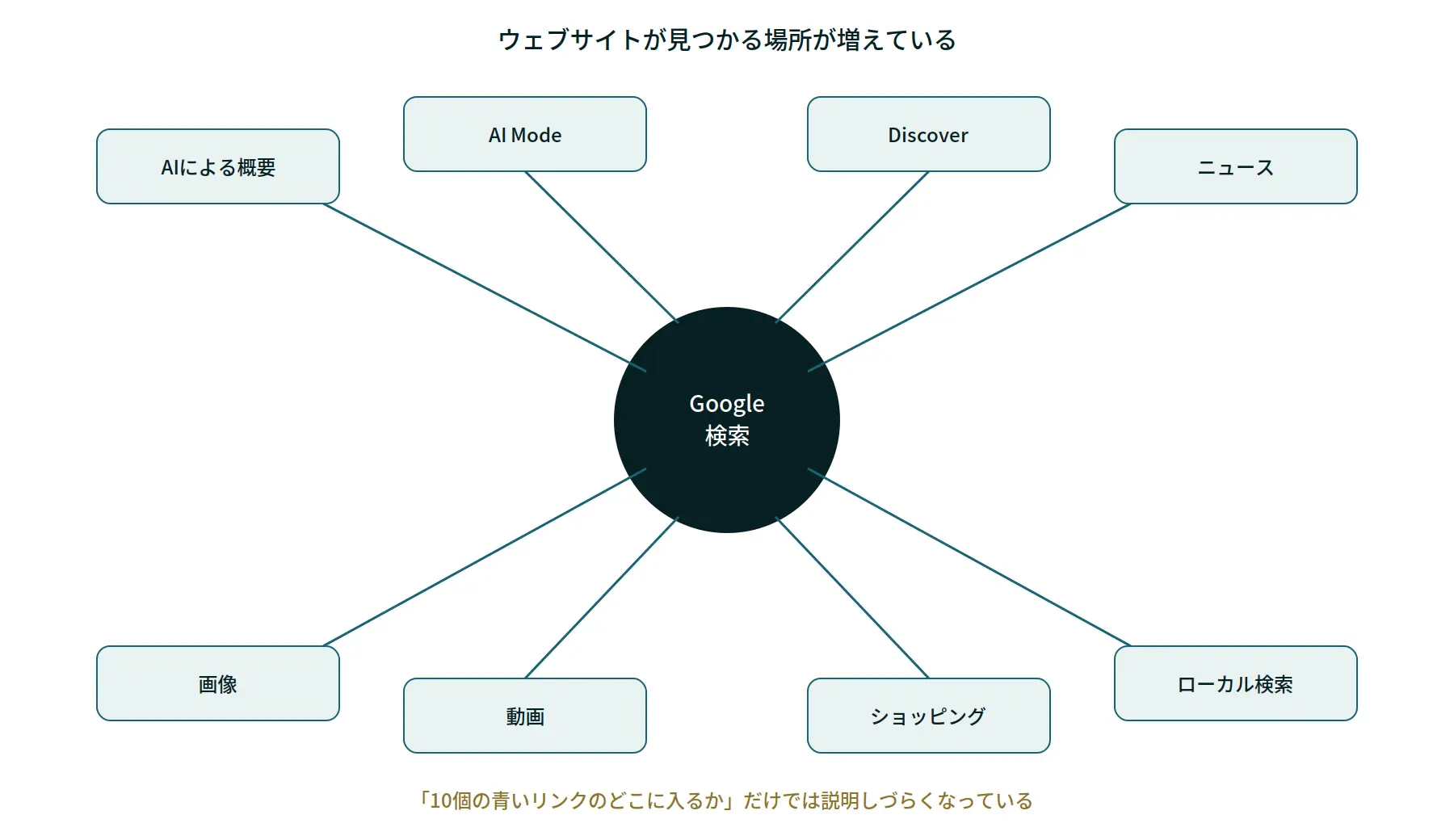
In other words, it’s not accurate to say that “SEO is over because AI search has arrived.” Rather, it might be more accurate to view the emergence of new AI search features as an expansion of traditional SEO into new areas.Websites are now discoverable in more places within Google—not just in traditional search results, but also through AI-generated summaries, AI Mode, Discover, News, Images, Videos, Shopping, and Local Search. That’s precisely why I believe the importance of building a solid website is actually evolving.
Are AEO and GEO “Completely Different Forms of SEO”?
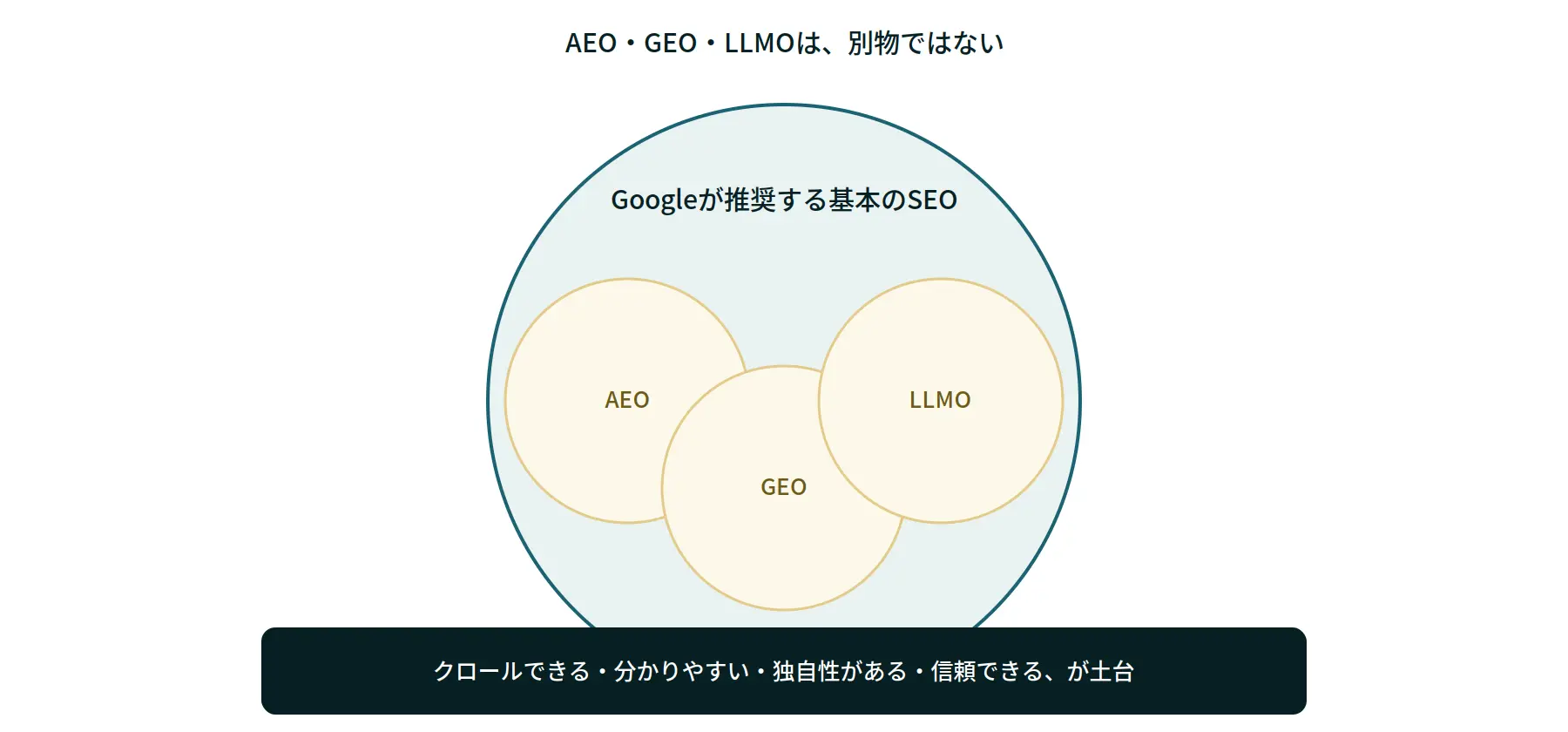
Terms like AEO, GEO, and LLMO have been popping up frequently lately. While there are subtle differences in their definitions, based on what’s outlined in “Google Search Essentials,” it doesn’t seem necessary to think that “there’s a completely different kind of SEO specifically for AI search.”Google recommends basic SEO practices even for generative AI search. These fundamentals include: ensuring Google can crawl the page; making the page’s content clear; using internal links appropriately; providing content that’s useful to users; ensuring the content is original; providing reliable information; using images and videos appropriately; and ensuring that structured data matches the actual page content.
Therefore, rather than thinking, “I’ll write special content for AI search,” the approach of “creating pages that are easy for humans to read and easy for AI to understand” may be easier to manage in the long run.
Glossary: What Are AI Search Optimization, AEO, GEO, and LLMO?
Let’s take a moment to clarify some terms you often see. These are all terms that have come into use within the industry; Google itself has not officially defined them. As a result, explanations may vary slightly depending on the article or service. Please consider these definitions to be generally accepted meanings only.
Terminology | Meaning |
SEO (Search Engine Optimization) | Search engine optimization. General efforts to make it easier for users to find your content in search results on Google and other search engines. |
AI Search Optimization | Efforts to ensure content is displayed and cited more frequently within Google’s generative AI search features, such as AI Overviews and AI Mode. This is generally discussed as an extension of SEO |
AEO (Answer Engine Optimization) | An approach aimed at ensuring a company’s information is more likely to be cited or referenced within “answers” generated by AI |
GEO (Generative Engine Optimization) | A general term for optimization strategies that take into account how generative AI engines, such as ChatGPT, process information. It is often used interchangeably with AEO. |
LLMO (LLM Optimization) | Optimization focused on increasing the likelihood that a company’s information will be selected as a source for large language models (LLMs) to learn from and reference |
When listed side by side like this, they may appear to be distinct specialized techniques, but as we’ve seen in this article, what Google’s official documentation ultimately recommends is, in essence, an extension of basic SEO. Rather than searching for “specialized strategies” every time a new term emerges, I believe that returning to the basics first—even if it seems like a detour—often turns out to be the shortest path to success.
“Unique Information” Emphasized by Google in 2026
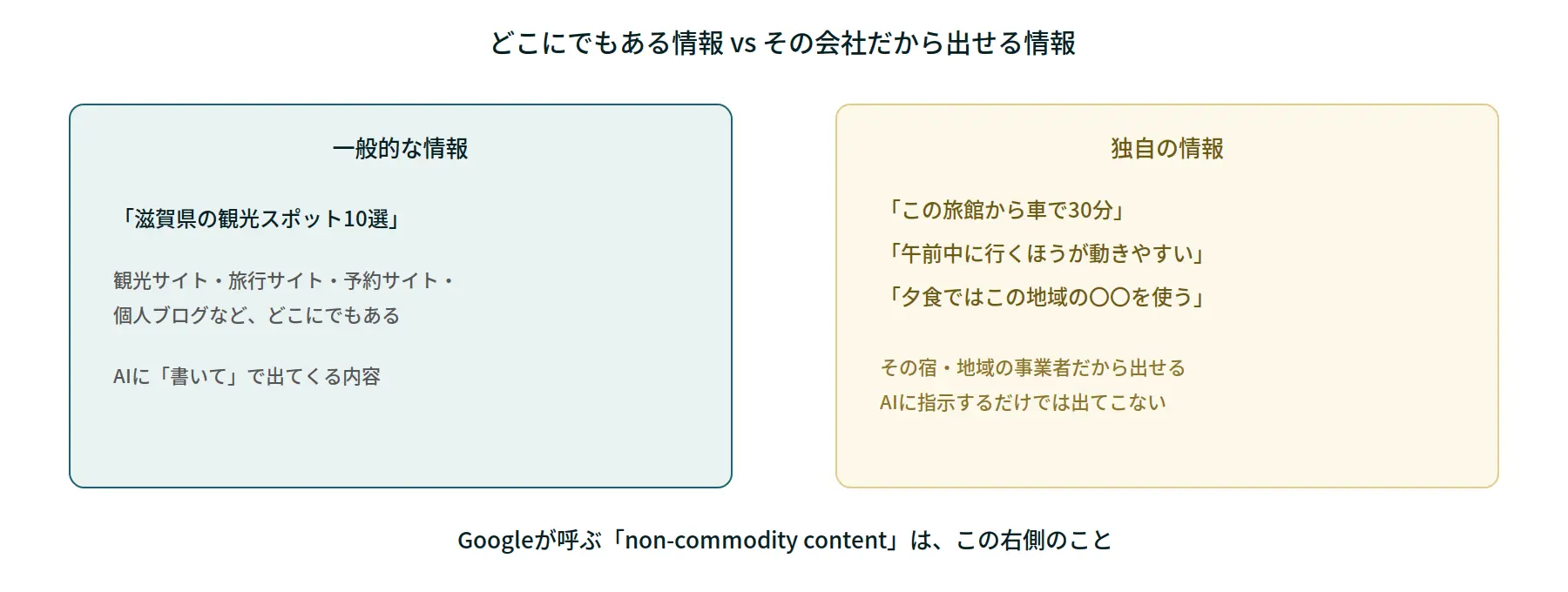
In the 2026 guide for generative AI search, the concept of “non-commodity content” is particularly noteworthy (Google Search Central). While this term is a bit difficult to translate into Japanese, simply put, it refers to content that offers value unique to that specific site—not just generic information that can be found anywhere.
For example, let’s say you write an article titled “10 Must-See Tourist Spots in Shiga Prefecture.” Of course, this is useful information.However, there are plenty of similar articles on tourism sites, travel sites, hotel booking sites, and personal blogs. On the other hand, information like “If you actually drive from this ryokan, it takes about 30 minutes in the morning” or “If you’re traveling with small children, you might find it easier to visit this tourist spot in the morning”or “For dinner, we use [X] from this region”—this is the kind of information that only that specific inn or local business can provide. This contains details that wouldn’t emerge simply by instructing an AI to “write about tourism in Shiga Prefecture.” For websites moving forward, this “content that only that company, that store, or that person can write” may become more important than ever before.
Precisely because we live in an era where AI can write text, information that’s difficult for AI to generate becomes all the more important
With generative AI, it’s now possible to create fairly coherent text in a short amount of time. This is a huge change for web development and SEO. On the other hand, being able to generate text and possessing unique information are two different things.
For example, writing an article titled “How to Choose a Home Builder in Shiga Prefecture” isn’t particularly difficult in and of itself. However, when it comes to topics like “How should you consider sunlight exposure during winter when actually building a house in this region?”“How to handle visibility from the street on this lot,” or “These are the kinds of questions we often get from clients building homes in Shiga Prefecture”—these topics require the real-world experience of a company actually doing the work. Therefore, I don’t think the problem lies in AI generating text itself; rather, what you can include in that text will become increasingly important going forward.
Will Adding llms.txt Improve AI Search Performance?
When researching AI search, you may come across a file called “llms.txt.” It’s sometimes introduced as a new file designed to help AI understand websites. However, Google Search Central explains that llms.txt is not required for Google Search and has no positive or negative impact on search visibility or rankings.Of course, this doesn’t rule out the possibility that systems other than Google might use it. However, if you’re thinking about Google Search optimization, there’s no need to believe that “you absolutely must include llms.txt because it’s essential for AI search.”
In SEO, whenever a new term emerges, it’s easy to feel that “if you don’t do this, you’ll lose out in search results.” But if you take a look at Google’s official documentation, you’ll find that some of these factors actually have a surprisingly low priority.
Changes to FAQ Rich Results
It wasn’t just AI-related changes that took place in 2026. There were also major changes to FAQ rich results displayed in search results. Starting May 7, 2026, Google stopped displaying FAQ rich results in search results. The related documentation was also removed in June (Google Search Central).
This serves as a reminder that “just because a strategy was effective for SEO in the past doesn’t mean you should keep doing it the same way forever.”Structured data itself isn’t going away. However, the relationship where “if you include structured data, it will be displayed this way in search results” can change due to updates to Google’s specifications. In SEO, it’s not enough to simply set up techniques once and forget about them; it’s also important to regularly check Google’s official information.
In 2026, it became possible to measure “how a site appeared in AI search”
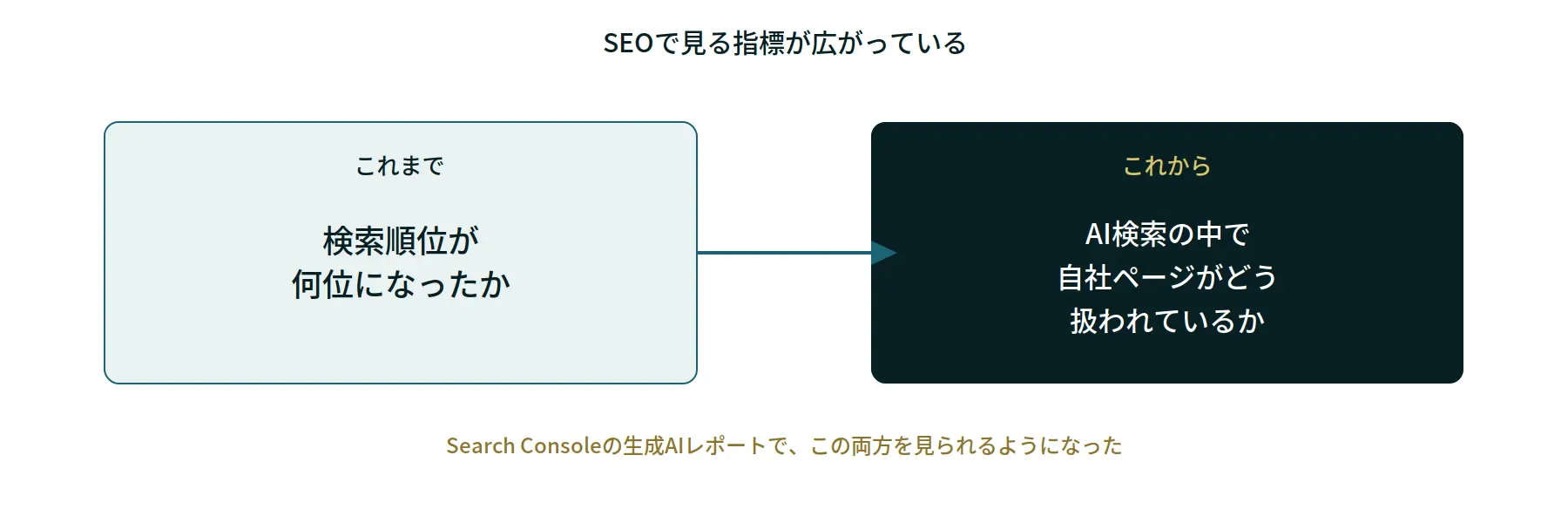
This is another significant change. In June 2026, Google announced new performance metrics for website owners to check how their content appears in generative AI search.Subsequently, on August 31, Google announced that reports on generative AI search in Search Console had been rolled out to websites worldwide (Google, “New opportunities, control, and insights for website owners”). This makes it easier to see how a website appears in searches that include generative AI features such as AI Overviews and AI Mode.
This may require a slight shift in SEO thinking. Until now, the focus has often been on “what search ranking a site achieved.” From now on, it will also be possible to see “how your pages are being treated within AI search results.” SEO may be shifting from a focus solely on search rankings to a focus on where your content appears within the overall search experience.
AI Mode Is Already Available in Japan
Let’s now take a look at the situation in Japan. In September 2025, Google rolled out AI Mode to multiple languages, including Japanese (Google: “Google Search AI Mode Now Available in Japanese”).Users can ask Google questions in Japanese and not only view standard search results but also search for information through a conversational interaction with the AI. The feature is being developed to handle complex searches, such as travel planning.
In other words, it’s no longer accurate to say that “AI search is only a U.S. phenomenon” in Japan. For companies operating Japanese-language websites, AI search has already become a topic they should be considering.
Search Live has also been rolled out in Japan
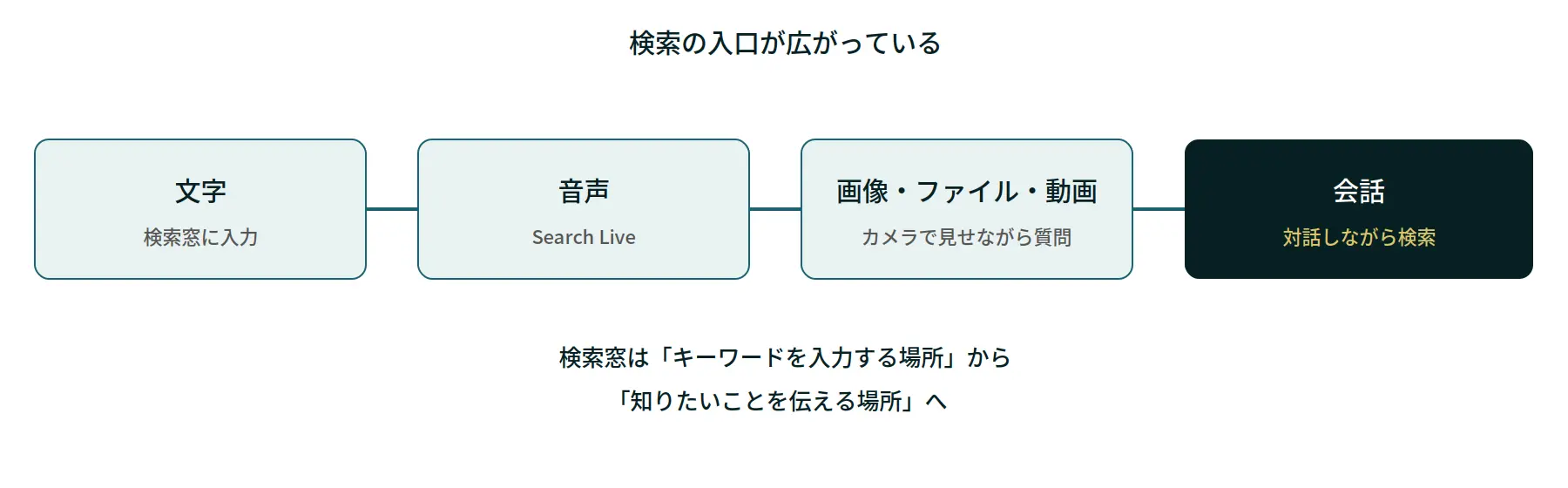
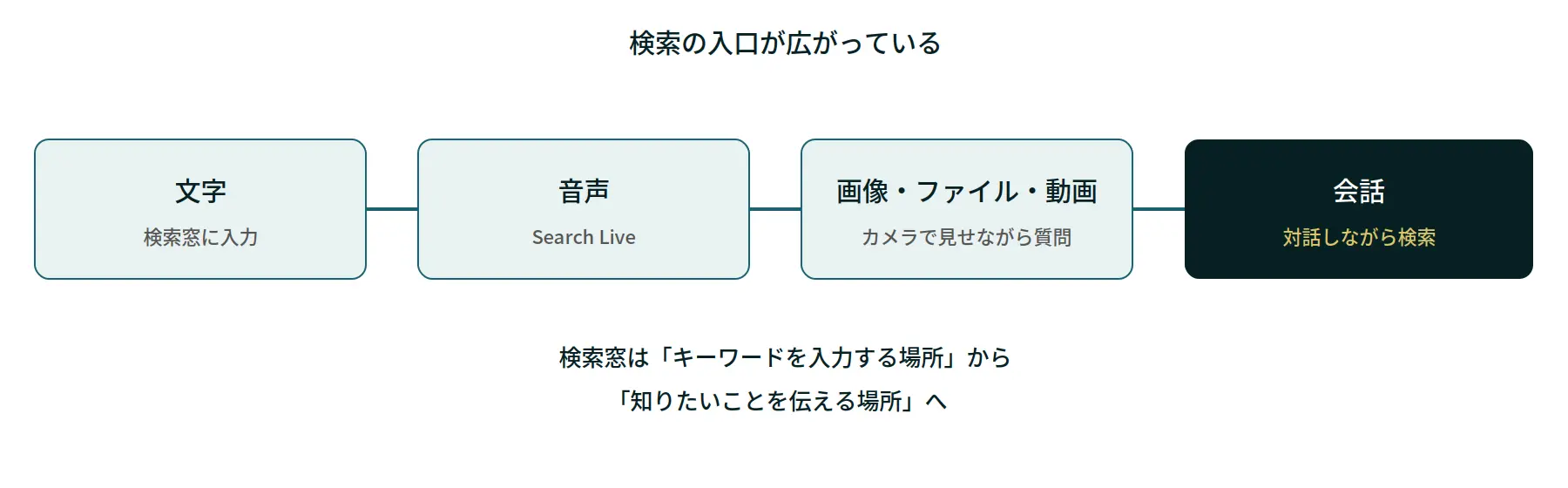
In March 2026, Search Live was also rolled out to regions supporting AI Mode, including Japan (Google: “Search Live Now Available in Japan”). Search Live offers an experience where you can search while having a conversation, using voice or the camera. For example, you can ask a question while showing the camera an object right in front of you.
This is quite different from the traditional method of “typing text into a search bar.” The entry points for search are expanding from text to voice, images, and conversation. With this in mind, website operators would be wise not to assume too strongly that searches will be conducted using text alone.Various types of information on a page—such as photos, videos, store information, product details, locations, and business hours—will increasingly become part of the search experience.
Google Search Now Supports Inputs Other Than “Text”
At Google I/O 2026, features were introduced for AI Mode that allow users to input not only text but also images, files, videos, and Chrome tabs (Google, “Search’s I/O 2026 updates: AI agents and more”).The search bar itself is evolving from a “place to enter keywords” to a “place to convey what you want to know.”
This also has implications for website design. For example, a restaurant might use photos of its menu; a hotel, photos of guest rooms and meals; a construction company, photos of projects in progress; a hair salon, photos of hairstyles; and a tourist attraction, photos of the surrounding scenery. Such visual information may take on greater significance in the search experience of the future.
Some features are not yet available in Japan
On the other hand, not all of Google’s AI-related features are available in Japan in the same way. It’s best to distinguish between “Google announcing a new feature” and “that feature being generally available in Japan.” Google Search Labs imposes country and language restrictions on experimental features.Additionally, some AI agent-related features are limited to specific countries and languages. Therefore, just because a feature launched in the U.S. doesn’t necessarily mean it will launch in Japan right away. If a specific launch date for Japan hasn’t been announced, it’s more accurate to assume that “no specific launch date for Japan has been announced at this time.”
“Announced overseas” ≠ “A launch date for Japan has been set”
Google services are often rolled out in phases. First, in select countries.Next, English-speaking regions. After that, they add more supported languages. Finally, they expand to various regions, including Japan. This is often the sequence of events. Therefore, it’s a bit risky to write an article predicting, “Since it launched in the U.S., it will start in Japan in [month].” If Google hasn’t announced a specific launch date for Japan, it’s best to treat that fact itself as the information.
What Google Updates Happened in 2026?
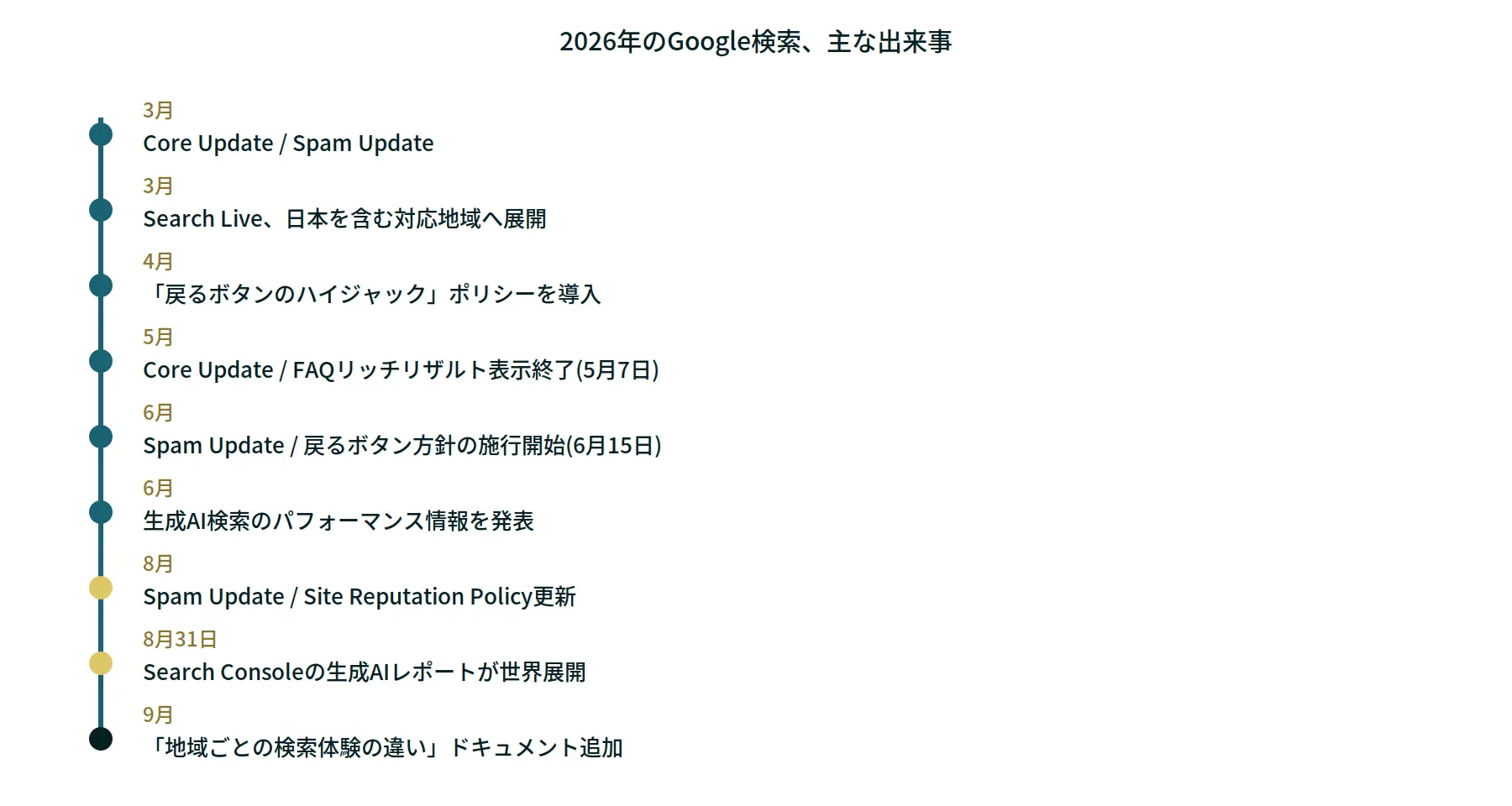
In addition to major changes in regular search results, Google Search also implements Core Updates and Spam Updates. In 2026, there were a Core Update and a Spam Update in March, a Core Update in May, and Spam Updates in June and August. Updates related to Discover were also implemented (Google Search Central).
The key here is not to simply assume that “rankings dropped because there was an update.” Since Google’s search system consists of multiple mechanisms, it’s important to identify exactly what kind of update it was. Was it a Core Update? A Spam Update? A Discover update? Or perhaps a change in how search results are displayed? The appropriate course of action depends on the specific update.
Trends Emerging from the 2026 Updates
By tracking Google’s official documentation from 2026, several trends become apparent.
First, AI search is becoming an integral part of the search experience. Features like AI Overviews and AI Mode are being integrated into the Google Search experience itself, rather than simply being “new features next to the search results.” As a result, SEO can no longer be explained solely by “which of the 10 blue links you appear in.”
Second, the importance of uniqueness is increasing. It’s no longer just about general information; “information that only that site can provide” is becoming crucial. This doesn’t seem to be a concept that suddenly emerged because we’re in the AI era; rather, it appears to be a natural extension of Google’s long-standing principles of “user-first” and “useful, trustworthy content.”
Furthermore, it’s necessary to look beyond search results. With features like AI Mode, AI Overviews, Discover, images, videos, and local search, the number of places where websites appear is increasing. When evaluating SEO performance, search rankings alone are no longer sufficient.
Finally, regional differences can no longer be ignored.In September 2026, a document titled “Regional differences in Search experience” was added to Google Search Central (Google Search Central), addressing variations in the search experience by region. Google itself has clarified that the search features available differ by country and region. In other words, simply applying SEO strategies from overseas to Japan as-is is likely to result in an increasing disconnect going forward.
And here are the SEO practices that Google explicitly prohibits
So far, we’ve looked at “what’s important for SEO moving forward.” On the other hand, when considering SEO, it’s important to know not only “what to do” but also “what not to do.”
Google Search Central features an official document titled “Spam Policies for Google Web Search.” The term “spam” here does not simply refer to annoying ads. It targets actions such as deceiving users or manipulating the search system to make content stand out unnaturally in search results.Furthermore, it has been reaffirmed that by 2026, these spam policies will also apply to AI-generated answers in Google Search. In other words, just because it’s “AI search” doesn’t mean it’s exempt from existing SEO rules. Any behavior that deceives users or manipulates the search system—including AI-generated answers—will be considered a problem across the entire search ecosystem.
Does creating a large number of articles with AI constitute spam?
This is an area where misunderstandings are quite common.Google does not say that “using generative AI constitutes an SEO violation.” What is problematic are cases where generative AI or similar tools are used primarily to boost search rankings—such as creating large volumes of pages with little value to users, publishing large volumes of content lacking originality, merely compiling information from other sites, or creating large volumes of pages that simply stuff keywords.Google describes these practices as “scaled content abuse” (Google Search Central).
In other words, the problem isn’t “using AI” itself, but rather “creating large amounts of low-value content to manipulate search rankings.” Therefore, “writing articles with AI” does not automatically mean it’s a no-go.For example, using AI to draft or organize text when summarizing the experiences of your own staff is fundamentally different from having AI automatically generate a large number of articles and publish them based on specific search keywords—even though both involve “using AI.”
Mass-producing pages by gathering information from other sites
Under Google’s spam policies, practices such as scraping are also problematic. This involves gathering text from other sites, slightly altering the wording, publishing it on your own site, and adding search keywords to create a large number of pages. Simply changing the wording slightly does not, in and of itself, create original value.Beyond simple reposting, practices such as using machine translation, substituting synonyms, automatically merging multiple pages, or creating pages that merely slightly modify information from other sites can also be problematic if they do not provide new value to users (Google Search Central). Rather than assuming that “changing the text makes it original,” it’s better to focus on “what new information or experiences have been added.”
Creating a large number of pages where only the city name has been changed
When it comes to SEO for small and medium-sized businesses, one thing to be especially careful about is “pages with different place names.” For example, suppose you create pages titled “Otsu City Website Design,” “Kusatsu City Website Design,” “Moriyama City Website Design,” and “Ritto City Website Design.” It would be a different story if each page contained genuinely distinct information about its respective region that is useful to users.However, imagine creating dozens or even hundreds of pages where you simply replace the word “Otsu City” in a sentence like “We provide website design services in Otsu City” with “Kusatsu City,” “Moriyama City,” or “Ritto City.”This tactic—creating a large number of “entry pages” for each search query that ultimately lead to the same page—closely resembles what Google describes as “doorway abuse” (Google Search Central).
Creating separate pages for each region isn’t inherently bad. There are valid reasons to do so, such as having actual project examples, a proven track record in that region, the ability to explain region-specific circumstances, service offerings that differ by region, or information that is genuinely useful to customers in that area. If these reasons apply, it makes sense to create separate pages. Here, too, it’s important to ask yourself, “Is the sole reason for creating this page to improve search rankings?”
“Cloaking”: Showing Different Content to Search Engines and Humans
One of the practices explicitly prohibited by Google is cloaking. Simply put, this involves intentionally displaying different content to search engines than to human users. For example, this could involve showing a page with travel information to search engines, while displaying entirely different products or ads when a human user visits the site (Google Search Central).
Of course, it’s not a problem in and of itself if the display on a desktop and a smartphone differs slightly for technical reasons, such as responsive design or JavaScript. The issue lies in “showing different content to search engines and human users for the purpose of manipulating search rankings or deceiving users.”
Hidden Text and Keyword Stuffing
Although these are long-standing forms of SEO spam, it’s still important to be aware of the concepts behind them.For example, this involves cramming an unnaturally large number of keywords—such as “Shiga website design,” “Otsu website design,” and “Kusatsu website design”—into the text. You should also be wary of text that matches the background color, extremely small text, text invisible to users, and lists of keywords intended solely for search engines.
The mindset of “how many times do I need to include this keyword to rank higher?” has become quite risky in today’s Google search environment. It’s better to prioritize the following: ensuring the text reads naturally; providing the information the page is intended to convey; and making sure users can read and understand the content.
Creating a Large Number of Unnatural Links
In SEO, it’s sometimes said that “backlinks are important.” Certainly, being referenced by other sites does have value. However, the situation changes entirely when you start “creating links solely to improve search rankings.”This includes practices such as purchasing large numbers of links, engaging in excessive link exchanges, automatically generating massive amounts of links, creating a large number of sites solely for the purpose of linking, and placing a large number of unnatural links with keyword-stuffed anchor text.It’s not a matter of “the more links, the better.” There’s a significant difference between being linked to as a result of creating content that people genuinely want to share and increasing the number of links solely for the sake of search rankings.
“Site Reputation Abuse” Involving the Use of Strong Domains
Google also has a policy called “Site Reputation Abuse.” Simply put, this policy addresses practices where third-party content is published solely to exploit the strong domain of a site that is already highly ranked in search results.For example, this includes cases where a site—which is primarily operated as a news outlet—publishes a large amount of third-party content that has little relevance to the site’s core subject matter, with the sole purpose of improving its search rankings. In August 2026, Google announced an update to this policy (Google Search Central: “Update to the Site Reputation Policy”).
This further illustrates that the focus is no longer on the idea that “if a domain is strong, whatever you post will be advantageous in search results,” but rather on the context of whether “it makes sense for that site to be covering that information.”
“Back Button Hijacking” Also Explicitly Prohibited in 2026
In 2026, “back button hijacking” was also explicitly defined as a violation of Google’s spam policy (Google Search Central, “New Spam Policy on ‘Back’ Button Hijacking”).This refers to actions that interfere with the normal behavior of the browser’s “Back” button when a user clicks it—namely, returning to the previous page. Instead, such actions may redirect the user to a different page, display unsolicited ads, show unintended recommendations, or otherwise disrupt normal browsing.
Google announced that it will enforce this policy starting June 15, 2026, and explained that affected pages may be subject to manual actions or automatic demotions. This is less an SEO technique and more of a user experience issue. However, the fact that Google is treating even these aspects as search spam is an interesting point to consider when thinking about the future of SEO.This is becoming increasingly at odds with the mindset that “it’s acceptable to sacrifice user experience to some extent for the sake of search rankings.”
To summarize the practices to avoid in SEO:
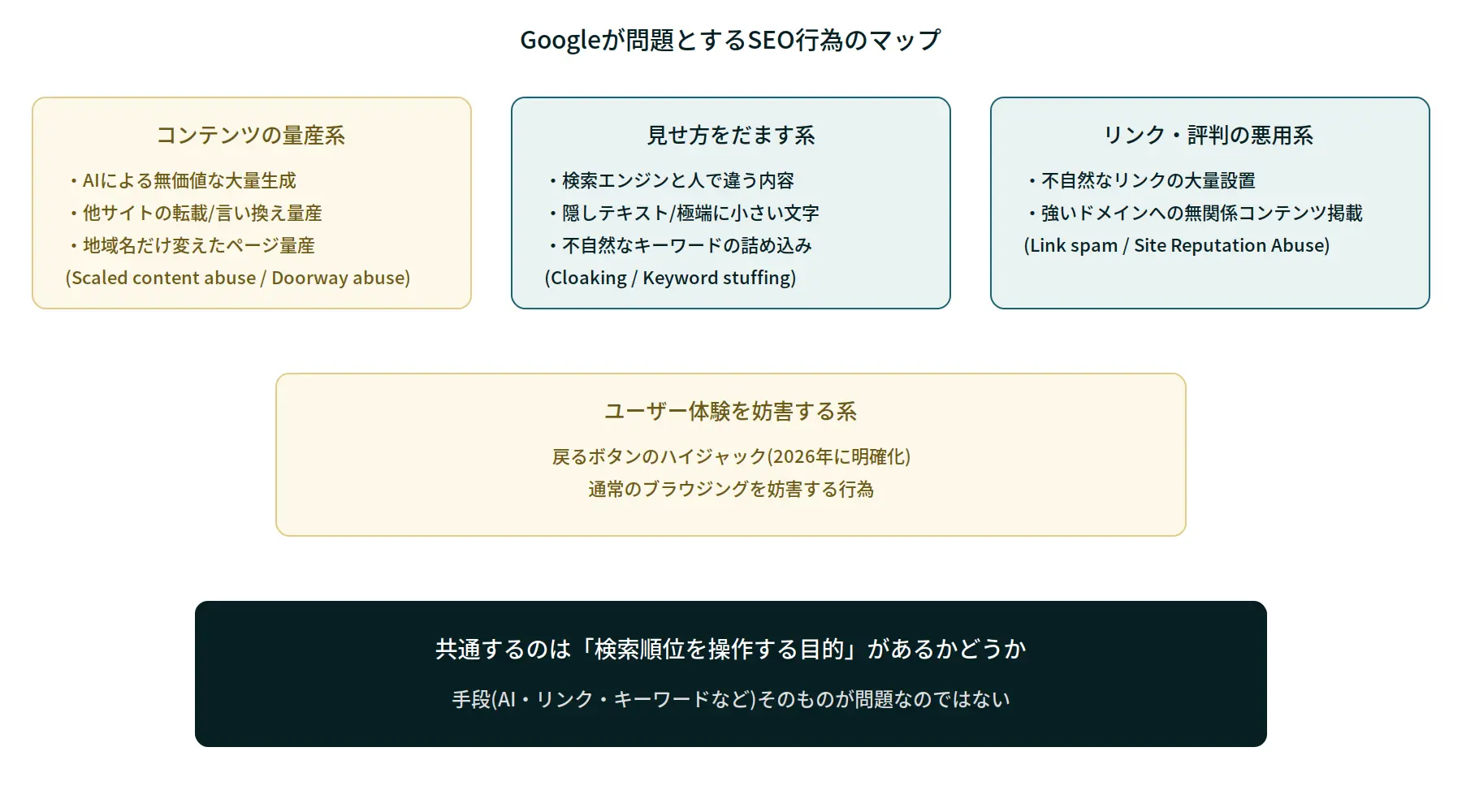
Behavior | Google’s Perspective |
Mass-generating low-value articles using AI | May constitute the unauthorized use of mass-generated content |
Reposting articles from other sites almost verbatim | Potential issues such as scraping |
Publishing large quantities of articles from other sites with only minor rephrasing | May become an issue if there is no original value |
Creating a large number of pages where only the location name has been changed | May constitute doorway page abuse |
Showing different content to search engines and human users | Cloaking |
Unnatural insertion of large numbers of keywords | Issues such as keyword stuffing |
Hidden text | Potential spam |
Unnatural links intended to boost search rankings | Link spam issues |
Posting large amounts of irrelevant third-party content on high-authority sites | Site Reputation Abuse Issues |
Interference with the Back Button | Spam Practices Clarified in 2026 |
Automatically retrieving large volumes of search results | Potential issues related to “automated queries” |
Of course, it would be simplistic to assume that performing any of these actions will inevitably result in a drop in rankings. Google relies not only on automated systems but also on human review when necessary, and may take manual corrective actions—such as lowering a site’s visibility in search results or removing it entirely—in response to policy violations (Google Search Central).
It’s Not About Using AI, but “Why You Use It”
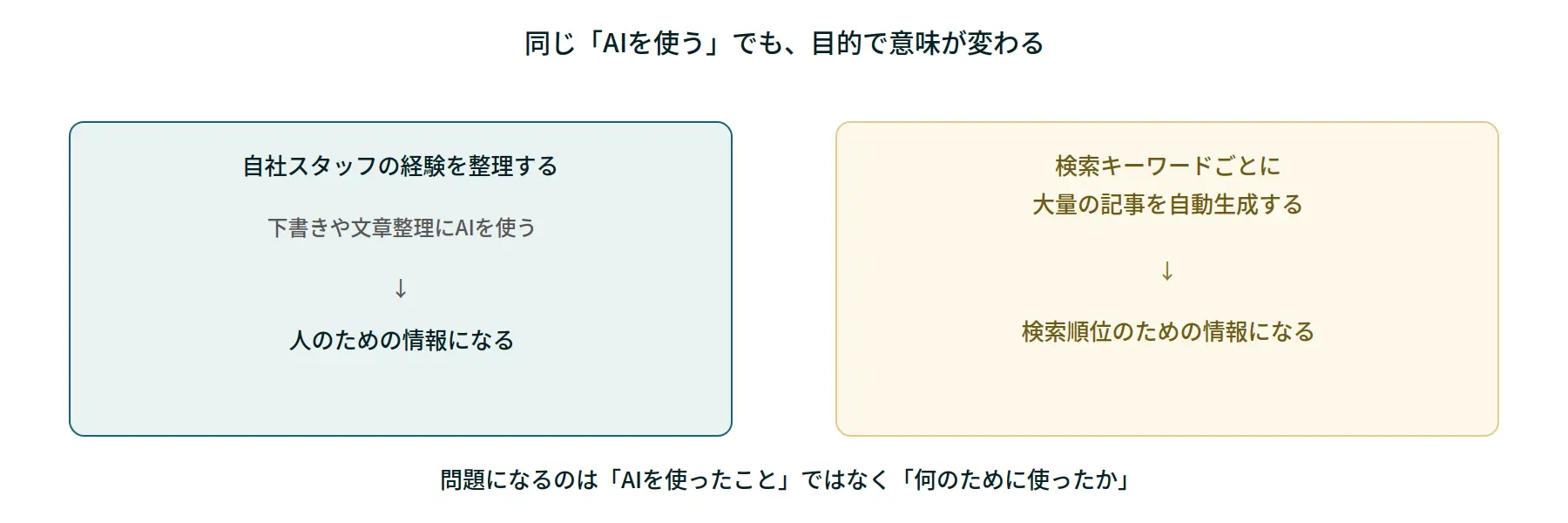
Looking at these spam policies reveals an interesting perspective on Google Search in 2026. Google does not view AI itself as the enemy. In fact, Google is incorporating generative AI into its own search. So what is the problem? It is using AI or automation not for the benefit of users, but solely to manipulate search rankings.
For example, there’s a significant difference between using AI to “organize and write articles based on our staff’s actual experiences, with the AI assisting with the drafts” and using it to “have AI generate 1,000 articles to target search rankings for 1,000 keywords.”Even when using the same AI, the objectives are different. This distinction will likely become quite important as we continue to use AI to manage websites and blogs moving forward.
What to Do and What Not to Do in Google Search in 2026
Let’s summarize what we’ve discussed so far from the perspective of a website operator.
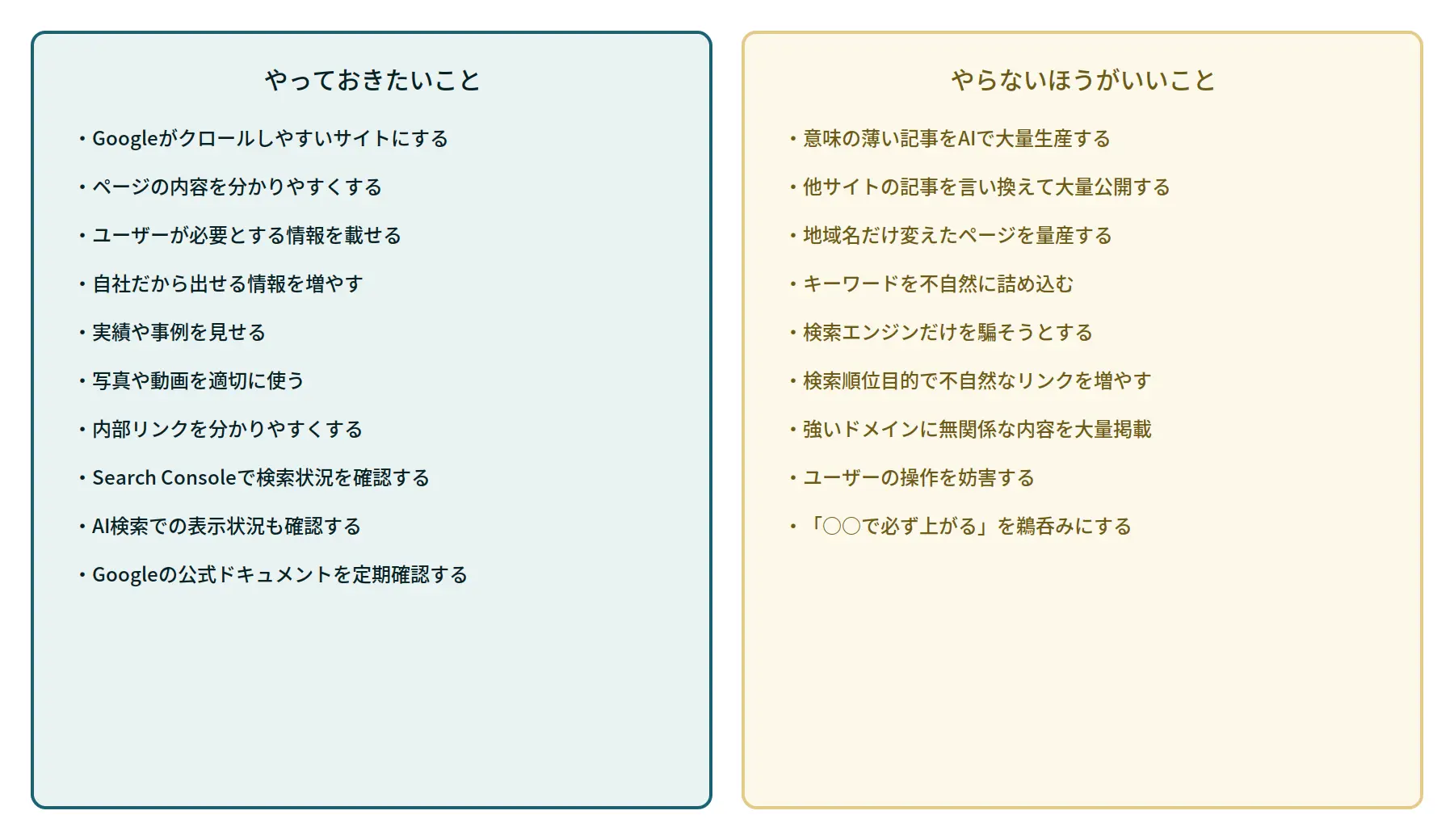
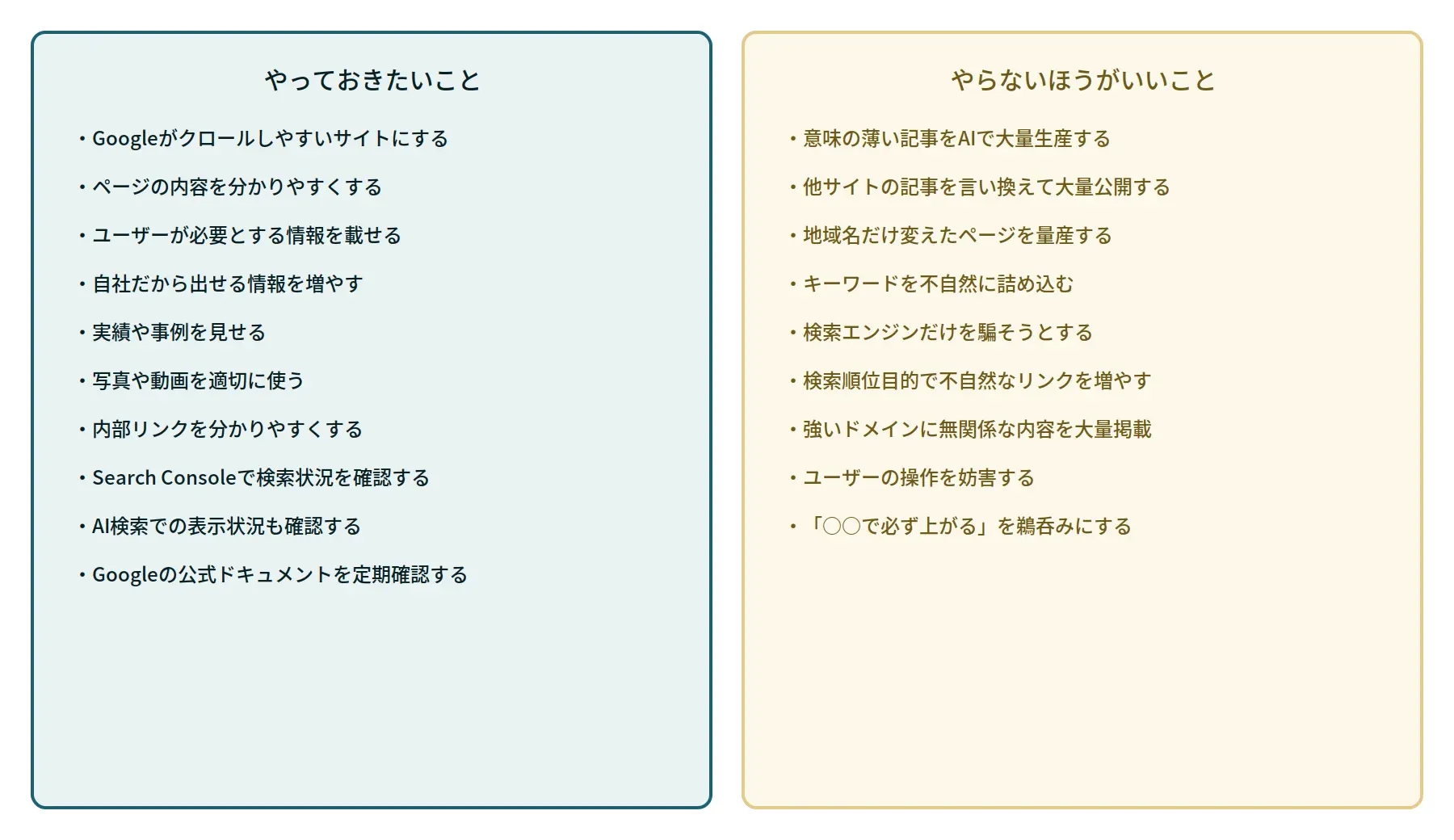
What you should do is make your site easy for Google to crawl; make page content easy to understand; provide the information users need; increase the amount of information only your company can provide; showcase your track record and case studies; use photos and videos appropriately; and make internal links easy to follow.Check your search performance in Search Console. Monitor how your site appears in AI-powered search results. And regularly review Google’s official documentation.
Things you should avoid include mass-producing articles with little substance using AI; rephrasing articles from other sites and publishing them in large quantities; creating a large number of pages that only change the location name; and unnaturally stuffing keywords into your content.Trying to trick search engines. Increasing unnatural links solely to boost search rankings. Posting large amounts of content unrelated to a strong domain. Interfering with user navigation. And blindly accepting claims like, “If you do X, your rankings will definitely go up.”
Looking at it this way, SEO seems to have become more difficult than before, but in some respects, it has actually become much simpler.
SEO is moving away from the concept of a “website designed solely for search rankings”
When thinking about SEO, we often find ourselves focusing solely on “how to improve rankings.” However, if you read Google’s spam policies closely, you’ll see that the opposite approach is actually encouraged. If you go too far in the direction of adding pages, keywords, links, and word count—or using AI to generate articles—solely to boost search rankings, you’ll gradually drift away from your users.
Instead, we should ask: “What do people who visit this page want to know?” “What information can only this company provide?” and “How can we convey real-world experiences and case studies?” As a result, people will find us through search as well. This approach may be better suited to the future of Google Search.
“Information Architecture” Will Become Even More Important in Website Development
From the perspective of website creators, I believe this is a significant shift. Until now, the prevailing mindset was to “create pages based on search keywords.” Going forward, however, we’ll need to consider “what Google and users want to know about that company.”
For example, for a hotel, you should clearly explain what the guest rooms are like, what kind of cuisine is served, what the bath facilities are like, what activities are available in the surrounding area, and how to make a reservation. For a construction company, you should show what kinds of homes they build, in which areas they operate, what values they prioritize, and examples of their actual construction projects.For a restaurant, you should clearly outline what kind of food is served, what the atmosphere is like, the price range, the location, and whether reservations are accepted. These fundamentals won’t change significantly even with the advent of AI search.
You Don’t Need to Cram Everything onto a Single Page
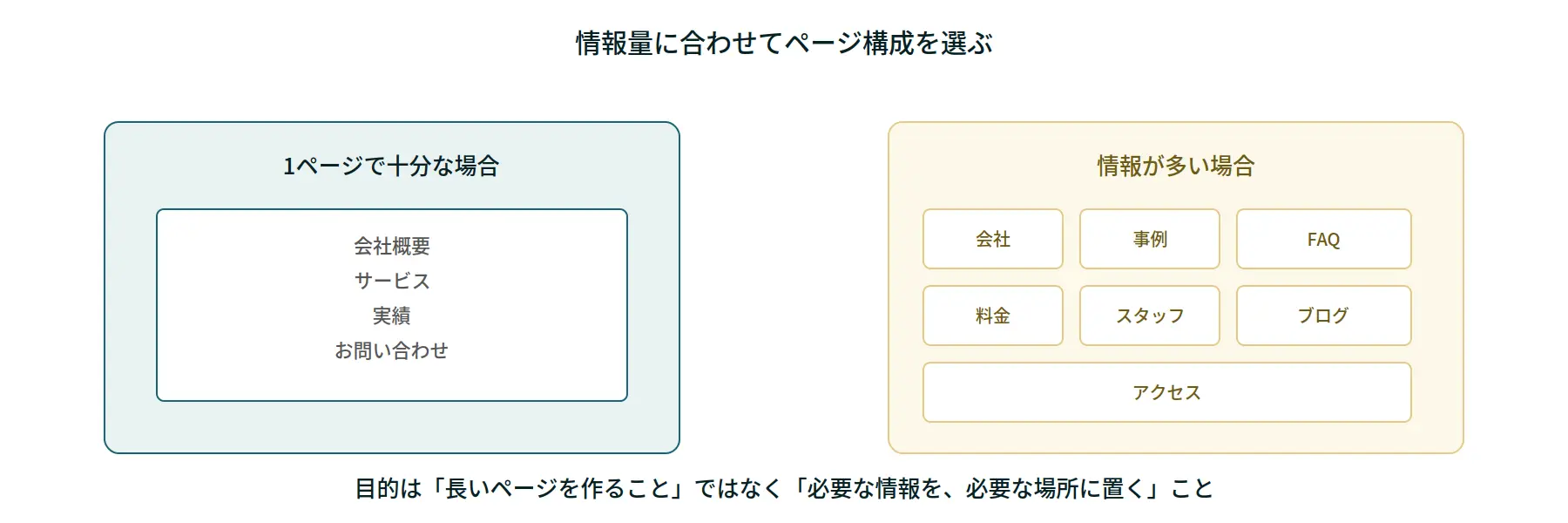
When thinking about AI search, you might assume that “the more information you include, the better.” However, just because there’s a lot of information doesn’t mean you need to cram it all onto a single page. In fact, it’s often clearer to organize the information into separate sections—such as About Us, Services, Project Examples, FAQs, Pricing, Directions, Staff, and Blog.
Even when considering how to adapt to AI search, the goal isn’t to “create a long single page.” Place the necessary information where it belongs. As a result, the number of pages may increase in some cases, while in others, a single page may be sufficient. That’s a perfectly valid approach.
What’s Next for Google Search After 2026?
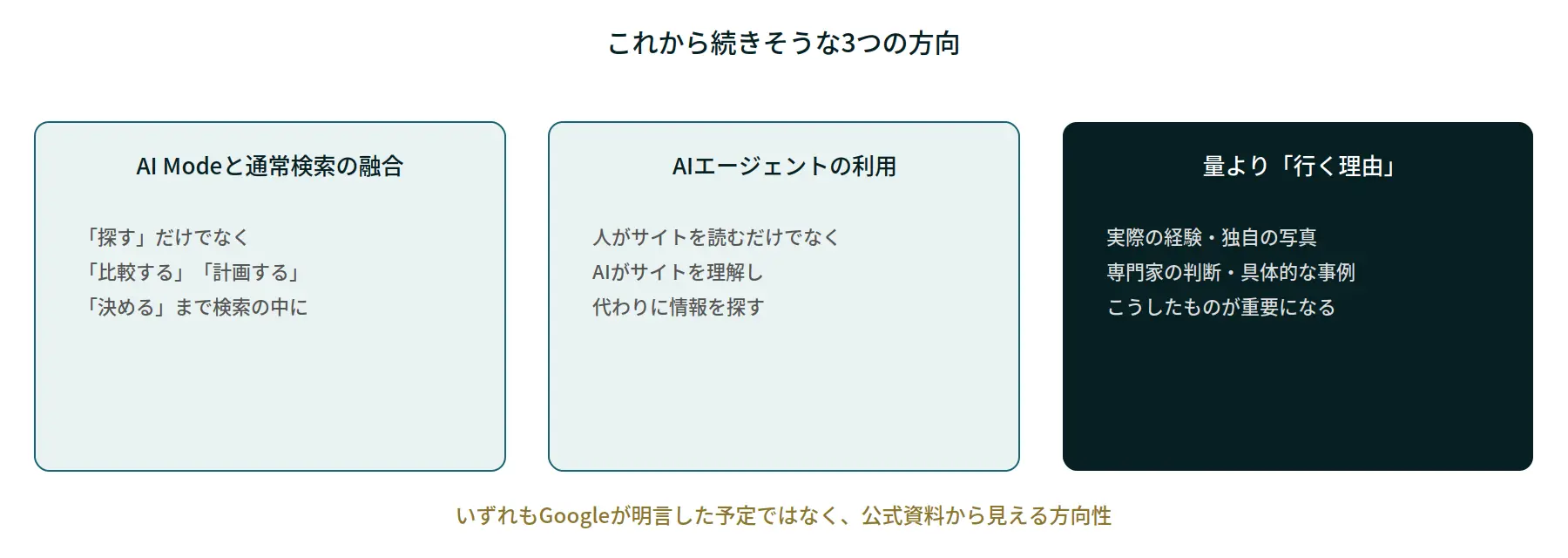
From here on out, this is speculation. Since Google doesn’t disclose all the specific details or schedules for its next Core Update in advance, we can’t definitively state that “XX will be evaluated in the next update.” However, based on the official documentation and announcements from 2026, we can identify trends that are likely to continue.
One trend is the integration of AI Mode and standard search.AI Mode is likely to continue expanding its functionality. Search will evolve beyond simply “finding information” to include actions such as “comparing,” “planning,” “making decisions while researching,” and “using external services.” As a result, websites will no longer be merely “pages to be read” but will also serve as information sources that AI can reference when answering users’ questions.
Another trend is the use of the web by AI agents. At I/O 2026, Google also announced “Search agents” (Google, “Search’s I/O 2026 updates: AI agents and more”).This trend is expanding the scope of search from “getting an answer on the spot” to “actively pursuing information,” including agents that continuously gather information. If this trend continues, we could see a world where it’s not just “humans reading websites,” but “AI understanding website information and searching for it on the user’s behalf.”For example, if AI begins to perform tasks such as “Find a hotel that meets these criteria,” “Check the inventory of this product,” or “Confirm this store’s hours of operation,” the way information is structured on websites may also change.
Moreover, what matters more than the volume of content is “the reason to visit that page.” As AI becomes capable of summarizing large amounts of general information, the approach of “just writing a long article” may no longer be as straightforward as it once was. Instead, the question “Why would someone visit this page?” will become crucial. Real-world experiences.Original photos. Expert opinions. Specific case studies. Locally unique information. The philosophy of a company or store. Up-to-date information. These elements differ from simple generalizations.
The Value of Reading “English Google Docs” for SEO in Japan
There are a vast number of Japanese SEO articles. Of course, you can gather information from them. However, if you’re researching Google Search, it’s worth taking a look at the English documentation on Google Search Central at least once. The reason is simple: you can verify what Google itself is saying.
In Japanese articles, information like “It seems that X works for SEO” or “It seems that Y is important for AI search” sometimes spreads first. When you then check the original Google documentation, you may find that “Google didn’t actually say that.” Conversely, by reading the English documentation, you can quickly learn information that hasn’t been widely covered in Japanese articles yet.Of course, information in English isn’t necessarily applicable in Japan as-is. That’s why it’s important to follow a two-step process: first, review Google’s official English-language documentation, and then verify how those features are implemented in Japan.
To summarize as of September 2026
Item | Status as of September 2026 | Relation to Japan |
AI Overviews | Rolled out as a search experience using generative AI | Also Relevant for Japanese Searches |
AI Mode | Rolled out as a conversational search experience | Available in Japanese starting in 2025 |
Search Live | Search experience using voice and camera | Available in Japan starting in March 2026 |
Search Console Reports on Generative AI | Rolling out worldwide on August 31, 2026 | Available for Japanese sites as well |
Preferred Sources | Featured in Top Stories and other sections | Features such as AI Mode depend on region and language |
llms.txt | Does not affect rankings or visibility in Google Search | Low priority for Google SEO purposes |
FAQ Rich Results | No longer displayed as of May 7, 2026 | This is not limited to Japan |
AI Agent-Related Features | Some are experimental or region-specific | Specific launch dates in Japan have not yet been announced for some features |
Region-specific search features | Google explicitly highlights differences by country and region | Verification is also necessary for SEO targeting Japan |
What’s important in this table isn’t just whether or not an AI feature is available. It’s about seeing which features are available in which countries, in which languages, and to what extent.
Frequently Asked Questions About SEO in 2026
As AI search becomes more widespread, will traditional SEO become obsolete?
Not necessarily. Google itself explains that AI Overviews and AI Mode are built on top of its existing search ranking and quality systems. Fundamentals such as crawlability, content clarity, originality, and reliability will continue to be key evaluation criteria even after AI search becomes more widespread.
Should I set up an llms.txt file?
If your focus is solely on Google Search, it’s not a high priority. Google has stated that `llms.txt` has no positive or negative impact on rankings or visibility in Google Search. While other AI services may use it, omitting it won’t put you at a disadvantage in Google Search.
Is using AI to write articles in itself a violation of SEO guidelines?
Using AI in and of itself is not considered a problem. The issue arises when low-quality pages are mass-produced with the intent to manipulate search rankings. Using AI to create drafts that organize your company’s experiences is entirely different—and has a completely different meaning—from automatically generating a large volume of articles for each search keyword, even though both involve “using AI.”
Should I stop creating pages with different location names?
Splitting pages by region isn’t the problem in and of itself. If there are genuine differences for each region—such as actual project examples, track records, or region-specific circumstances—that are truly useful to users, then splitting the pages makes sense. The problem arises when you create a large number of pages with essentially the same content, simply by swapping out the region names.
Do small and medium-sized businesses and sole proprietors also need to read Google’s official English-language documentation?
It’s not mandatory, but it’s worth skimming through at least once. When you trace Japanese SEO information back to the original Google documents, you’ll sometimes find cases where “Google didn’t actually say that.” You don’t need to read everything, but it’s reassuring to get into the habit of referring back to the primary sources whenever you come across information that piques your interest.
SEO in 2026: From “New Tricks” to “Proper Websites”
Google Search in 2026 has changed significantly. Features like AI Overviews and AI Mode are becoming more widespread, and AI Mode and Search Live are now available in Japan as well. Search Console has also expanded its features to help you monitor how your content appears in generative AI search results.
On the other hand, the fundamental principles Google outlines aren’t all that revolutionary. Stick to SEO basics. Provide information that’s useful to users. Offer unique value that can’t be found elsewhere. Structure your pages so Google can easily understand them. And regularly monitor changes in the search landscape. These points will continue to be crucial for Google Search in 2026.
Another important point may be to move away from the mindset that “anything goes as long as it boosts search rankings.” Generating massive amounts of content using AI; mass-producing content by slightly modifying text from other sites; increasing the number of pages by simply changing the location name; unnaturally stuffing keywords; and increasing the number of unnatural links.Interfering with the user experience. While these methods may appear to be effective SEO tactics in the short term, Google explicitly identifies them as problematic. Just because AI search is becoming more widespread doesn’t mean you suddenly need to create “content that appeals to AI.”
Instead, we should ask, “Does this site provide the necessary information for people who want to learn about this company?” We should examine whether that information is unique to that specific company or store. And we should organize it in a way that’s easy to understand for both people and search engines. While the term “SEO” itself may seem daunting, when viewed from the perspective of website development, it actually brings us back to some surprisingly basic principles.
Google Search will continue to evolve. New search experiences like AI Mode may become more widespread, and we may see more instances of agents handling information on the web. That’s precisely why, rather than clinging to SEO strategies once they’re set in stone, we should keep an eye on Google’s announcements and gradually refine the website itself. From 2026 onward, this approach may be the right way to engage with the platform.
 Contact Form


 Related Articles
 ![[2026 Latest Edition] 12 Recommended Free SEO Tools | A Comprehensive Comparison by Purpose (Keyword Research, On-Page Optimization, Site Audit)](https://images.microcms-assets.io/assets/5c8b5d0f3c3045c4bf65bf33c482859f/714062f38860482da18148b79c0dc254/ogp-seo%20(1).webp)