

Overview of Key Features
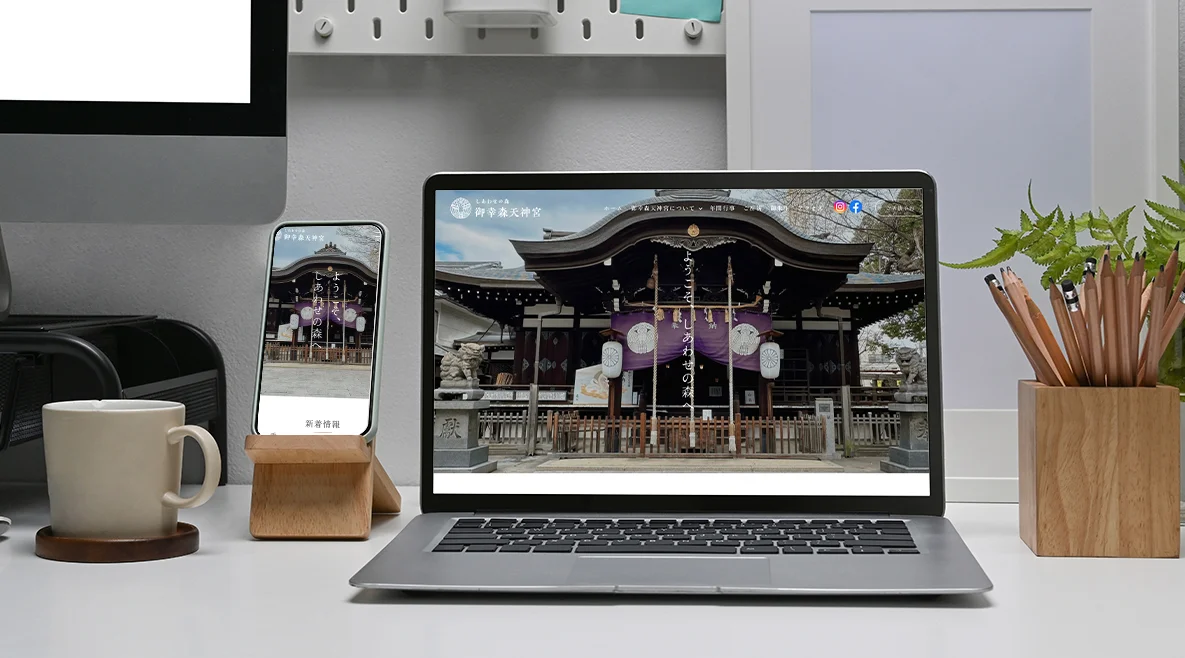
- Client: Miyukimori Tenjingu Shrine (Ikuno Ward, Osaka City)
- Scope of Work: Resolution of display errors following server migration / Website redesign
- Scope of Work: Emergency recovery, client consultation, SEO planning, coding, and design
- Key Production Points: Fundamental overhaul of outdated code and SEO optimization starting from the internal structure
Miyukimori Tenjingu, located in Ikuno Ward, Osaka City, is a Shinto shrine with a history spanning approximately 1,600 years. Its grounds include a forest said to be where Emperor Nintoku once rested, making it a place that maintains a unique sense of tranquility despite being situated in an urban area.
We received a request from Miyukimori Tenjingu stating, “Our website isn’t working properly.” Originally created to help local residents feel a closer connection to the shrine, the site was 15 years old at the time. They reported that immediately after migrating to a new server, error messages in English began appearing.
Emergency Response: Why 15-Year-Old Code Was “Running Out of Steam”
The first step was to apply a temporary fix to the display errors.
Upon inspecting the source code, we found a program built using technology from 15 years ago.At the time of its creation, the iPhone was just beginning to gain popularity, and the design was fully functional for its era. However, web technology changes drastically every few years. Compared to the 1,600-year history of the shrine, the 15 years of web technology have seen changes on a comparable scale.
The root cause of this issue was that the outdated program could not keep up with the new server environment, leading to errors. We’re starting by fixing this issue to restore the website to its normal state.
The Underlying Issue That Has Come to Light: The Problem of Not Appearing in Search Results
While implementing these temporary fixes, the chief priest brought up another issue: “Lately, the shrine hasn’t been showing up in search results very often.”
This issue ran deeper than a mere display problem. Search engine ranking criteria are becoming stricter every year, and no matter how rich a shrine’s history or how deep its ties to the local community may be, if the internal structure (code) of its web pages remains outdated, its value will not be properly recognized. In other words, simply tweaking the surface-level design will not improve its visibility in search results.
To address this issue, we first carefully gathered information—such as the shrine’s history, the chief priest’s vision, and day-to-day operations—that is not readily apparent from the outside. Based on this, we decided not to simply tweak the existing site but to rebuild it from the ground up, starting with its internal structure.
Rather than merely making the site look nice, we are meticulously refining the underlying structure piece by piece so that search engines can accurately interpret the content. While we could have settled for a temporary fix, we determined that a fundamental overhaul was necessary to ensure that this shrine—which has been in existence for 1,600 years—would continue to be discoverable through search for the next 10 or 20 years, and we proposed this approach accordingly.
Redesign Policy: Information Architecture That Makes Use of “White Space”
In undertaking this redesign, our focus was not on incorporating trendy design elements, but rather on ensuring that the “white space” and “ma” inherent to a shrine could be felt online as well.
The uncluttered tranquility one feels when walking through the shrine grounds—how could we convey this sensation through a screen? Through repeated discussions with the chief priest, we proceeded with selecting and organizing the information and designing the layout.
The process of reviewing the code line by line is much like cleaning the shrine grounds. By removing what is unnecessary, the refreshing atmosphere that was originally present in that space naturally emerges. It can be said that this redesign was not about adding flashy elements, but rather a process of organization aimed at ensuring the site’s inherent charm remained unobstructed.
Renovating an Aging Website Requires a Two-Pronged Approach: “Display” and “Search”
To summarize the measures taken this time, they consist of the following three points:
- Emergency response to errors caused by the server migration
- Identifying the issue where the outdated code structure was hindering SEO, and rebuilding the site from the ground up
- Information architecture based on user feedback that preserves the site’s unique character
A website created 15 years ago served its purpose well at the time. However, since server environments and search engine ranking criteria continue to change year by year, it is not uncommon for a site to be receiving lower rankings internally—even if there are no visible issues.
Similarly, if you are a shrine, temple, or local business owner struggling with errors on an outdated website or noticing that your site has recently stopped appearing in search results, please feel free to contact us. We can provide a fundamental overhaul that addresses not only display issues but also search engine optimization.
 Contact Form


 Related Cases