
Hello. This is Lake and Moon Design.
When we’re working in Shiga, we sometimes hear comments like this:
“We spent a lot of money building a recruitment site, but we’re not getting any applications at all.”
“It’s just sitting there, and I still don’t know why it isn’t working…”
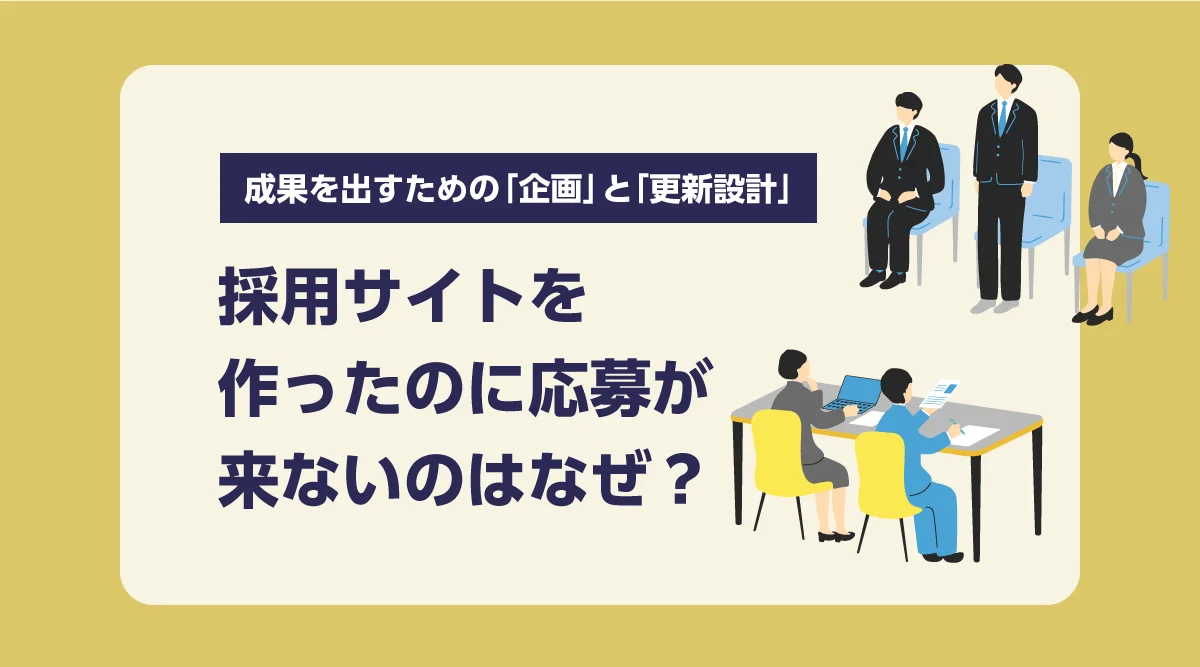
The site you worked so hard to create has ended up in a place where no one can find it. I think that’s such a waste. What these situations have in common is that people may have become complacent just because they “built” the site.
For a recruitment site, the day it’s completed is just “the beginning.”
I’d like to share our thoughts on moving beyond a site that’s merely a repository of information—focusing on the “strategy” needed to foster genuine, meaningful connections and the “update plan” required to maintain it sustainably.
Why Recruitment Websites Don’t Work

The reason you’re not getting applications is that it’s unclear whether the site is “active”
You went to the trouble of creating a recruitment site, yet you’re not getting any applications. The biggest reason for this is that, to job seekers, your company appears to be stagnant—they can’t tell if it’s actually active.
In fact, many “failures” of recruitment websites stem from the fact that, once built, the clock stops ticking. Let’s examine, from three specific perspectives, what kinds of situations deter job seekers from taking the next step.
The Freshness of Information Directly Impacts “Company Trust”
Job seekers want to know the “real” story about your company right now.
How do they feel when they see a site where an employee interview from several years ago is still listed as the latest post? They’re bound to feel a sudden sense of unease, wondering, “Is the person in this article still smiling today?” or “Have they perhaps already left the company?”
The older the information gets, the less persuasive it becomes. Conversely, even a short post describing something that happened “last week” is enough to instill a solid sense of reassurance that “this company is still thriving today.”
“Planning”: The Key to a Successful Recruitment Site

Concrete Examples for Preventing Mismatches
Before you start worrying that “this isn’t working,” you should pause and thoroughly define certain key points. If this foundation is shaky, even the most beautifully designed site will end up feeling somewhat distant and unapproachable.
Narrow Your Target Down to Just One Person
The desire to say, “We want anyone to apply,” ultimately leads to a situation where “no one is reached.”
For example, describe your ideal candidate in enough detail to visualize a specific person—such as “someone living in Shiga, around 30 years old, making their second career move, who values ‘time with family’ over stability and wants to rethink their work-life balance.” Only by narrowing it down this much can you clearly determine which photos to feature and choose wording that truly resonates with that person.
Clearly define the “people you don’t want to attract” as well
This isn’t cold-hearted; it’s a sign of genuine integrity.
Don’t just say, “We have a free-spirited corporate culture”; clearly state, “Our environment might not be a good fit for those who simply want to follow instructions without question.” This prevents mismatches after hiring and, as a result, attracts people who feel, “I can be myself at this company.”
Be honest about both the positives and the challenges
A website that only highlights the “good things” can actually come across as insincere to today’s job seekers.
Don’t just highlight the fun aspects of the job; be honest about the gritty realities as well, such as “The first six months are tough because there’s so much to learn” or “Overtime is unavoidable during peak seasons.” By showing both the light and the shadow, you’ll attract determined applicants who are willing to embrace even the “shadow” and take on the challenge.
The Psychological Hurdle of “Are They Really Hiring?”
Looking for a job takes a lot of courage. The “date” listed on a job posting can either give someone the push they need or make them hesitate.
When people see a site where the last update was a year ago, many unconsciously hesitate to apply, thinking, “Maybe the recruitment is already over,” or “Even if I contact them, I might not get a reply.” No matter how appealing the job description is, if the date is outdated, it no longer feels like a message meant for today’s job seekers.
Convey a “Live” Feel, Not a “Static Image”
Polished photos of models in advertisements or overly polished taglines—while certainly beautiful—what today’s job seekers are looking for is an “authentic everyday life,” rather than a staged ideal.
Photos taken with a smartphone by people actually working on the job, or a “quote of the day” captured in a candid moment, can resonate much more deeply than a perfectly staged group photo taken by a professional. Move beyond a website that looks like a polished “still image” and instead convey a “sense of liveliness” that authentically conveys your current energy. That is the first step toward getting candidates to choose your company.
What Is a “Sustainable Update Strategy”?
Even if you understand that “updates are important,” you may find yourself putting them off because you lack a “plan.” To keep your website “alive,” establish the following four rules in advance.

Four Elements to Ensure Operations Don’t Grind to a Halt
- Who will handle updates? (Clarifying the person in charge) It’s crucial to assign this role to a
specific “one person.” Creating an environment where that person can stay attuned to what’s happening in their daily life is the first step toward consistency. - What to Update (Standardizing Content)
Wasting time wondering, “What should I write today?” is the biggest reason updates stop. Decide on a “framework” for your content in advance and create a system where you simply fill in the “current facts.” - How often to update (a sustainable rhythm)
: Continuing at your own pace—without overreaching—is the best way to build “trust.” - Is the Structure Easy to Update? (Choosing a System)
No matter how enthusiastic the person in charge may be, if the system is difficult to use, updates will eventually stop. Choosing a stress-free admin interface or operational method is an extremely important factor.
Choosing Tools Based on Operational Philosophy
The system you should choose depends on your philosophy regarding “how you want to develop” your recruitment site.
WordPress, microCMS, or Static Sites
Selection Criteria | WordPress | microCMS | Static Site |
Operational Philosophy | Want to keep adding features and “expand” your site | Prioritize speed and ease of writing to “continue” publishing | I want to keep “finalized information” online safely and for the long term |
Strengths | A wide range of existing plugins provides the peace of mind that you can do anything | Simple structure and overwhelmingly fast page load times | Maintenance costs are extremely low, and there’s virtually no risk of it breaking |
Security | Regular maintenance and management of the core system are essential | Extremely secure by design | Highest level (no vulnerabilities) |
Recommended | Companies that want to enjoy customizing the system themselves | Companies that want to eliminate the stress of updates and focus on content | Companies that update information only a few times a year and prioritize stability |
To be honest, any tool will do.
For example, a “static site” is a choice that prioritizes overwhelming speed and security by intentionally omitting the ability to update it yourselves. While changing the information requires specialized work, it’s the most reliable option for companies that say, “We don’t update frequently, but we want to create a rock-solid platform that won’t embarrass us no matter when it’s viewed.”
What matters most is whether “the design allows you to use that tool to convey your company’s daily activities.” Only with that foundation in place will the options for quickly conveying the company’s message to potential employees truly come to life.
Regarding Cost Estimates
Finally, let’s touch on the practical side of things briefly.
At Lake and Moon Design, for a simple recruitment site consisting only of a homepage and post pages, the “Mini Site Plan” starts at 440,000 yen; for a more robust recruitment site featuring employee interviews and pages for each job opening, the “Standard Plan” starts at 880,000 yen.
Properly establishing a “system for updates” from the ground up directly impacts how easy the site is to manage after launch. We hope you’ll evaluate the cost-effectiveness not just based on the initial costs, but also by considering the “ease of updates” down the line.
How do you determine if a site is “active”?
We’ve discussed the importance of updates, but finally, let’s touch on the question: “So, what should you look at to make improvements?”
Rather than relying solely on intuition to decide that “it seems good,” I recommend regularly monitoring the following metrics:
- Page views and time spent on the careers page: Are job seekers reading the content thoroughly?
- Conversion rate to the application form: Are interested candidates actually reaching the “Apply” button?
- Traffic sources: Are visitors coming from Google searches, or via links from social media or job boards?
You can check these metrics using the free Google Analytics (GA4). Even without specialized technical knowledge, simply tracking whether “more people viewed the page than last month” or “too many people are abandoning the process at the application form” will help you identify where to make improvements next.
Summary: Keep improving—but stay true to your core.
A career site’s real work begins after it’s launched.
While monitoring traffic analytics, make repeated fine-tuning adjustments—asking yourself, “Is this part hard to understand?” But never change the site’s “vibe” or the “core values” that underpin it.
We’ll make improvements, but we’ll steadfastly preserve the colors and atmosphere. Over time, these efforts will build “trust” in the eyes of job seekers.
A recruitment site is like a “sincere invitation” to future colleagues, honestly conveying where we stand today. It’s not something you write once and forget; until it reaches someone we haven’t met yet, we’ll continue to carefully craft our words and share who we are right now. We believe that this “consistent, sincere effort” is the best recruitment strategy.
 Contact Form


 Related Articles
.webp)