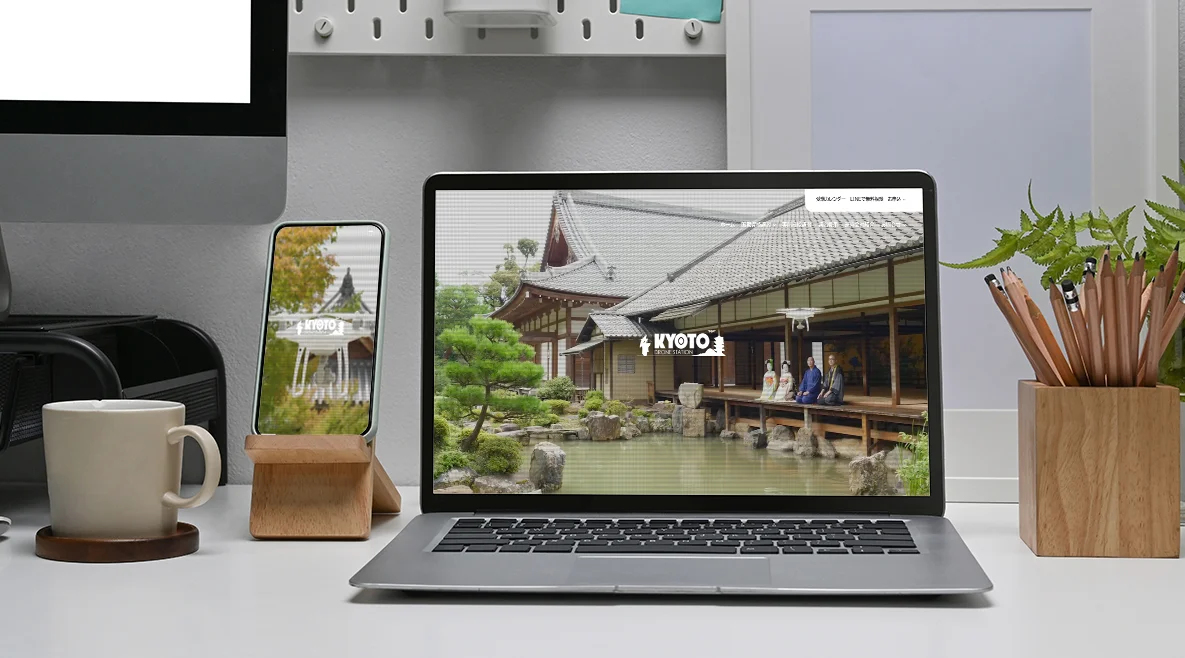


“How much has the website—which had been on hold during production—improved?” I believe the clearest way to understand this is to look at the actual numbers. We used our proprietary SEO diagnostic tool to analyze the Kyoto Drone Pilot Training School’s website after it went live, and it yielded the following scores.
Refining the design and building a site that is properly evaluated by search engines actually require different efforts. I believe this score reflects the fact that we thoroughly rebuilt the site from the “ground up”—not just the appearance—including the implementation of full-site editing and the security measures discussed below. Anyone can view the detailed results of the analysis by clicking the link in the banner.

It’s not at all uncommon for a project to come to a standstill
At some point, the production company we had previously hired stopped responding. With no progress reports, some pages were partially complete but couldn’t be published. Even if we wanted to request revisions, we didn’t know who to contact or how to reach them. The Kyoto Drone Pilot Training School, which consulted us on this matter, found itself in exactly this kind of limbo.
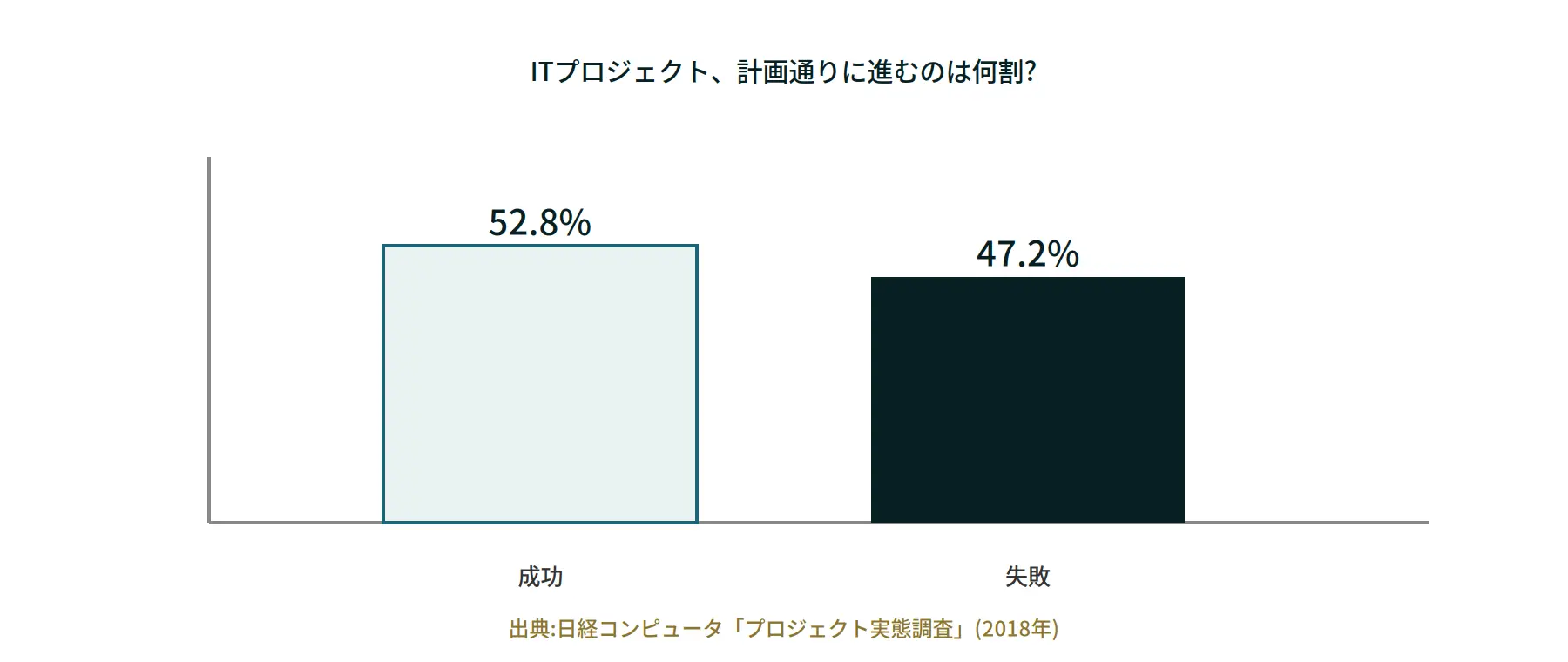
Inquiries such as “We’ve lost contact with the development company” or “They’ve only completed part of the work and aren’t moving toward completion” are by no means uncommon.According to the “Project Reality Survey” conducted by Nikkei Computer, out of 1,745 system implementation and renewal projects, the success rate was 52.8% and the failure rate was 47.2% (2018 survey).
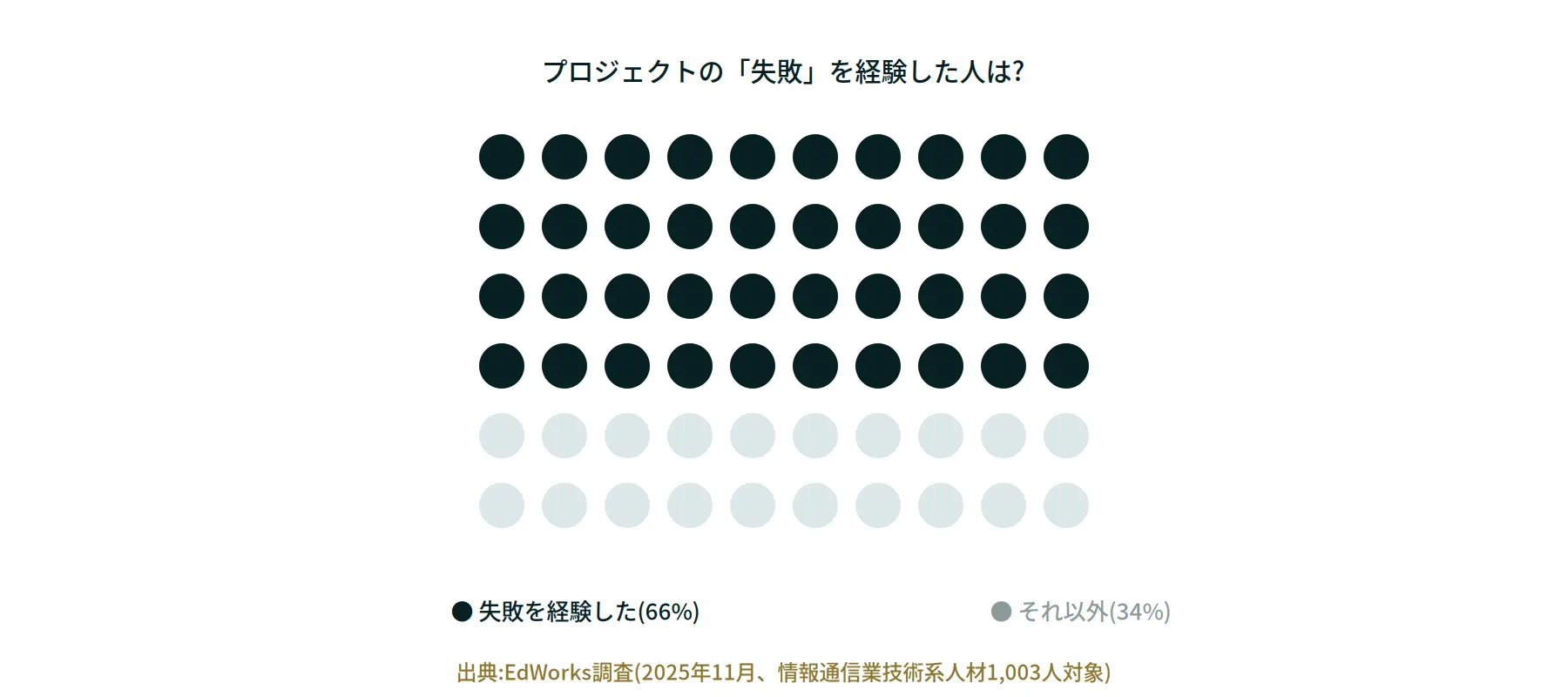
Furthermore, in a recent survey conducted in November 2025 by EdWorks, a professional development service, among 1,003 technical professionals in the information and communications industry, it was reported that 66% had experienced a “failure” in past projects in the form of schedule delays, quality issues, or cost overruns.In other words, it’s not uncommon for projects in web production and system development to deviate from their original plans. The Kyoto Drone Pilot Training School was not the only one to experience particularly bad luck.
This is considered such a structurally common problem within the industry that Daiichi Hoki, a publisher specializing in legal texts, has even published a practical guide titled *How to Avoid On-Site Problems When “Commissioning” Web Production*. In particular, at smaller production companies, projects tend to be concentrated on a single person in charge; if that person falls ill or leaves the company, the entire project can be left in limbo.When project progress relies on interactions with individuals rather than a designated corporate point of contact, such situations are more likely to occur. I believe this recent incident was yet another example of a situation arising from that very structure.
First, Let’s Take Stock of What We Have
When we received the consultation, the first thing we tackled was taking stock of what already existed. Which pages had already been completed? In whose name were the domain and server contracts registered? How did the client want to update the information going forward? After carefully confirming each of these points one by one, we decided to divide the work into two phases.
First, we needed to ensure that the information currently required was properly posted and ready for publication. Only then would we revisit the design of the entire site. Rather than rushing to rebuild everything at once, we prioritized breaking free from the “stalled state” as our top priority.
“Since we’re doing this anyway, we want to fully express the essence of Kyoto.” This statement left a strong impression on us during our consultation. Even in the far from ideal situation where production had come to a standstill, the client’s positive attitude—expressing that “if we’re going to redo it anyway, we want to make it truly great”—served as a major source of support for us as well. To summarize, the challenges fell into two main categories.
01| Complete the website that had been left unfinished: Organize the
necessary information and bring it to a state where it could be properly launched as a website. We needed to make the site functional while utilizing existing materials as much as possible—including existing text, assets, and decisions made during previous communications with the former production company.The key difference from a typical new project was that we didn’t start from scratch; instead, we had to begin by figuring out “how to make the most of what we already had.”
02| Revamping
the Site’s Image from Scratch: Moving beyond simply presenting information, we aimed for a design befitting the name “Kyoto Drone.” While drones often conjure up an impersonal, high-tech image, the client requested that we also incorporate an atmosphere unique to Kyoto.
The target audience consists mainly of people in their 40s and 50s. That’s precisely why “approachability” is essential.
There was another factor we kept in mind when considering the design direction.
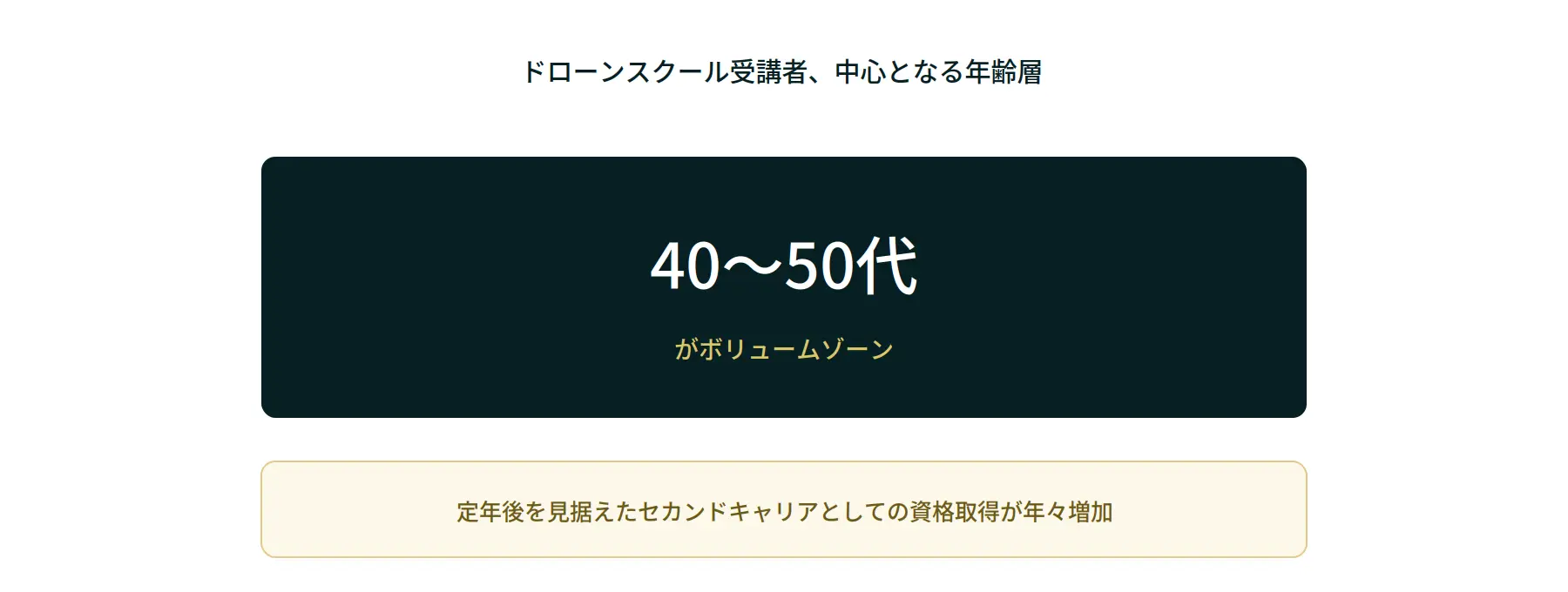
That was the demographic of the drone school’s students. According to surveys of other schools in the industry, the largest age group consists of people in their 40s and 50s, and the number of people considering obtaining a certification as a second career after retirement is reportedly increasing year by year.Since the national drone certification system itself is a new program that only began in December 2022, the idea that “if you get certified now, you’re more likely to reap the first-mover advantage” seems to be gaining traction among this demographic.
In other words, it’s likely that many of the people visiting this site are not young tech enthusiasts, but rather people in their 40s and 50s who are opening these pages with a touch of nervousness as they take the next step in their lives. If we overemphasize a cold, high-tech look, it might actually make them feel a sense of distance, as if this were “a world far removed from their own.”Our decision to prioritize the gentle, approachable qualities characteristic of Kyoto was not merely a matter of personal preference, but a necessary choice to empathize with the feelings of those actually reaching out to us.
Design Philosophy: Balancing “Kyoto-esque” Charm and the “Lightness of Drones”
In this project, we did not receive any specific design specifications. While we were given the broad direction of “something Kyoto-like and bright,” there were no concrete materials such as color swatches or reference images. Therefore, we began by articulating the concept based on our discussions with the client. We started by defining the direction for the foundational elements of the design—such as color, white space, and typography.
Our goal was to create a bright, approachable design that didn’t feel too heavy, while layering in a traditional Japanese aesthetic characteristic of Kyoto. We aimed to incorporate traditional Japanese colors and motifs while also expressing the imagery associated with drones—the “sky,” “flight,” and “expansiveness.”Our goal was to seamlessly blend Kyoto’s sense of tradition with the modern technology of drones within a single screen. This became the core of our creative approach for this project. While the term “Japanese-style” often conjures up images of something subdued—and at times, even solemn or formal—what we aimed for here was something almost the exact opposite.
Design: A Bright, Modern Take on Kyoto’s Traditional Aesthetic
We designed the overall tone of the site based on colors that evoke the essence of
Kyoto. Since using traditional Japanese color schemes as-is would inevitably create an impression that’s too subdued, we adjusted the saturation and brightness to ensure the design fits naturally within the context of a modern website.Precisely because these pages handle information that demands credibility—such as national certifications and specialized skills training—we were mindful of striking a balance: neither too flashy nor too plain.
White Space and Layout
Since this is a site with a large volume of information—including national certification courses, specialized skills training, and fees—we’ve ensured ample white space to prioritize readability.Since this industry involves a lot of information needed for comparison—such as course types, fees, and the availability of subsidies—we made a point of separating each block of information with white space to organize the flow of the reader’s gaze and prevent the page from becoming cluttered and hard to read.
Fonts
: We selected fonts while balancing the site’s atmosphere with the readability of the information itself. Even though we wanted to convey a traditional Japanese feel, overusing highly decorative typefaces would have made the essential practical information—such as course content and fees—difficult to read.I’ve differentiated the typography by using fonts that convey a soft, Kyoto-like feel for the headings, while prioritizing readability above all else for the body text. I also paid close attention to font size and line spacing to ensure the text is easy to read for people in their 40s and 50s.
Illustrations: We created bright, approachable illustrations that incorporate a
Japanese-style aesthetic. We were careful not to make the “Japanese style” feel too heavy or solemn, striking a balance between the essence of Kyoto and the lighthearted nature of drones. We designed the illustrations to complement the school’s approachability and atmosphere—aspects that photographs alone cannot fully convey.
Implementation: A Foundation for Easy Updates with Full Site Editing
For this WordPress build, we adopted a system called “Full Site Editing” (FSE). Since this term might be unfamiliar to some, let me explain it in a bit more detail.
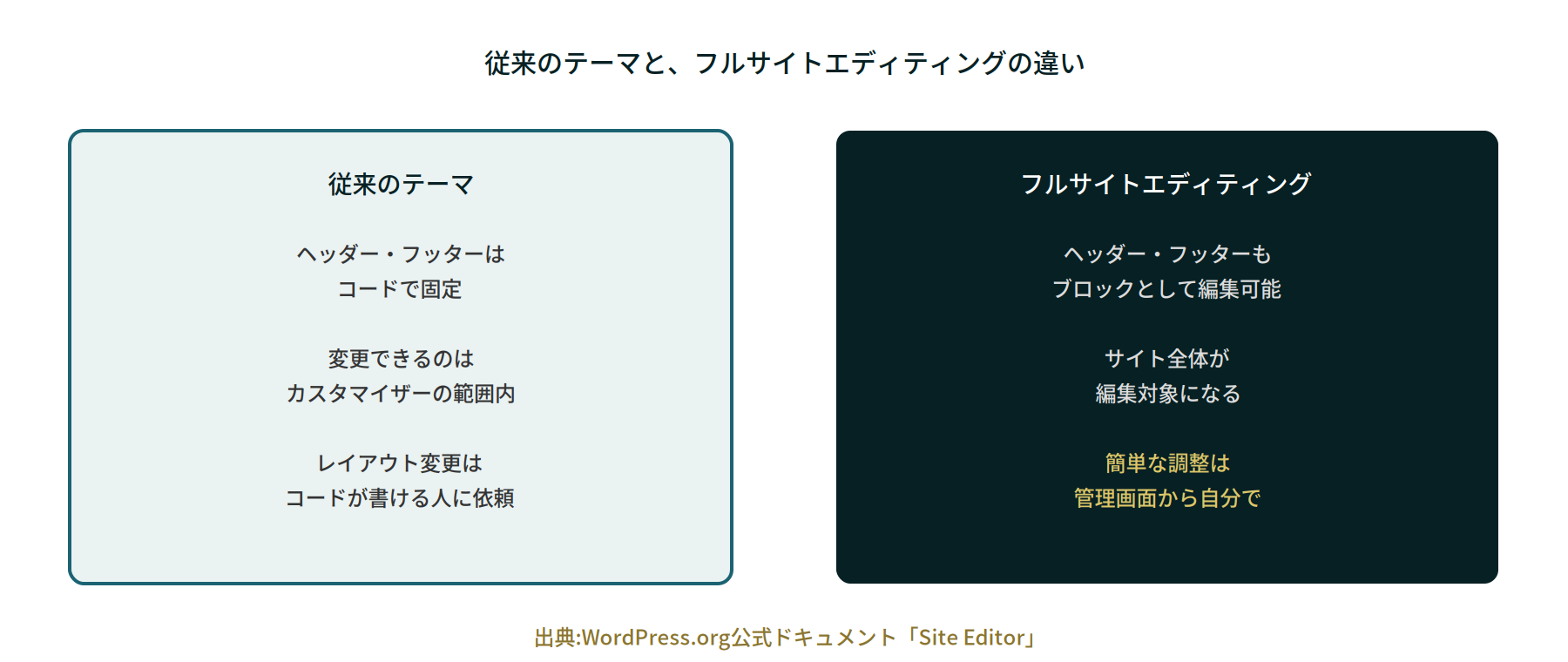
In many traditional WordPress sites, the internal code of the theme (the program that determines the site’s appearance) is written in specialized code, and the scope of customization was limited to specific items—such as colors, fonts, and widget placement—provided by the “Theme Customizer.”Whenever requests arose—such as changing the header structure or rearranging the homepage layout—it was necessary to ask someone with coding skills to make the changes.
Full Site Editing is a system that fundamentally changes this approach. The official WordPress documentation describes it as a feature that allows you to “design your entire site using blocks—including the header, footer, and everything in between” (Official Documentation: “Site Editor”).It is a relatively new standard feature introduced in WordPress 5.9, released in January 2022. It allows you to rearrange the entire site’s templates (page types) using the same “block” concept you use when writing page content.
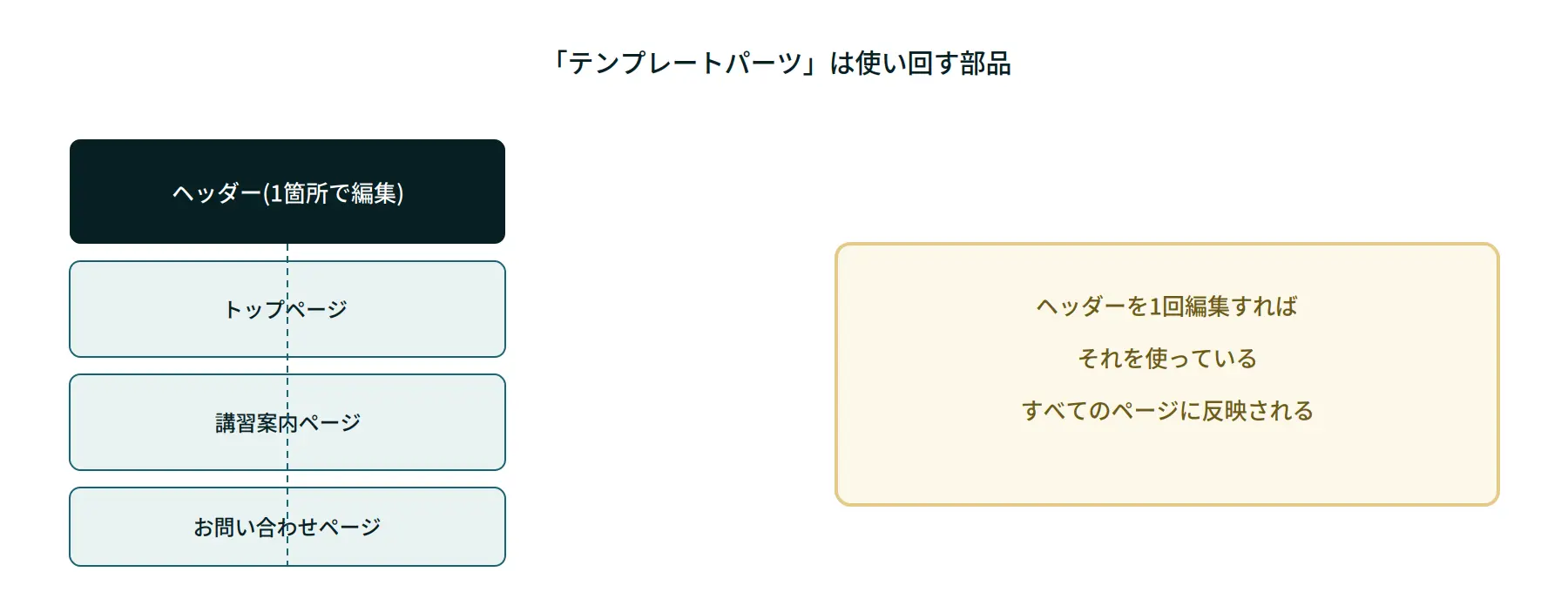
Specifically, there are two key concepts: “templates” and “template parts.” A template refers to the structure for each type of page, such as post pages or list pages. A template part is a component—like a header or footer—that can be reused across multiple templates.The system works such that editing the header in one place updates it on all pages that use that header. This allows you to make adjustments—such as “changing the position of the announcements section on the homepage” or “making the phone number in the header stand out”—without writing any code, simply by manipulating blocks within the admin panel.
There’s a specific reason we deliberately chose to adopt this system. It stems from the fact that the initial consultation arose because “we could no longer get in touch with the previous web development company.”Even if a similar situation arises in the future—such as “I’d like to request a minor change, but I don’t know who to ask”—Full Site Editing opens up the possibility for you to make certain adjustments on your own, without needing specialized coding knowledge.Of course, major design changes, feature additions, and complex layouts will still require specialized knowledge, but you’ll be able to move away from the situation where you “have no choice but to rely on an outside party for every small daily update.” We wanted to reflect the philosophy we’ve prioritized throughout this project—“leaving no room for mistrust”—not only in communication during development but also in the ease of management after launch.
Security: Addressing the “wp2shell” Vulnerability in WordPress Core
I’d like to highlight one more measure we implemented in preparation for the launch. In July 2026, a critical vulnerability affecting the WordPress core was reported.
According to an advisory released by the Information-technology Promotion Agency, Japan (IPA) on July 22 of that year,it was reported that by combining a vulnerability related to batch processing in the REST API (CVE-2026-63030) with an SQL injection vulnerability (CVE-2026-60137), it was possible to execute code remotely without authentication.Dubbed “wp2shell” by its discoverer, this issue was classified as the highest severity level, with a CVSS score of 9.8 out of 10.It is believed that even standard WordPress installations without any special plugins were affected, prompting WordPress.org to take the unusual step of forcing automatic updates for the affected versions.
In response to this information, we promptly checked the versions of WordPress core and plugins on the Kyoto Drone Pilot Training School website and confirmed that the patched versions (6.8.6, 6.9.5, and 7.1.1) have been applied.It would be a complete waste of effort to spend time restoring a site that had been down, only to be hit by a new vulnerability immediately afterward. It’s not just about “building and being done”; we want you to be able to continue using the site with peace of mind even after it goes live. This is also an integral part of the development process that we value highly.
Taking Over a Project Mid-Development: Starting by Organizing “The Information Needed Now”
Since this was a project taken over midway through development, rather than diving straight into designing the layout, we began by organizing the information necessary for the website.
We organized the overall site structure, the information for each page, details on national certification courses and specialized skills training, course fees, subsidies, and the inquiry and application processes—one by one—to shape the site into a cohesive whole.When people hear the term “hand-off,” they might imagine simply reproducing an existing design as-is, but in reality, it’s also a process of taking stock from scratch to determine “what’s there and what’s missing.”
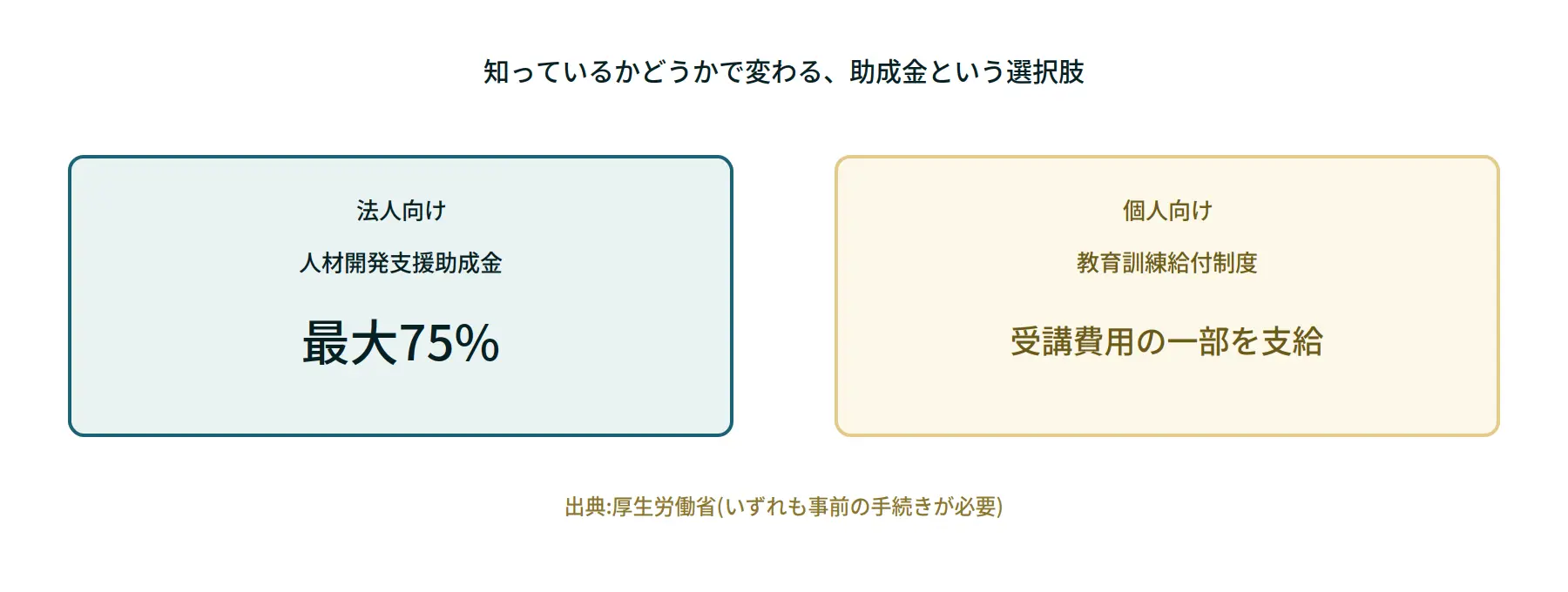
Information regarding grants, in particular, required careful handling. For corporations seeking to obtain national drone certifications, the Ministry of Health, Labor and Welfare’s “Human Resource Development Support Grant” may cover up to 75% of course fees, depending on the company’s size and other conditions.For individuals as well, if a course qualifies under the “Education and Training Benefit System,” a portion of the course fees may be reimbursed. However, in neither case is the subsidy granted automatically upon enrollment; these programs require prior procedures, such as submitting a training plan notification before the course begins.For people in their 40s and 50s considering taking these courses at their own expense as part of a second career, this is crucial information that can make or break their financial plans. Precisely because this type of information—where a single mistake could result in ineligibility for benefits—is so sensitive, the website’s presentation had to be both accurate and easy to understand.
A Production Process That Leaves No Room for “Distrust”
In this project, we placed just as much importance on the production process itself as we did on design and coding.This was because, through our interactions with the previous production company, we sensed that a certain degree of distrust had developed within the Kyoto Drone Pilot Training School. Proceeding with a project while harboring the anxiety that “this might happen again” would make the entire process a struggle—even if the final result turned out well.
Therefore, we proceeded with the following principles in mind:
- Sharing Progress Thoroughly
- Clearly defining the next steps
- Proceeding while reviewing the work as it’s created
- Not leaving any questions unanswered
- Provide support for necessary written content
We may not have been doing anything out of the ordinary. However, we made it a point to clearly articulate and share every detail—one by one—rather than leaving things to vague assumptions. Simply being able to see “what has been completed so far and what’s coming next” makes a world of difference in terms of peace of mind regarding the project’s progress.For those who’ve experienced a breakdown in communication, simply “receiving a reply” and “knowing what’s coming next” are already major sources of reassurance. Even before considering the quality of the design, it’s crucial that clients feel “things are actually moving forward.” I believe this was the most important aspect of this project.
General Breakdown of the 4-Month Production Period
The total production period for this project was four months. Unlike a completely new project, this one began with tasks specific to the handover process, so the rough breakdown is as follows:
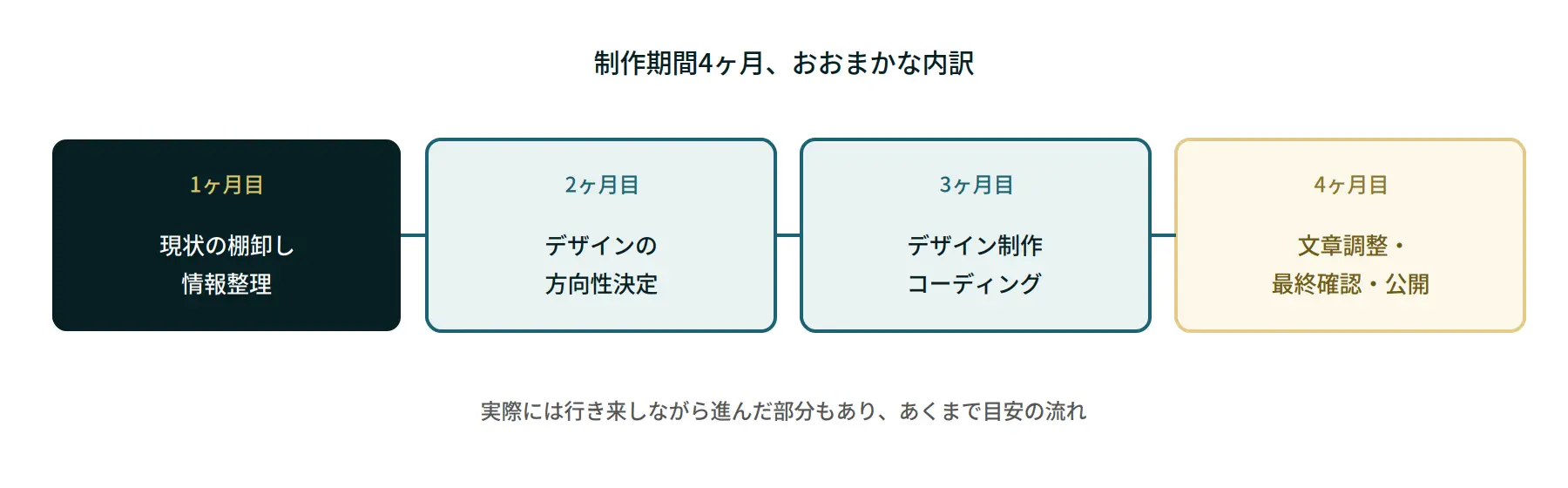
Month 1: Assessing the Current State and Organizing
Information—We reviewed existing pages, checked the status of the domain and server, and identified the necessary information. This was the most mundane yet crucial phase.
Month 2: Determining the Design Direction We finalized the direction for foundational elements such as colors
, white space, and fonts, and aligned on the style of key visuals and illustrations.
Month 3: Design Production and Coding
—While refining the design for each page, we simultaneously proceeded with coding and building the WordPress site.
Month 4: Copy Editing, Final Review, and Launch
While providing support for copywriting, we performed a final check for layout issues and typos before launching the site.
Of course, in reality, the process wasn’t so neatly divided into these stages; there were parts where we moved back and forth between them. Even so, I feel that maintaining a clear overview of what was being done and when was itself of great importance for this project.
To Those Whose Projects Have Stalled
If anyone reading this is currently in a similar situation, I’d like to share the items we checked first for this project. I hope you’ll find them helpful as you assess your own situation.
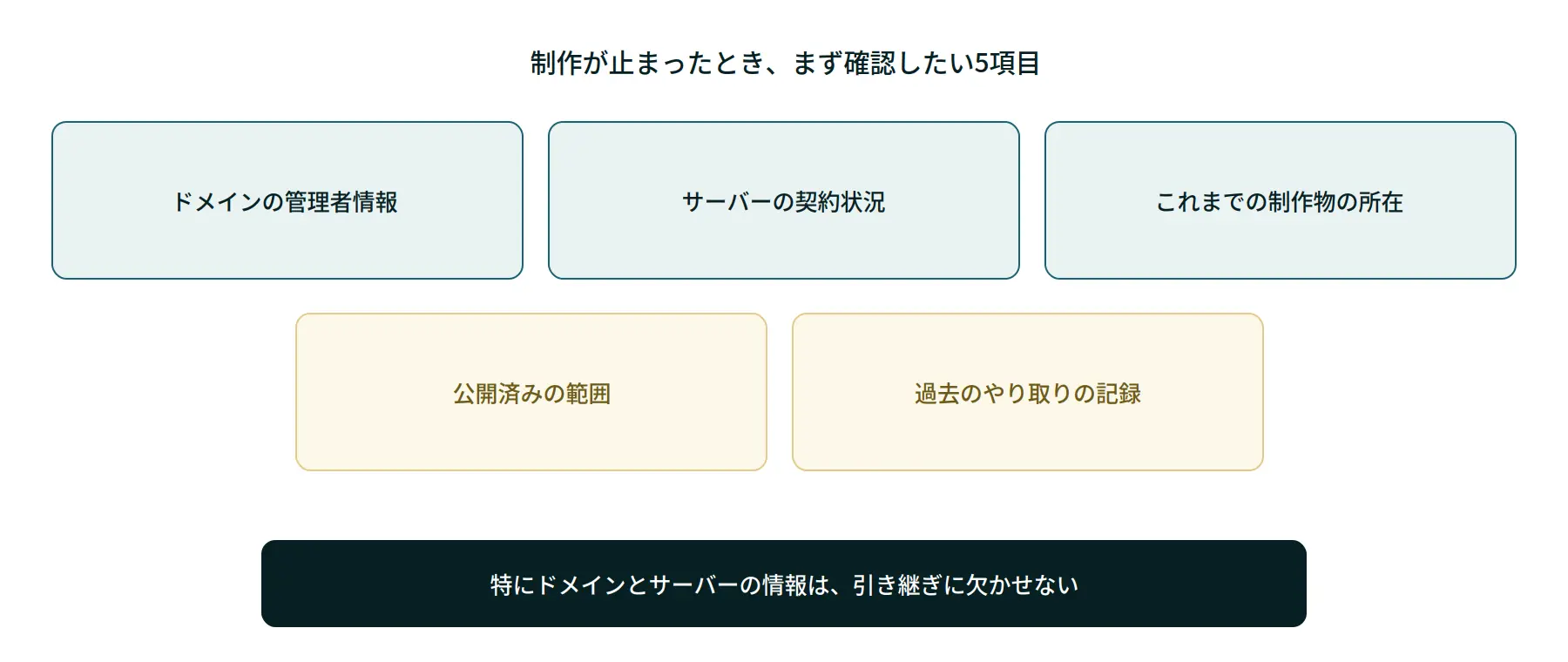
- Domain administrator information: Is the domain contract registered under your company’s name or the production company’s name?
- Server contract status: Who holds the server contract, payment status, and where the login credentials are located
- Location of existing work: Where and in what format are design files, copy, photo assets, etc., stored?
- Scope of what’s been published: Which pages have actually been published, and which parts are still unfinished
- Records of past communications: What was agreed upon with the previous production company, and what was left pending?
In particular, the domain and server administrative information is essential when handing over the project to the next production company. It’s not uncommon for projects to stall because this information remains unclear, so if you have any concerns, we recommend starting by checking these five points.
What Can We Conclude from This Data?
So far, we’ve cited several figures. Let’s lay them out and organize them.
Data | Value | Source |
IT Project Success Rate | 52.8% (failure rate: 47.2%) | |
Percentage of Projects That Experienced “Failure” | 66% | EdWorks Survey (November 2025, based on 1,003 technical professionals in the information and communications industry) |
Launch of the National Drone Certification System | December 5, 2022 | Amendment to the Civil Aviation Act (Ministry of Land, Infrastructure, Transport and Tourism) |
Number of National Drone Certification Holders | Over 45,100 | Announced by the Ministry of Land, Infrastructure, Transport and Tourism (as of the end of April 2026) |
Number of Registered Training Institutions (Drone Schools) | Approximately 680 schools nationwide | Ministry of Land, Infrastructure, Transport and Tourism “List of Registered Training Institutions” |
Domestic Drone Business Market Size | FY 2025: 497.3 billion yen (up 13.8% from the previous fiscal year); projected to reach 954.4 billion yen in FY 2030 | Impress Research Institute, “Drone Business Survey Report 2026” |
Age Groups of Drone School Students | People in their 40s and 50s make up the largest demographic | Statistics on Students at Industry Schools |
Human Resource Development Support Grants (for Corporations) | Up to 75% Subsidy |
When you look at these side by side, a few things become clear.
First, it’s actually not that uncommon for web production and system development projects to not proceed as planned.Looking at survey results showing a success rate of around 50% and a failure rate exceeding 60%, I feel that consultations like the one we’re discussing here are not so much a matter of exceptional bad luck as they are simply one of the common realities of this industry. That’s precisely why I don’t think you need to worry too much about the fact that the project stalled along the way. Isn’t what’s more important how you bounce back from there?
Second, the drone industry itself is clearly a growth industry. More than 45,000 people have already taken the national certification exam—a program launched just in 2022—and the market continues to expand at an annual rate exceeding 10%.On the other hand, with 680 schools nationwide offering certification programs—providing plenty of options—we’ve entered an era where students “shop around” to compare schools. Precisely because the market is growing, I feel that the quality of the website—as the first point of contact—has become more important than ever.
Furthermore, the fact that the core audience consists of people in their 40s and 50s pursuing a second career directly influences the direction of our design and information architecture. Rather than a cold, stylish, tech-focused approach aimed at younger generations, we needed to create a sense of approachability and trust—one that allows people considering certification for the first time to reach out without feeling intimidated.Our decision to emphasize the gentle, understated charm characteristic of Kyoto was not merely a matter of personal preference. It was a deliberate choice made with these students in mind. I believe it was all the more important to organize information about grants accurately and clearly precisely because this generation has significant financial concerns.
Summary: Bringing a Website to Completion, Even Mid-Production
This website had stalled midway due to communication issues with the production company. First, we organized the necessary information and made it ready for publication; then, we revamped it with a design that embodies the spirit of Kyoto. More than just refining the design, I believe the process itself—"getting something that had stalled moving again"—held great significance this time.
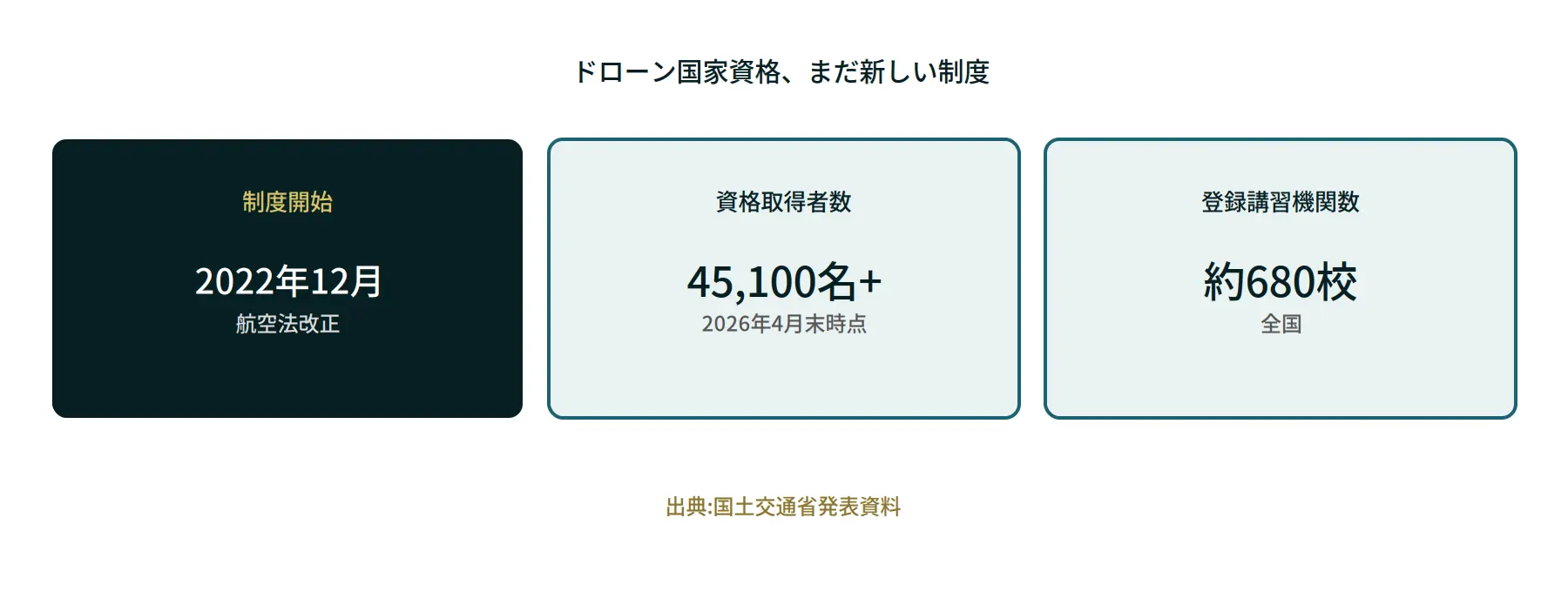
I’d also like to touch briefly on the current landscape surrounding drone schools. The national drone certification system (Unmanned Aircraft Pilot Skill Certificate) is a relatively new system that was established following the amendment to the Civil Aviation Act on December 5, 2022.According to an announcement by the Ministry of Land, Infrastructure, Transport and Tourism, the number of certified individuals (holders of the skill certification) has already reached over 45,100 (as of the end of April 2026), and there are approximately 680 registered training institutions—commonly known as drone schools—nationwide where one can obtain this certification.
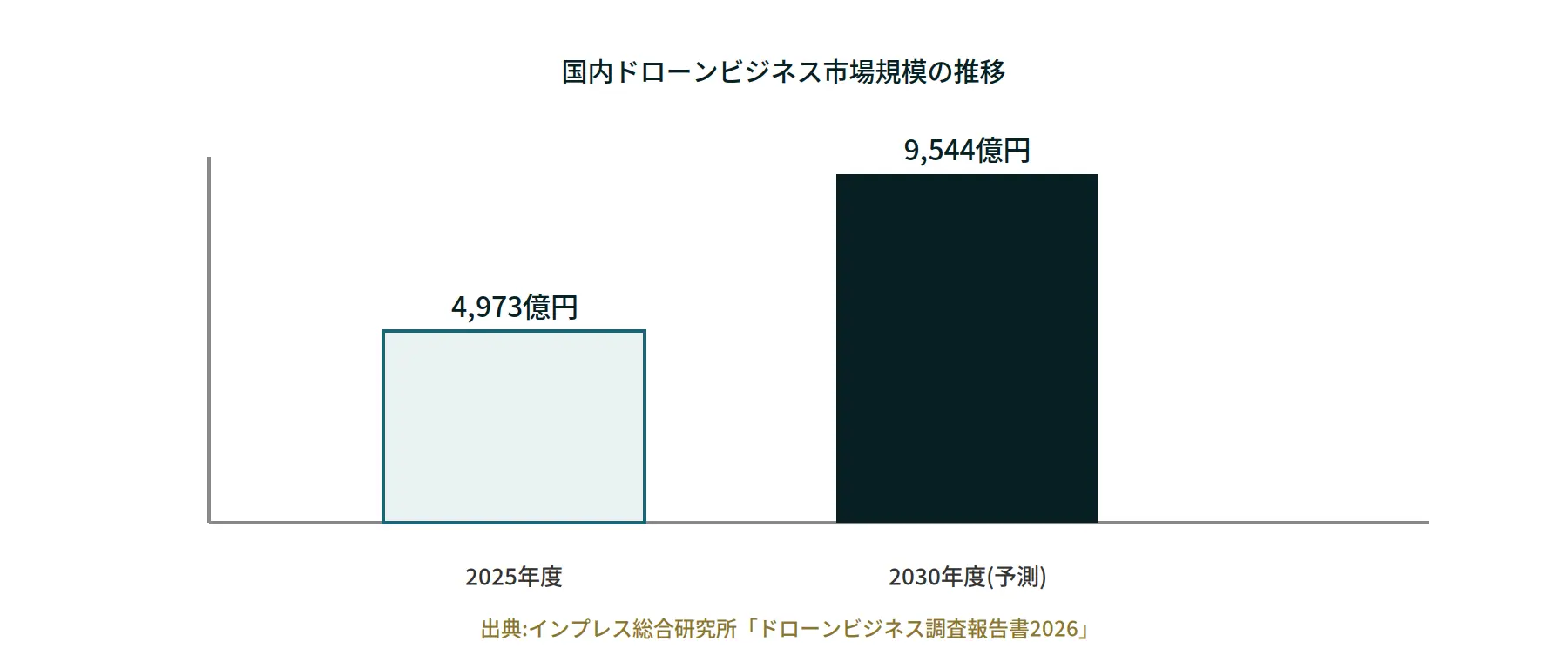
According to a survey by Impress Research Institute, the domestic drone business market in Japan is projected to reach 497.3 billion yen in fiscal year 2025 (a 13.8% increase from the previous fiscal year) and expand to 954.4 billion yen by fiscal year 2030.
The market is growing, and there are 680 schools nationwide to choose from. Furthermore, the core audience consists of people in their 40s and 50s who are carefully evaluating their options with an eye toward a second career. In other words, this is a field where building a website designed with the expectation that users will thoroughly compare and evaluate options will become increasingly important.Just as with government grants, there is a great deal of information where the financial burden can vary significantly depending on whether one is aware of it or not. The ability to convey such information accurately and clearly will likely become the deciding factor between schools that are chosen and those that are not. Given this context, I believe it is a real waste of opportunity for a website to remain “stuck in limbo.”
“We can’t get in touch with the web design company anymore,” or “It’s partially built, but progress has stalled.” AtKototsuki Design, we handle everything from taking over such stalled websites to planning, design, and implementation. If you currently have a website stuck in a similar situation, please feel free to contact us—we’ll start by working with you to assess its current status.
 Contact Form


 Related Cases