
Hello. This is Lake and Moon Design.
“We want a stylish website.” That’s something we hear often when clients consult us about web design. At the same time, when we’re actually discussing projects, we also hear comments like, “It looks nice, but something’s off,” or “It ends up looking just like other companies’ sites,” quite frequently.
Today’s web industry is flooded with beautiful, polished “stylish websites.” But the reality is that the vast majority of them are designed in such a way that if you swapped out the company name and logo for those of another company, no one would even notice.
Why does the “company’s unique identity” disappear even though you’ve hired professionals to create a beautiful site? In this article, we’ll unravel the source of that sense of dissonance and explain how to create a “brand-appropriate design” that breathes life into every detail.
Before we dive into the main topic, just a quick note. If you’re wondering, “What is microCMS, anyway?” or “How is it different from other tools?” and want to get the big picture first, please read this article, “What is microCMS?”
That way, the specific details I’m about to discuss will make more sense and resonate more personally with you.
What Is “Brand-Authentic Design”?

To begin with, what does “authenticity” mean in design? As an easy-to-understand example, imagine the Inazuma Rock Festival—Shiga Prefecture’s premier rock festival—and the Otsu Festival, a fall tradition in Otsu.
At the Inazuma Rock Festival, held on the Karasuma Peninsula, colorful signs, playful typefaces, and maps placed throughout the venue create an exciting atmosphere that’s “fun, lighthearted, and easy to navigate.” On the other hand, what about the historic Otsu Festival?Lanterns glowing at dusk, the spirited chants of “Toko-yoi, Toko-yoi” echoing alongside the “konchikichin” rhythm of the festival music, and the imposing hikiyama floats. The atmosphere there is imbued with a sense of “passing down history” and “local pride.”
Although both are “events” in Shiga, their “design philosophies”—what they want participants to feel—are completely different, and this is clearly reflected in the “details,” such as the atmosphere and sounds of the space.
The same applies to websites. Design is not simply about decorating the surface with a “stylish atmosphere.” It is, in essence, the process of carefully crafting every detail to convey the intended meaning: “Who should experience this, and what emotions should they feel?”
Topic | ||
Nature of the Event | Contemporary Music Festival | Historic, traditional festival |
Spatial Details | Colorful signs, playful typefaces, and maps placed throughout the area | Lanterns lit at dusk, the “Konchikichin” festival music, the chant of “Tokoyoi,” and the imposing festival floats |
Impressions on Participants | Fun, lighthearted, and easy to navigate (an atmosphere of excitement) | Preservation of history, local pride (a sense of solemnity and significance) |
Design is not just about “appearance”
We often say, “Appearance is the very last result.”
Beautiful layouts and smooth animations are, after all, merely the output. Before that lies a vast amount of invisible foundational work: “In what order should we convey the information?” “What meaning should we assign to this button?” “What kind of experience do we want users to take home with them?”
We infuse that framework with the “essence” of a company’s philosophy and stance. Only when we achieve this does it become a “design” with a soul.
How Does a Brand’s Identity Emerge?
Functional aspects and usability—such as “buttons that are easy to press” or “fast loading times”—are, of course, wonderful things. They are also one of the major strengths of microCMS, the platform we use.
However, when it comes to building a brand, that alone is not enough. High functionality is, so to speak, the “foundation.” Unless that foundation is underpinned by a clear core—specifically, “for whom is this experience, and what is its purpose?”—the result will end up being nothing more than a website that merely lists information.
To create a brand identity, you first need to “articulate” your values—in other words, define your concept. Then, you must prioritize what to communicate and what to deliberately leave out. It is only by thoroughly examining “how we want to be perceived by the world” that a unique brand identity truly takes shape.
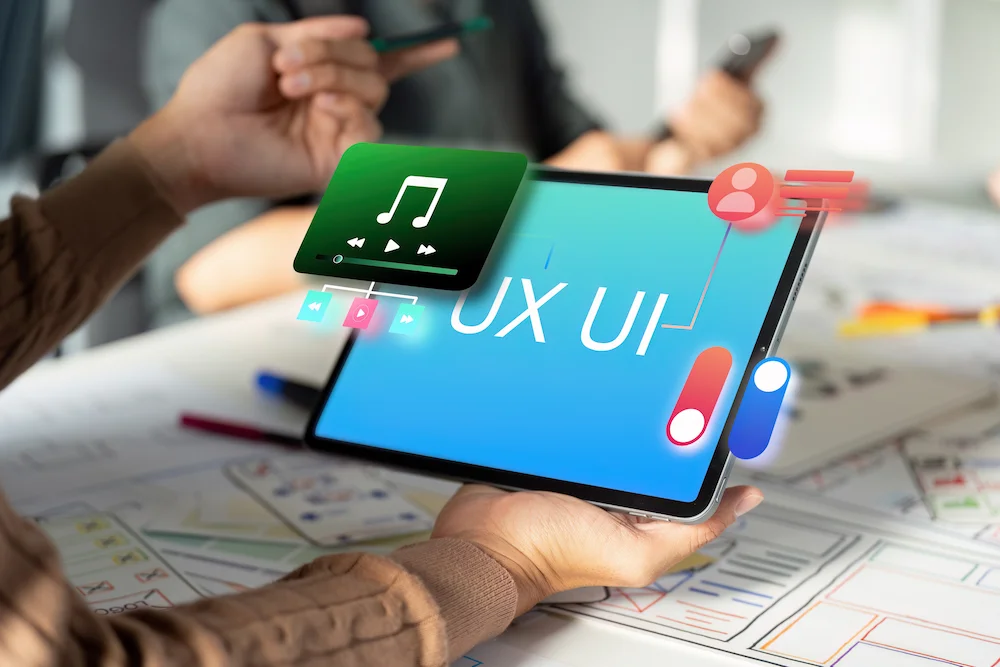
We’ve organized the structure that builds from a “functional foundation” to “brand identity” from three perspectives: UI, UX, and graphics (branding).
We’ve compared the roles of each element with what specifically needs to be designed.
By organizing the elements that shape a brand, the importance of a “unique character”—which goes beyond mere “usability”—becomes clear.
Category | Role/Positioning | Specific Design Elements |
UI (Usability/Functionality) | “Foundation”: A |
|
UX (Experience and Purpose) | “Core”: |
|
Graphic (Visuals and Brand Identity) | “Texture”: |
|
Why Do So Many Websites “Lack Authenticity”?
.webp)
Despite this, why is the world still flooded with “sites that all look the same”? To put it simply, it’s because “they’re forcing themselves to fit into pre-made templates.”
They simply plug in whatever photos and text they have on hand into a fixed layout. They just assemble the pre-made components. Admittedly, this approach is efficient and easy.
However, the moment you adopt a template’s structure, “expression in the details” becomes restricted, and the company’s unique character gets watered down, making the site feel like “something you’ve seen somewhere before.”In exchange for efficiency, they’re losing the most important element: “brand character.” This is the root of the unease we feel when we see a mass-produced website that’s “stylish yet fails to leave a lasting impression on anyone.”
That is precisely why “free design” is necessary.
This is precisely why we prefer to use the microCMS system in our production work.
Based on my experience working with several CMS platforms, I’ve found that systems like microCMS—known as “headless CMS”—aren’t constrained by specific plugins, outdated libraries like jQuery, or predetermined HTML structures, unlike traditional systems.
Instead of adapting the design to “what the system can do,” we can adapt the system to “the design (layout) we want to express.”
Precisely because we don’t have to compromise our design to fit an off-the-shelf system, we can pay meticulous attention to every detail of the brand. We use microCMS as the “behind-the-scenes” tool that makes this possible.
What Changes When the Design Changes?
When you move away from templates and rebuild your site with a design and structural architecture that truly reflects your company’s identity, you’ll see a clear difference.
Your company’s unique identity and brand concept become much easier to convey, and user reactions shift from a superficial “It looks nice” to a deeper sense of connection—such as “What this company is saying really makes sense” or “I feel like this is a good fit for me.”
Your message “truly gets across,” ensuring your site doesn’t get lost among the countless others out there and instead leaves a lasting impression. This becomes an overwhelming strength—whether in recruitment efforts or corporate branding.
This Approach Is Best Suited for Companies Like These
As you can tell from what we’ve discussed so far, the “brand-centric design approach” we propose isn’t suitable for every company.
Our approach is completely unsuitable for companies that simply want “a cheap, quick website that serves as a business card.”
On the other hand, our approach is a perfect fit for companies currently experiencing the following issues or concerns:
- “We built our site using a template, but it just doesn’t feel like our company.”
- The design looks great, but it’s not generating the inquiries you expected
- They haven’t been able to effectively articulate their true strengths and appeal
- They have a recruitment site, but there’s a mismatch with applicants
“Even if it takes time, we want to build the foundation for a brand that will be loved for years to come.” For companies that genuinely feel this way, I am convinced this will be the most powerful tool they could ask for.
7. Summary | “Authenticity” Lies Beyond the Design
In this day and age, anyone can easily create a website that’s merely beautiful and well-organized using AI or free tools. That’s precisely why the value of superficial “stylishness” is steadily declining.
“Authenticity” does not come from embellishing the appearance; it quietly resides at the heart of a deep design that breathes life into every detail.
If you find yourself looking at websites similar to your competitors’ and feeling a sense of unease—thinking, “Our company should really be different”—or if you currently have a vague feeling that “something just isn’t quite right,” I believe that intuition is spot on.
That sense of dissonance is surely a crucial starting point for reshaping your brand. We will continue to confront the challenge of designing this “authenticity” head-on.
 Contact Form


 Related Articles