
Hello. This is Lake and Moon Design.
You put in a lot of time and effort, but the appeal just doesn’t come across.
If you’ve ever had that experience, it might not be the fault of the design or technology.
In previous articles, we’ve discussed “design that doesn’t hinder understanding, rather than just focusing on appearance” in the Design series, and “stress-free usability and speed” in the Implementation series.
But from a production perspective, before we even get to those techniques, the fundamental question is whether the underlying structure—or “how it exists”—has been properly defined. I believe that’s what determines the very foundation of a website.
It’s perhaps similar to buying land and building a house.
Before erecting stately pillars, you first need to ask yourself, “How do I want to live on this land?”
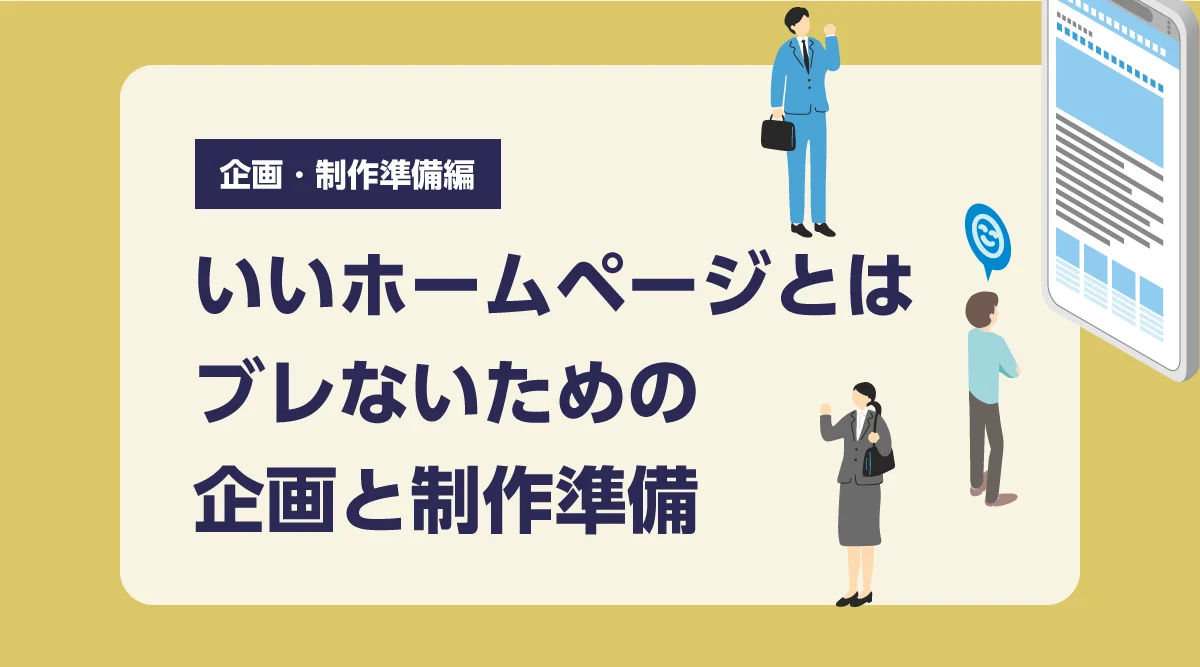
This is a discussion about planning and preparation for production.
Conclusion: “A good website starts with establishing a solid framework before you even begin building it.”
No matter how many cutting-edge technologies you pack into a site, if the creator’s “framework” is shaky, visitors will end up feeling lost.
The “framework” I’m referring to here isn’t a complicated system. It means “clearly articulating who the audience is, what you want to convey, and how you’ll deliver it, along with having a set of criteria in place to ensure there’s no confusion when making decisions.”
A good website is one where this solid framework is established before development begins.
To that end, I’ve outlined several important preparatory steps.

Essence #1: Articulate “Who it’s for and what it’s for”
Creating a website is like launching a new business. There must be a specific audience you want to attract and a “gift” you want to offer them. First, don’t leave this as a vague concept—solidify it into clear, concrete language.
Asking the Right Questions | The Role of the “Mechanism” Behind Those Words | Specific Tips for Digging Deeper |
Who is the target audience? | It serves as your “destination” when you’re unsure | Until the face of that person you pass on the street comes to mind. |
What do you want them to do? | Illuminate the “Exit” of Your Site | After reading, do you want to make a call or feel reassured? |
What kind of value do you want to convey? | It becomes a “souvenir” you hand to the other person | How will this service make the other person’s tomorrow just a little bit better? |
What kind of warmth do you bring to the interaction? | It determines the “distance” in the relationship | Will you use polite honorifics, or speak in a friendly, neighborly tone? |
Essence #2: Focus on the “state of mind,” not just the target
If Essence #1 is the “address” of who we’re targeting, Essence #2 is about capturing the “timing”—specifically, what kind of mood that person is in right now.
We’re not very comfortable categorizing people solely by numbers, such as “a man in his 30s.” Instead, we want to attune ourselves to the “situation”—whether the person standing at Makino Sunny Beach is “just gazing at the scenery” or “about to go for a swim.”
The “Current Situation” of Visitors | How to Present Design and Information | An Analogy |
A vague desire to know | Trustworthy and useful information, presented appropriately. | When you happen to spot a sign that catches your eye while driving. |
I want to compare it with others | Sincerely showcasing our unique charm. | When you’re at a local farmers’ market, trying to decide which vegetables to take home. |
I need help right now. | We’ll guide you to the “answer” in the shortest possible time, without leaving you in doubt. | When a sudden rain shower hits and you’re frantically searching for shelter. |
Essence #3: The “Compass” Called Concept
A concept isn’t just a standard—it’s a “decision-making criterion to fall back on when you’re lost.” Because of this, a ship can sail without losing its way even on a slightly rough day.
Elements of a Compass | The Details of the “System” You Need to Establish | Practical Implications |
Who We Are | The identity at the very “core” of who we are. | A self-introduction that says, “This is who we are.” |
What We Stand For | Not merely an explanation, but our “will.” | A business philosophy we will never compromise, no matter what anyone says. |
How we want to be perceived | Designing a “lasting impression” that stays with visitors. | Trust, familiarity, or a sense of tension that makes you sit up straight. |
What we deliberately choose not to do | “Subtraction” to highlight what sets us apart. | The courage to maintain our unique identity without over-broadening our target audience. |
Benefits | The promise of “change” after the purchase. | A refreshing feeling after receiving the service. |
The Tone of Our Worldview | Synchronizing the “breathing” of words, photos, and white space. | Harmonizing the overall texture like a single melody. |
Essence ④: Designing the User’s “Flow”
Rather than “reading” a website, people “flow through” it like water in a river. Instead of creating isolated points (pages), we craft a seamless flow of pleasant experiences.
Steps of the Experience | The “Flow of Water” to Keep in Mind | Using a Scenic Analogy |
Entry Point | Where do visitors come from, and where do they take their first step? | You casually step into Nagisa Park. |
Awareness | What do you feel when something catches your eye? | Seeing the light reflecting off the lake’s surface, I stop and think, “That’s beautiful.” |
Realization | As I read on, how does my heart respond? | Reading the information board, I find myself deeply nodding in agreement with the history of the area. |
Exit | Where will I head next, and what will I leave behind? | With a sense of fulfillment, I set off toward my next destination. |
Essence ⑤: Don’t Just “Prepare” Information—“Scrutinize” It
Content (such as case studies and service descriptions) isn’t enough just to be there. We assign a specific role to each piece and carefully consider “in what order should we present this to be most considerate of the audience?”
Types of Content | “Mechanisms” Called Roles |
Service Details | A promise to turn the client’s “inconvenience” into “convenience.” |
Portfolio | Show “Our History” to instill confidence. |
Concept | Conveying the passion behind “why we do what we do.” |
FAQ (Frequently Asked Questions) | Anticipate the client’s concerns and gently alleviate them. |
Common Mistakes That Cause Projects to “Stall”
Without sufficient preparation, a website will eventually start drifting aimlessly like a “ghost ship.”
Patterns of Failure | What Happens as a Result | A Strategic Approach to Preventing This |
Putting All the Information on the Site | It becomes a mere “box” that fails to resonate with anyone. | Have the courage to narrow it down to “the one thing you want to say most.” |
Copying other companies verbatim | Borrowed language is easily spotted. | Uncover the unique context right at your feet. |
Thinking while creating | If your core focus keeps wavering, the project will never be finished. | First, solidify the framework—the “mechanism.” |
Aside: Sometimes, you just have to “get started.”
I’ve been emphasizing how important “design” is up to this point, but it’s a bit of a shame to overthink things to the point where you can’t take action, isn’t it?
As I mentioned in my previous article, “Just Build It. Just Put It Out There. Improve It, Then Build Again,” even if it’s a bit rough around the edges, try launching a small boat first. You can adjust your course based on the view from the water.
What’s important isn’t “not thinking at all,” but “setting out with the resolve to go this far for now.” I believe that,
too, is a kind of “system.”
Conclusion: A good website is one where “the vision is clear before you even start building it.”
Both “design (appearance)” and “implementation (usability)” are built upon this foundation of “planning (system).”
- Design: Translating that intent into a visible form.
- Implementation: Delivering that intent to the user without a hitch.
- Planning: Determining where that intent should lead.
Only when these three elements come together does a website transcend being a mere tool and become a “place” where people can connect.
If you’re unsure how to give shape to the “thoughts within you that haven’t yet found words,” please don’t hesitate to reach out to a production agency like ours. Before we get into the technical details, why not start by taking the time to talk things through?
 Contact Form


 Related Articles