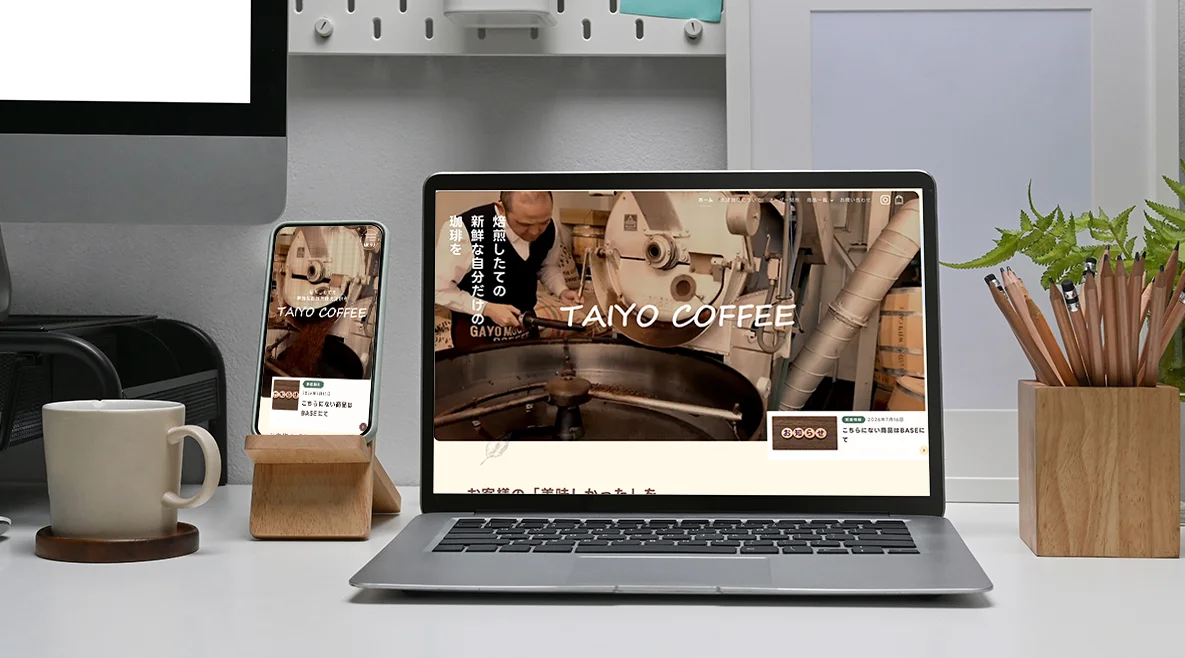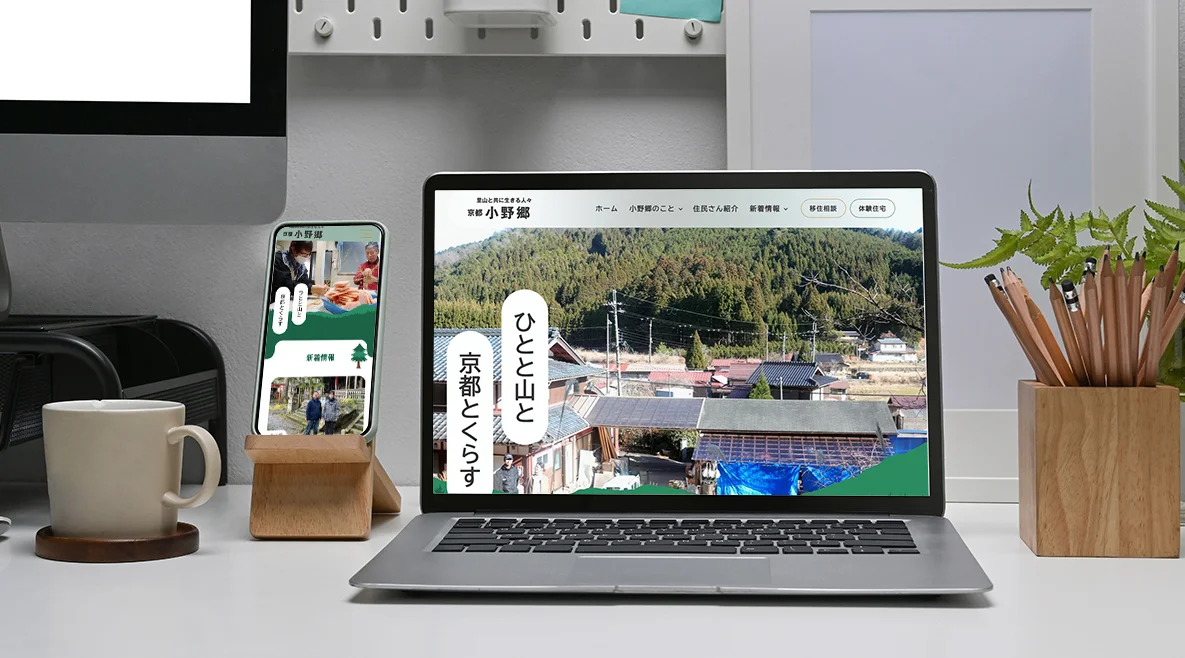

Hello, this isKototsuki Design.
The other day, while browsing a certain website, something caught my attention. The photos are beautiful, the writing is well-organized, and the design is neat. There are no faults anywhere, but even after finishing reading, I can't remember what company it was.
I think many people have had the same experience. Thanks to generative AI, anyone can quickly create both text and images that look "just like it." As a result, there are more websites that only look "like" to them.
So, how do viewers feel about this? We checked each case one by one, including global and Japanese surveys and actual AI image incidents in Japanese companies. Based on that, we thought about ways to convey on small shops or company websites that "this person exists." Using old terms like noren and wabi-sabi as clues, we also included our guesses about how people might receive them in Japan.
To be clear, we use AI every day. This is not about "not using AI." Our line is summarized in our website production policy of "not using AI at touchpoints."
Key points of this article
- 68% of U.S. consumers carefully consider whether what they see is real, and 50% say they would choose brands that do not use generative AI (Gartner).
- Regarding advertising, 78% responded that "AI reduces authenticity," and 73% said "ads suspected to be AI-created are hard to trust" (The Harris Poll).
- Japan's experience using generative AI is 58.8%, the lowest among Japan, the US, Germany, and China. The trust level in internet advertising is reported at 18.3%
- In Japan, there have been numerous criticisms of AI images at JAL, Kobe Fugetsudo, Sakura Craypas, Ajinomoto and others. What was discussed was more about verification, explanation, and effort required than "using AI"
- Noren curtain, applying a hand of salt, three directions of good fortune, wabi-sabi. Even from the perspective of traditional Japanese slang, we feel that what truly matters is that "this person exists"
- In Google's guides, what matters more is whether the content is useful to people and whether it shows who created it and how, rather than whether AI was used
- Real photos, your own words, concrete achievements, how to use AI, and the presence of people all in one place. These five elements convey that "this person exists"
An era overflowing with ''like' in numbers.
First, let's look at how viewers feel now, dividing them into world and Japan segments. Since the subjects and timing differ for each survey, don't just compare the numbers directly—read them with a sense of 'so this is the trend.'
World Data | Recipients Care About Whether It's Real
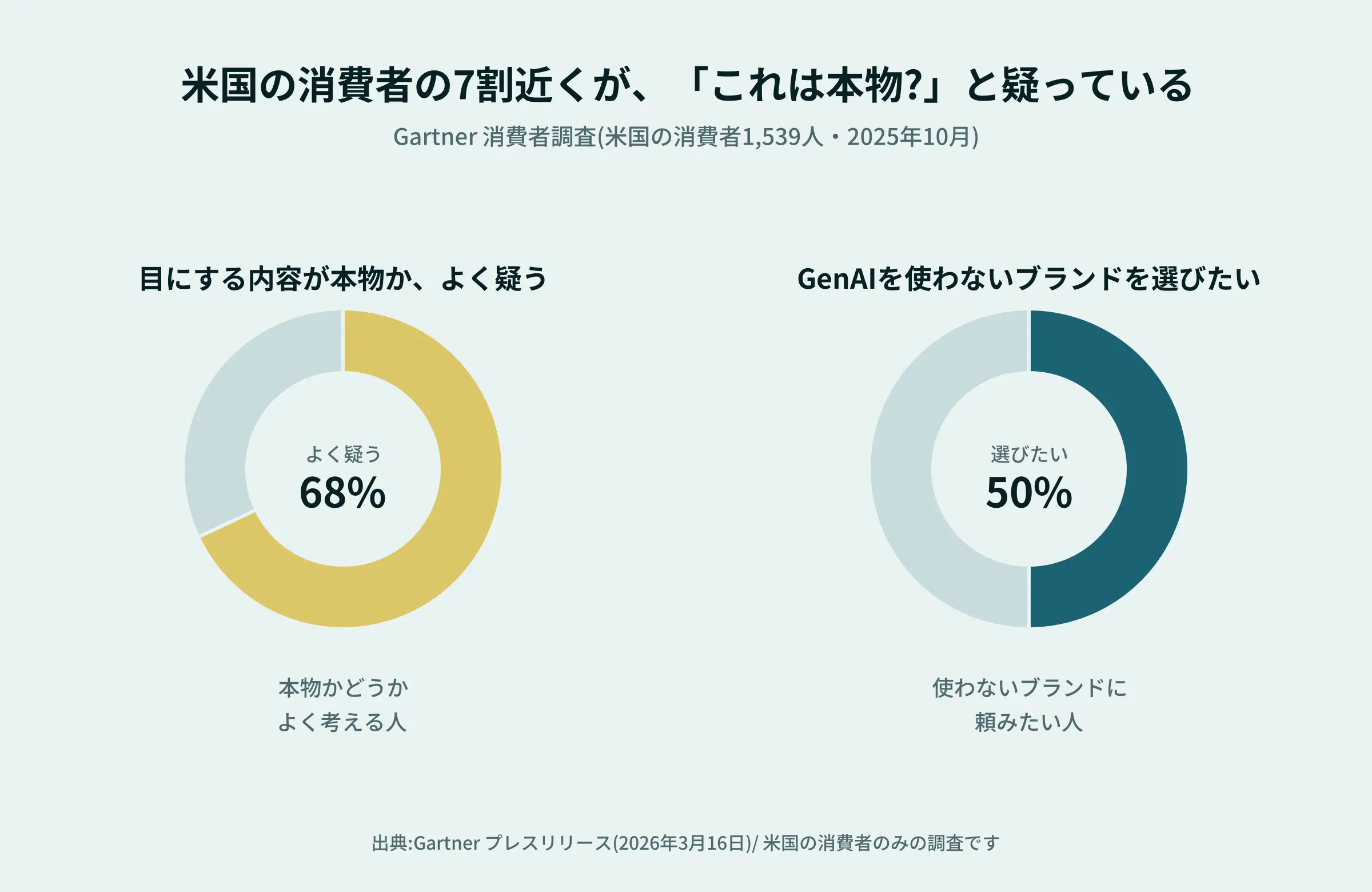
In a survey conducted by Gartner of 1,539 U.S. consumers (conducted in October 2025 and published in March 2026), 68% said they "carefully consider whether what they see is genuine." 61% said they often doubt whether the information they use for everyday decisions is trustworthy (Gartner | Press Release).
In the same survey, 50% said they would prefer to rely on brands that do not use generative AI. Gartner recommends that companies use AI "transparently, optionally, and in a clearly useful way."
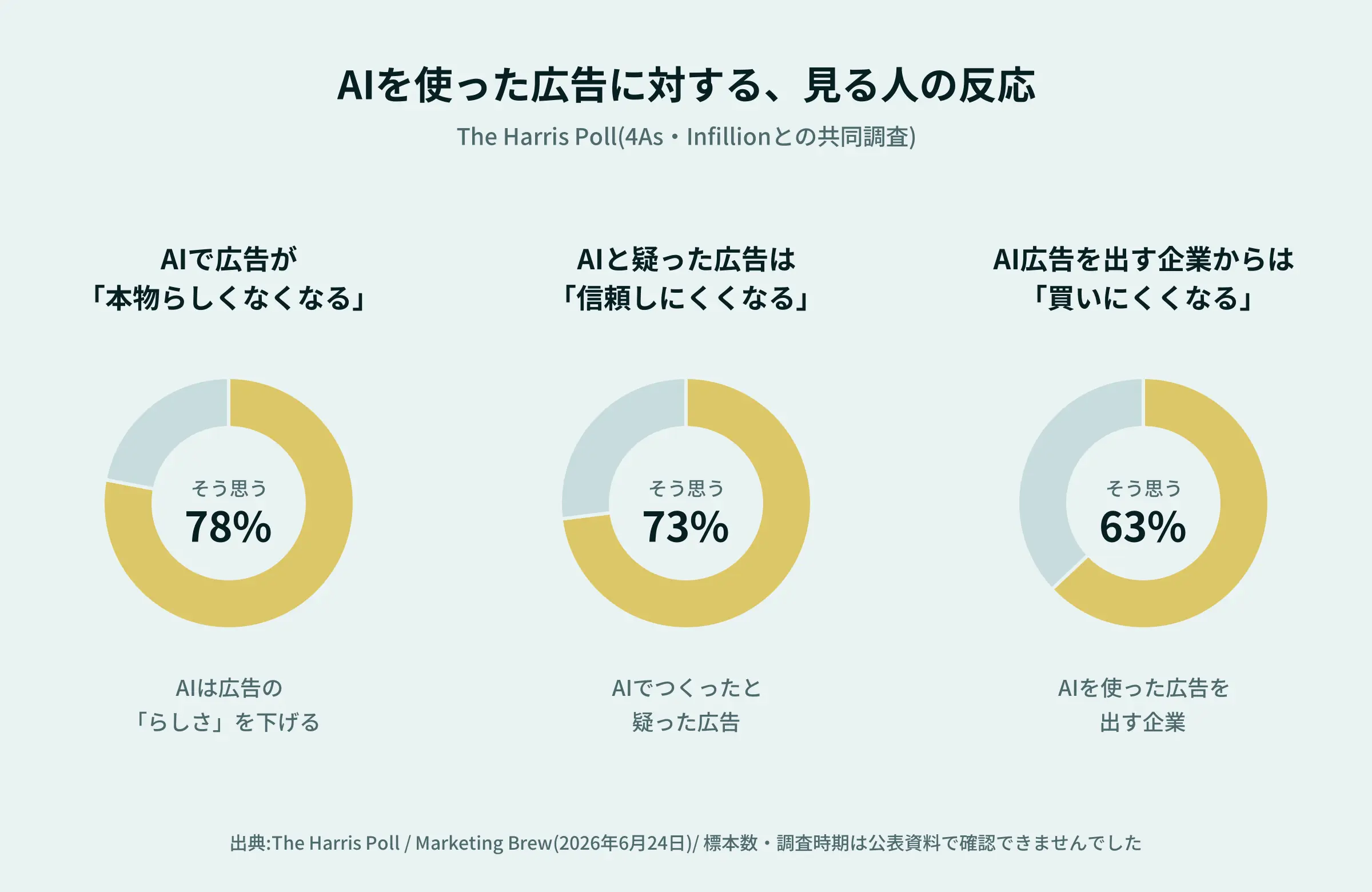
Similar results are seen in advertising. In a survey conducted by the research firm The Harris Poll with the advertising industry group 4As and the advertising firm Infillion, the following responses were reported (The Harris Poll| Key takeaways, Marketing Brew | June 24, 2026).
- 78% say AI makes ads "less authentic."
- 73% of respondents say ads they suspect were created by AI are "less trustworthy."
- 63% say companies running AI-based ads make it "harder to buy"
- 54% said they were "fed up" of hearing too much about AI
What you notice when you look at the numbers is not that the AI itself is being suspected, but rather that you might ask, "Is this real?" "Who made it?" That's the kind of thing that seems to be the case. This is our assumption.
Data from Japan | The number of users is rapidly increasing. But the eye for ads is strict.
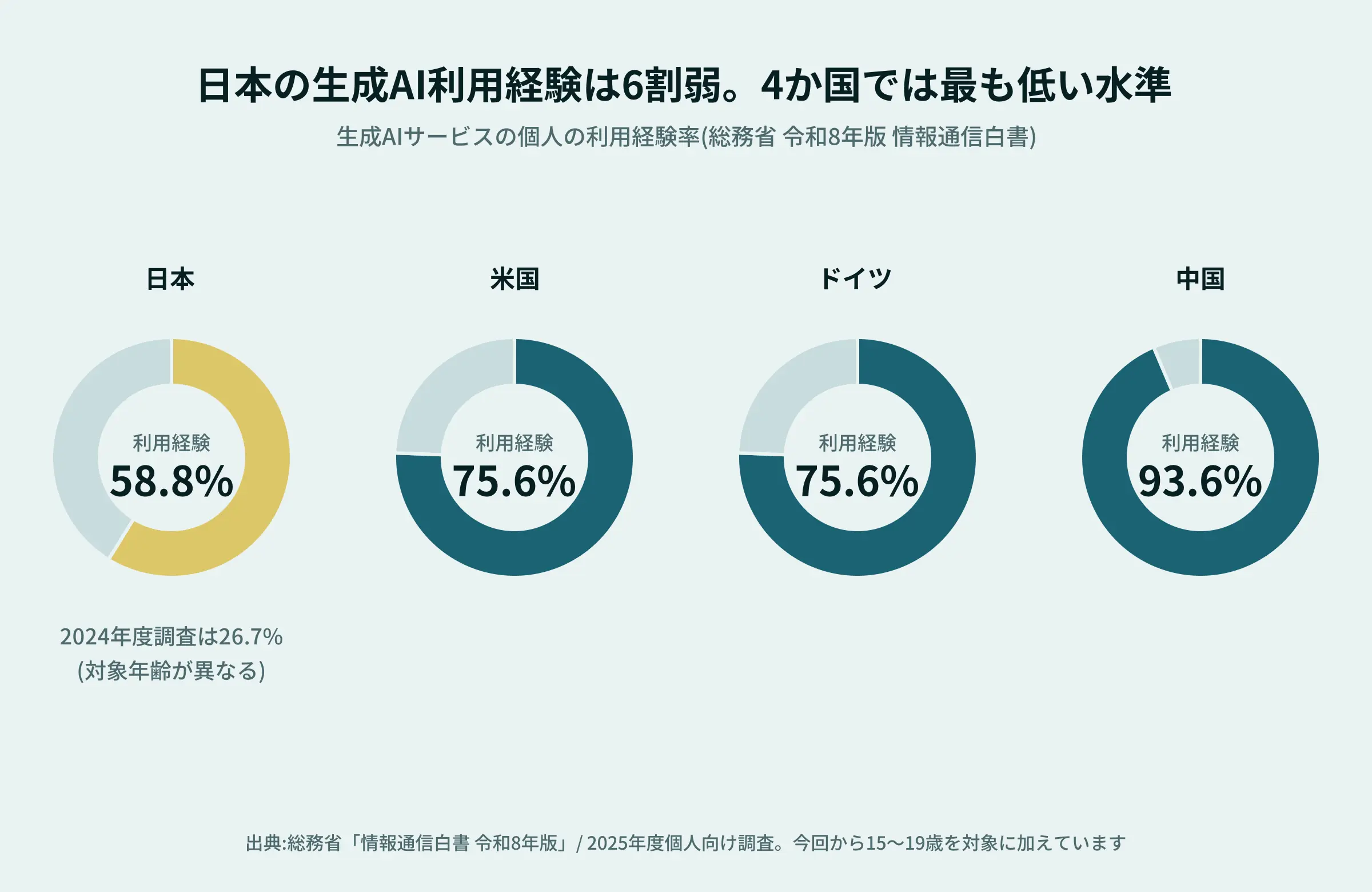
What about Japan? According to the Ministry of Internal Affairs and Communications' "Information and Communications White Paper, 2026 Edition," the rate of individual experience using generative AI in Japan was 58.8%. This is a significant increase from 26.7% in the 2024 survey (since 15–19 age groups were added to the survey this time, it cannot be simply compared). However, compared to the 75.6% in the United States and Germany and 93.6% in China, this is the lowest level among the four countries (Ministry of Internal Affairs and Communications | 2026 White Paper on Information and Communications, AdverTimes | July 29, 2026).
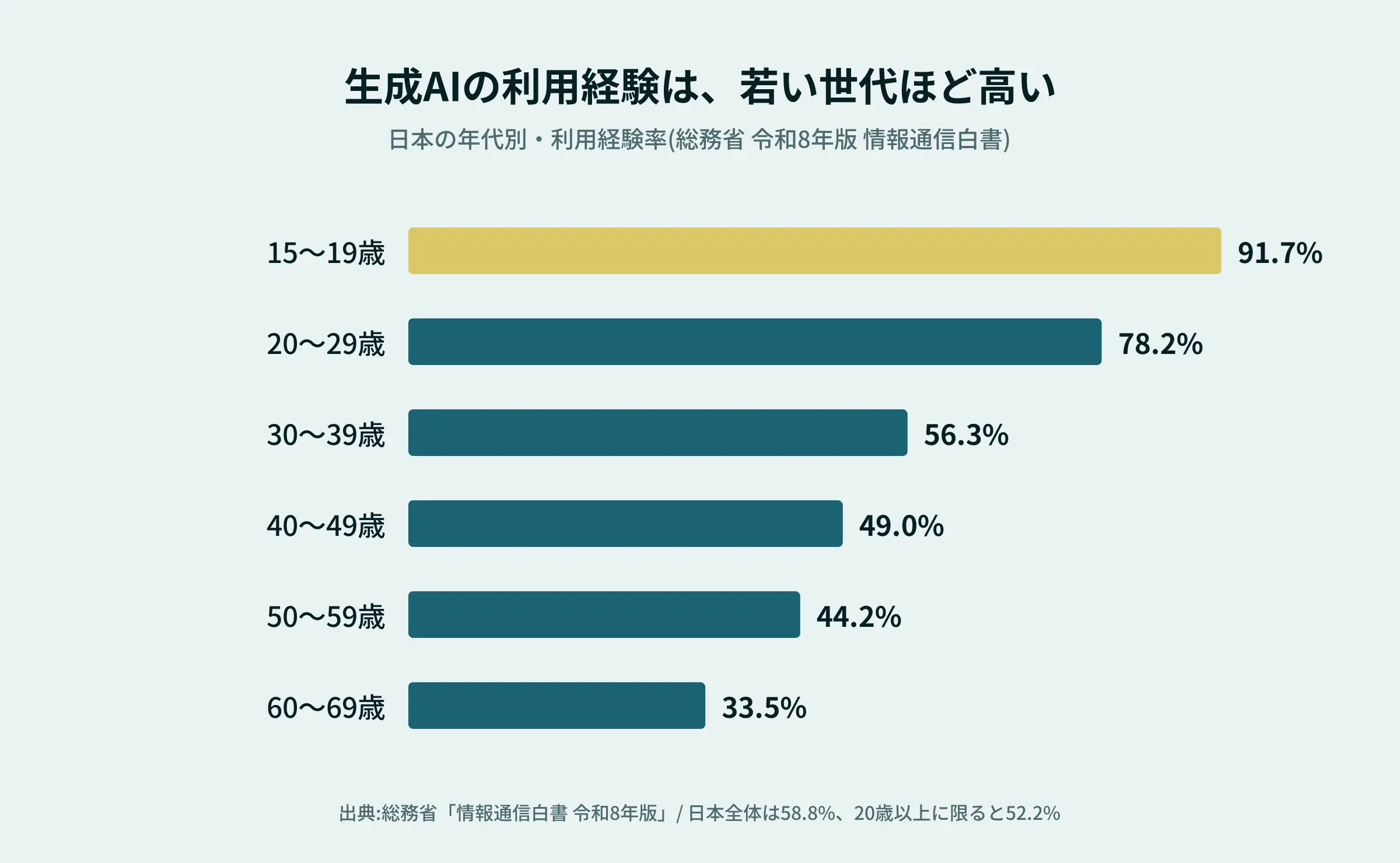
By age group, 91.7% of those aged 15–19 and 78.2% of those in their 20s are higher, with 33.5% among those in their 60s.
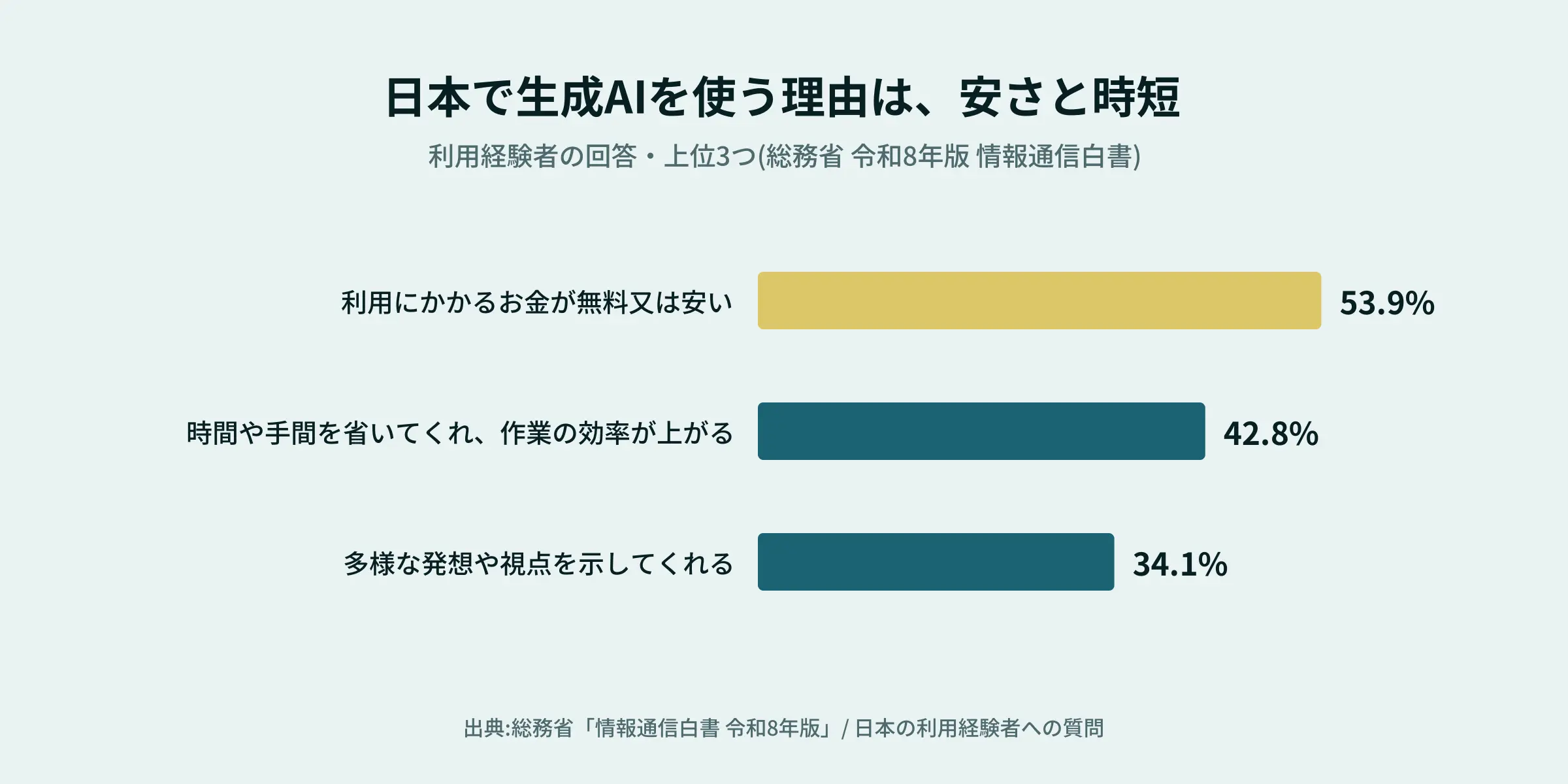
The main reasons creators use AI are "cheap and fast." So, what about viewers? According to a survey conducted by JIAA (Japan Internet Advertising Association) of 3,591 people aged 15 to 69 nationwide (conducted in February 2026), 18.3% of people answered that internet advertising is "trustworthy." Compared to a year ago, 20.9% said they "have become untrustworthy," which is higher than the 13.9% who said they have become "trustworthy" (ecnomikata| JIAA survey report).
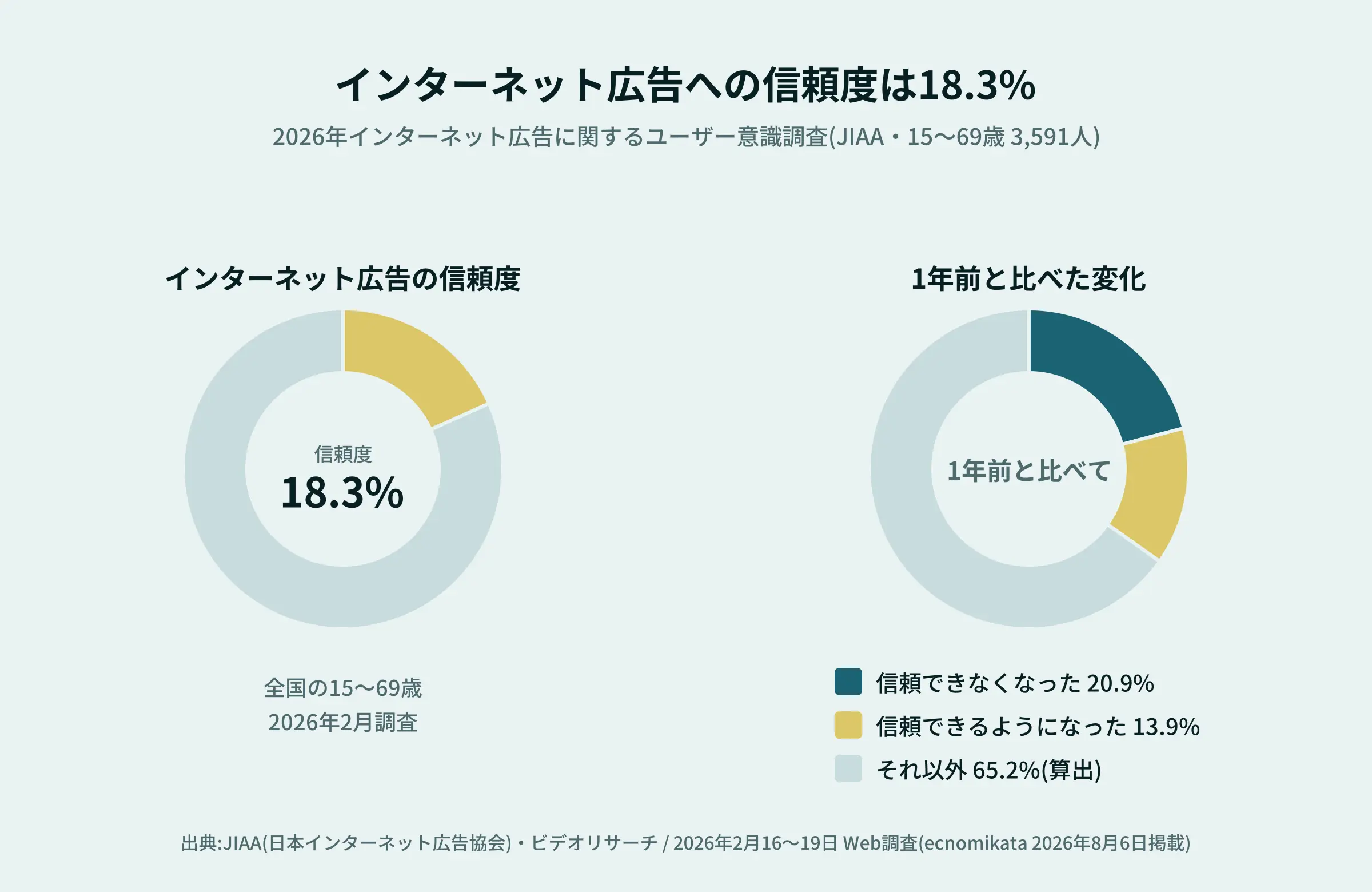
This survey was not about AI, but about trust in internet advertising in general. Still, it is clear that Japanese audiences have become quite cautious about information online.
Precautions when reading numbers
Investigation | Points to note |
Gartner | The target audience is only American consumers and does not necessarily reflect Japanese trends |
The Harris Poll | What we're asking about is 'advertising.' The sample size and survey period were not listed in the publicly available materials that could be confirmed |
Ministry of Internal Affairs and Communications (White Paper) | This is based on user experience and is a separate topic from how to evaluate AI |
JIAA | It's not about AI, but about the overall trust level of internet advertising. These are numbers confirmed through news reports |
We did not find any publicly available data that directly examined "how Japanese consumers view AI-powered websites." Therefore, we will look for clues from actual cases that have occurred in Japan.
Does 'anti-AI' mean AI is disliked?
Before the case study, let me introduce an experiment. We believe that "anti-AI" is somewhat different from the narrative that AI is disliked.
Nielsen Norman Group (NN/g), known for its usability research, asked 77 U.S. adults to view six types of fictional consulting firm homepages for 10 seconds each. The only difference was the top image: three were AI-generated and three were real stock photos. Participants were not told about AI.
The results showed that the AI image page was not at a disadvantage. The evaluation of trust, professionalism, and authenticity differed by about 0.2 to 0.4 points out of seven levels. In fact, the only slightly higher and statistically significant "authenticity" (NN/g| AI-generated images)。
However, there is a continuation. Some participants suspected it might be AI, and those who doubted it gave a low evaluation of the site. There were also cases where people mistakenly believed real photos were AI. NN/g also referenced previous research showing that disclosing AI use lowered trust in people and organizations. Note that this experiment had few participants and used only a single fictional site, so it may not apply to every industry.
To sum up to this point, it looks like this.
- AI-generated images themselves are not necessarily disliked.
- If people suspect things like 'I don't know who made it' or 'I don't know if it really exists,' your evaluation will drop.
- Even if it's genuine, it can sometimes be mistaken for AI.
The true nature of anti-AI may be not so much dislike of AI, but rather a sense of caution and boredom toward things whose creator is unknown. Photos that look familiar somewhere or sentences that apply to any company look the same even if created by human hands. Up to this point, this is our assessment.
The same trend is being discussed in the world of design. Creative Bloq's 2026 illustration trend article reports that "authenticity, imperfection, and the thirst for the warmth of human hands" are spreading. A designer from branding company FutureBrand described this year's theme as "embrace the mess." This is an expert's perspective and not backed by numbers (Creative Bloq| Messy, meaningful and made by humans)。
What Actually Happened in Japan| Five Cases Surrounding AI Images
In Japan as well, there have been a surge of criticism and criticism regarding AI-generated images. We have compiled five cases confirmed in the news. This is not to criticize each company, but to find lessons that small shops and companies can learn. We have not confirmed the official announcements from each company and are based on reports and explanatory articles.
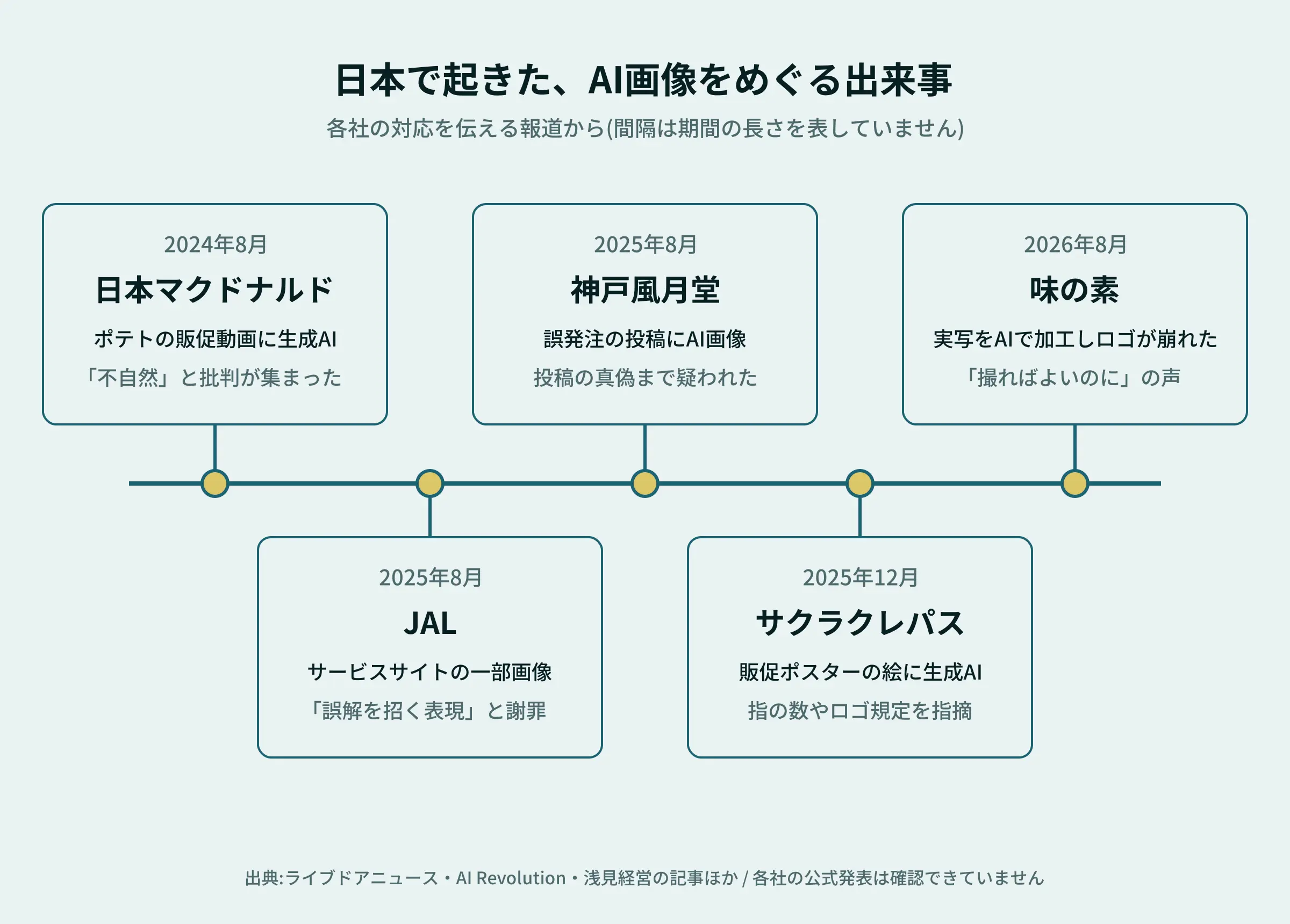
McDonald's Japan (August 2024)
It has been reported that when generative AI was used in promotional videos for McFries fries, criticism gathered for reasons such as being 'unnatural' (Asami Management| A case of controversy over AI-generated images). The company's response to this issue was not included in the articles I checked.
JAL (August 2025)
After the announcement of credit cards for wealthy individuals on August 1, 2025, there was a flood of complaints about the discomfort in the images on the service site. Images such as sticking a straw into popcorn and shopping with cards other than JAL cards have been pointed out.
JAL replaced the images deemed unnatural and reportedly apologized, stating, "Some images created by generative AI and used on our website contained misleading expressions." Although there was a review system, it was not widely recognized within the company and was reportedly not applied (Asami Management).
Kobe Fugetsudo (August 2025)
There was a post claiming to provide free cold red bean paste to customers ordering from a café menu, citing a mistaken order where 200kg of red bean paste had arrived. Because this post used AI-generated images, people suspected that the story of the wrong order that was the basis of the post was fabricated.
The next day, the store apologized, explaining that they used generated images close to the actual product, fearing that identifying the product could cause inconvenience to suppliers. They also apologized for the insufficient explanation (Asami Management).
Sakura Craypas (December 2025)
In December 2025, a local poster posted on social media about the company's promotional poster displayed at a manga event in Spain, sparking discussion that it might be an AI-generated artwork. Criticism has been raised such as the girl having only four fingers on her left hand, the pen she holds is too large, the small gray logo does not comply with the company's display rules, and the shape of the depicted product differs from the actual product.
The company issued its statement on December 9 and 11, acknowledging that the group's sales subsidiaries had created the products using generative AI. They apologized, saying, "We sincerely apologize for any discomfort caused by this incident," and indicated the suspension and removal of posters and the strengthening of group-wide inspection systems (Livedoor News).
Ajinomoto 'Hondashi' (August 2026)
On August 14, 2026, Ajinomoto Park's official X account posted a recipe image using "Hondashi." However, the logo of "HONDASHI" in the image now looks like "MONDASHI," and the words "Freshly Scraped Aroma" are no longer legible, which users pointed out.
On the 16th, Ajinomoto explained that it had released the live-action photos with distorted text and labels as a result of changing brightness and backgrounds with AI, and apologized for the lack of verification. They also released unedited real-life images. On social media, comments were raised, saying, "If it's our own product, you can just take a photo and it should be quick." It is explained that the criticism was directed not at the use of AI itself but at the fact that the display was released without checking the display (AI Revolution | Summary of the Ajinomoto Incident).
What we learned from the case
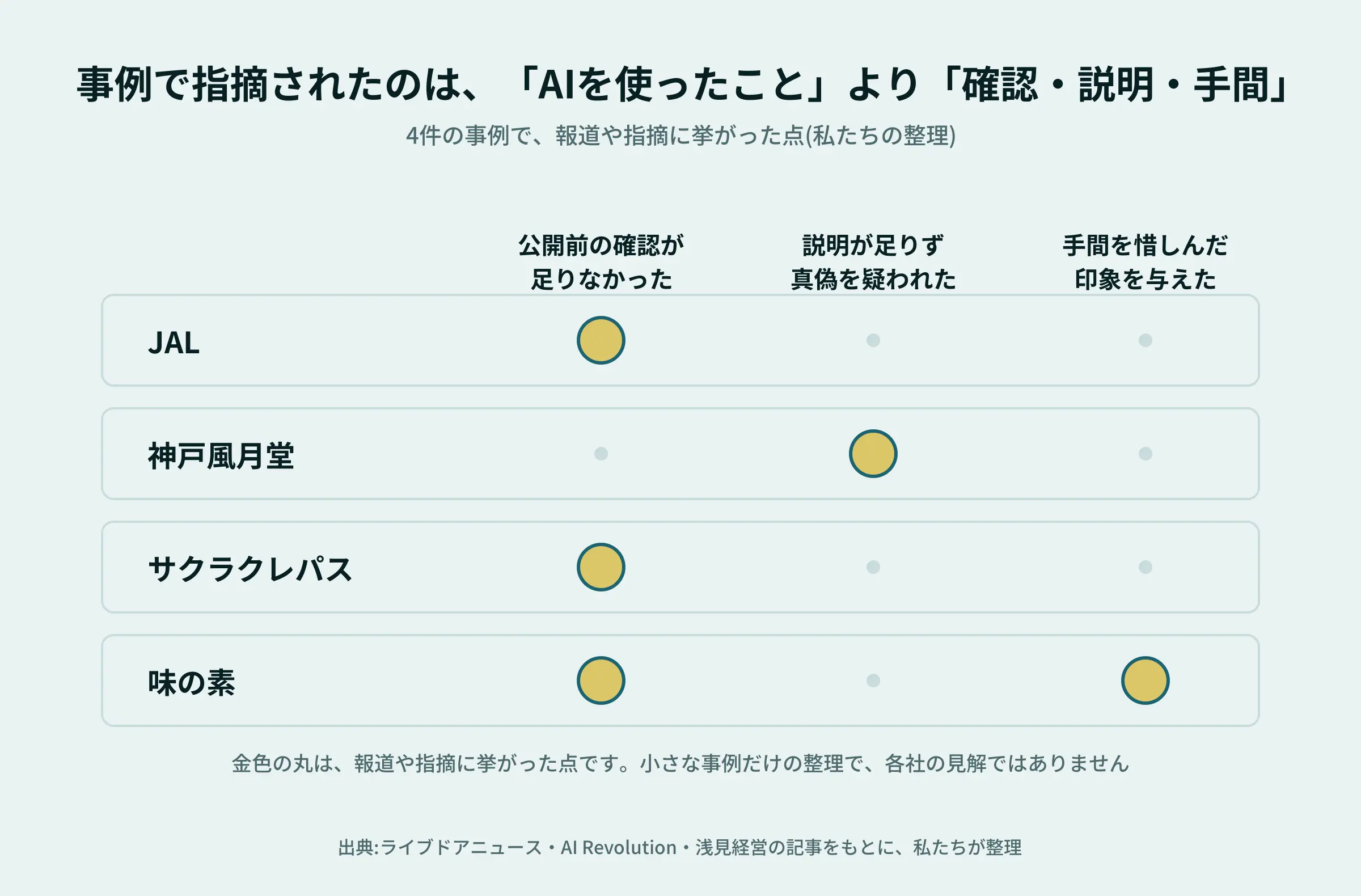
All five cases occurred in places where customers could see them. These are promotional videos, service sites, social media, and event posters. They almost overlap with the places where we have decided not to use AI at touchpoints.
We have also organized the points pointed out (only 4 cases, which is our summary).
- A major issue for JAL and Sakura Craypas was the lack of sufficient confirmation before release.
- Kobe Fugetsudo was largely questioned about the authenticity of its posts because of the AI images
- In addition to insufficient confirmation, Ajinomoto's impression was that they regretted the effort of 'they should just take the film'
It seems that more people focus on 'whether the AI was properly checked,' 'explained properly,' and 'whether the effort was put in' rather than 'using AI.' However, this only gathers the most prominent examples that caused controversy. Examples of effective AI use are rarely public, so please be careful about the fact that there are some side reports.
The opposite move: Proving that you are human
There are also opposing movements. Hakuhodo DY Holdings is reported to offer 'Human-Verified Ad' through its new company, Ads for Humanity, which delivers ads exclusively to real people, excluding AI and bots (Hiroaki Mori | The true meaning of 'AI refusal' ads). According to the company's demonstration, the click-through rate is about 10 times higher than conventional ads, but according to the company's announced figures, no third-party verification has been confirmed.
In the film world, it has been reported that the 'Human Made Mark,' which certifies works created without AI, will launch in April 2026 (DICE+). It can also be interpreted that 'created by people' and 'reaching people' is beginning to be treated as a value in itself.
The issue of responsibility is also discussed. AdverTimes notes that even if the production process shifts to AI, the creators still retain approval for release, credit for the work, and apologies when problems arise (AdverTimes | November 13, 2026).
What about Japan? Our speculation
From here, we will present our guesses based on Japanese cases and figures. Since this was not confirmed through surveys, please read with the mindset that "maybe this is how it looks."
Likely to be judged more by 'sparing the effort' than by 'using AI'
What was discussed in the case were more about using AI, more than just using AI, but 'not confirming,' 'not explaining enough,' or 'taking photos even though I could have done it myself.' In Japan, we believe that putting in the effort to help the recipient is often conveyed as sincerity. For example, a handwritten thank-you letter can convey the effort you put into writing even if the wording is standard. On the other hand, if you see that effort was saved, even if the content isn't bad, it can feel insincere.
Responsibility and apology remain with those who made them.
In cases where the apology was made public, every company bowed its head as a company. Regardless of whether AI created it, the party that released it takes responsibility. Small shops and companies can see their faces, making this responsibility much clearer. We believe that conveying that "this person is taking responsibility" leads to peace of mind.
Japan's audience may change from now on
Although Japan's experience using generative AI is the lowest among the four countries, it has grown significantly in about a year. As more people use it, their eyes for recognizing the "AI-like" qualities will likely grow. If that happens, websites that only look "like-the-scene" may become more buried than they are now. This is also speculation.
Thinking about traditional Japanese concepts such as noren and wabi-sabi in old Japanese terms Japanese
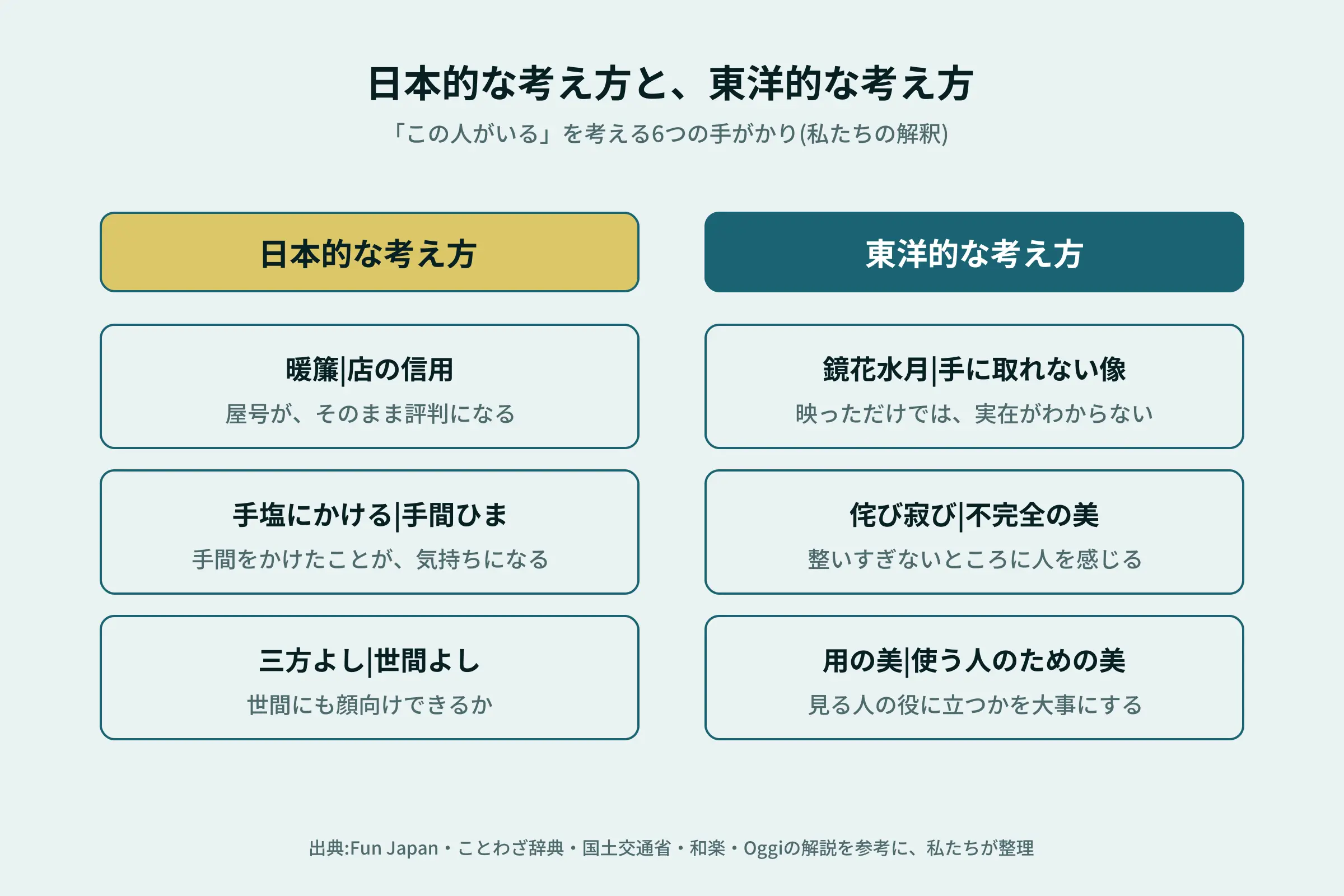
Japanese Perspective (1) Noren is the Shop's Trust
A noren is a piece of fabric hung at the entrance of a shop. From there, it has also come to mean 'reputation' (Fun Japan | noren).
We believe that a website is like a noren in today's era. If the noren is dirty or you don't know which shop it is, it becomes harder to enter. The same goes for websites—noren that seems like they could be hung in every store cannot live up to the trust of the shop name.
Japanese Approach (2): Taking Extra Risks
'Teshio ni kakeru' refers to the act of carefully nurturing the child with their own care. Originally, it is said to have come from adding salt at the table to suit one's own taste, but there are various theories (Proverb Dictionary | Teshio ni kakeru).
I think the comment about the Ajinomoto incident, "It's right away if you take a photo," is probably a similar feeling. If you intentionally put in the effort you can save, it shows how much you value the other person.
Japanese Philosophy (3): Three-Way Approach
Mikata Yoshi is known as the business philosophy of Omi merchants, meaning 'good for sellers, good buyers, and good for society.' According to materials from the Ministry of Land, Infrastructure, Transport and Tourism, it is introduced as the way of Omi merchants active from the 16th to 19th centuries (Ministry of Land, Infrastructure, Transport and Tourism | Mikata Yoshi).
For those of us working in Shiga, it's a familiar word. What I want to focus on is 'good for society.' It seems that the question regarding AI images was less about whether they would violate the law and more about whether they could face the public. Knowing who is responsible also helps demonstrate sincerity toward society.
Eastern Perspective (1): Wabi-sabi
Wabi-sabi is an aesthetic that appreciates simplicity, quietness, and imperfection. Wabi is described as "accepting and enjoying what is lacking," while sabi is described as "enjoying oldness, tranquility, and the taste of time passing by." There is also a story that Murata Jukō, a tea ceremony practitioner, liked the moon hidden among clouds (Waraku | What is wabi-sabi).
On the website, it's the good thing about not over-neatly tidying things up. A slightly messy workbench or scratches on used tools are proof that you're really working here. It's a concept similar to Creative Bloq's "embrace the mess."
Eastern Perspective (2): Mingei and the 'Beauty of Use'
Mingei is a concept popularized by Muneetsu Yanagi and others around the end of the Taisho era. It is believed that true beauty lies in what nameless people create in their daily lives (Waraku | Mingei).
Using this way of thinking, a good website seems to be useful to the user rather than just for display. Rather than looking equally beautiful to anyone, it answers what viewers want to know. We want to cherish that.
Eastern Perspective (3): Mirror Flower and Moon
Kyoka Suigetsu is a four-character idiom that describes things that are visible but have no substance, like flowers reflected in a mirror or the moon reflected in water. By extension, it refers to fleeting beauty, like ideals or fantasies (Oggi | meaning of Kyoka Suigetsu).
This phrase also overlaps with our concept of "lakes and the moon." AI is like a water surface that skillfully reflects the moon. It's beautiful, but just reflecting it makes it hard to grasp it. I believe that only when there are people and shops who can actually touch the moon can people feel at ease. This is our own way of interpreting the original meaning of the word.
Try making old words available on your website
Philosophy | Actions on the Website |
noren (shop trust) | Display your shop name, as well as the names and faces of the representative or person in charge on the top page. |
to be careful (time and effort) | Take photos of products and the site yourself. Write your own response to inquiries in your own words. |
Mikata Yoshi (Sekai Yoshi) | Briefly and specifically describe how AI is being used and who is responsible. |
wabi-sabi (the beauty of imperfection) | Don't over-tidy it. Capture snapshots from the site, handwritten notes, and photos of well-used tools. |
Folk crafts and the beauty of utility (beauty for the user) | Rather than just flashy phrases, answer each customer's problem. Record your achievements, including consultation details and creative solutions. |
Kyoka Suigetsu (Appearing Alone Is Not Substantial) | Placing visible information in one place rather than relying solely on images or text |
Kototsuki Design Approach
This is our own parable inspired by the shop name, 'Lake and Moon.'
The moon is reflected on the surface of the lake at night. However, without the original moon reflected, nothing is reflected on the water's surface.
We think of AI as something like this surface of water. It can be beautiful, fast, and projected as much as you want. But without the original moon to be projected, there is nothing to reflect. The moon represents the thoughts of the shop and the experience of the creators. That's why we want people to create the parts corresponding to the moon.
Our line is simple.
- The places customers touch (touchpoints) are created by people. Photos, words, achievements, responses to inquiries, and so on.
- I use it to help others behind the scenes. I do my research, organize information, and identify areas for improvement.
- If you use AI, people must see it before publishing it. And the responsibility lies with people.
A detailed approach is written in the website production policy of "not using AI for touchpoints."
How does Google view AI-generated pages?
Since this is also a concern in terms of search, I checked Google's official guide.
Regarding generative AI content, Google provides the following guidance (Google Search Central | Guidance on Content by Generative AI).
- Even if you create a large number of pages with generative AI, if they do not add value to users, you risk violating spam policies.
- AI does not capture facts and may contain inaccurate information. It is important for people to verify facts before publication, including titles, meta descriptions, and alternative text for images
- It is recommended to show readers how AI and automation were used in an easy-to-understand way
Also, in the guide to "useful and reliable content," among experience, expertise, authority, and reliability (E-E-A-T), "reliability" is considered the most important. It is also recommended to explain "who," "how," and "why" created it, and when AI or automation is used, showing how to use it is considered helpful. The explanation is that E-E-A-T itself is not a direct factor affecting rankings but is used as a combination of elements to find good content (Google Search Central | Useful, Reliable, User-First Content).
From what we have checked, it did not say "because it was created by AI, it will be lowered in ranking." What is being asked is whether the content is useful to people and whether it is clear who created it and how. I believe the direction is the same as the "this person exists" that we wrote about in this article. This is our interpretation.
Google Guide | What you can do on your website |
Who (the creator) | Include the names, faces, and backgrounds of the representative and staff. Write the person who wrote the article |
How (How to Make) | Describe how to use AI in one sentence. Attach who took the photos |
Why (Purpose of Creation) | Make the content useful to the reader, not just for searching. |
Experience (Actual Experience) | Includes photos from the site, real cases, and stories of things that didn't go well. |
Note that Google's "Quality Evaluation Guidelines" are intended for people evaluating search results and do not directly affect rankings. Rather than adding something just for ranking, I believe that creating something that truly resonates with readers is the shortcut to results.
Features that often appear on 'AI-like' homepages
Does your homepage look AI-like? Here, we've listed common features. These aren't based on research, but rather provide guidelines based on our own experience viewing websites.
Where to watch | Features that tend to look AI-like | How to fix |
Photos | Materials that look familiar. Hands of people, or unnatural lettering on signs and labels. | Replace them with photos you took yourself. |
Article | Words that apply to every company keep coming. "...to provide you" is lined up | Include triggers or actual events |
Achievements | No numbers or proper nouns, only 'courteous service' | Describe the consultation content, efforts, and duration |
headline | Everything is arranged in the same pattern, with no strength or contrast | Write what you want to say first, then sort it in that order. |
Personal Information | No name or face, and it's hard to find addresses or contact information | Clearly include the names, faces, and contact information of the representative and staff |
Novelty | No date, no recent information | Include announcements and update dates |
If you want to check quickly, you can also use our free tool, AI-like Diagnosis.
Small shops and companies are inherently strong.
Unlike large companies, small shops and companies inherently have a "human face." Who makes them, who will handle them, and what kind of motivation they have put into their work. Many reasons why customers choose small shops lie in these factors.
However, when it comes to the website, that face often disappears. A photo of a smile from free materials and the phrase, "We strive to be close to our customers and provide polite service." None of these are wrong, but none of them are shown in your store.
Nowadays, when viewers are suspicious, simply saying, "Here is this person," it sets you apart from others. You don't have to do anything special; just show what you already have as it is.
Five ways to tell "This person is here"
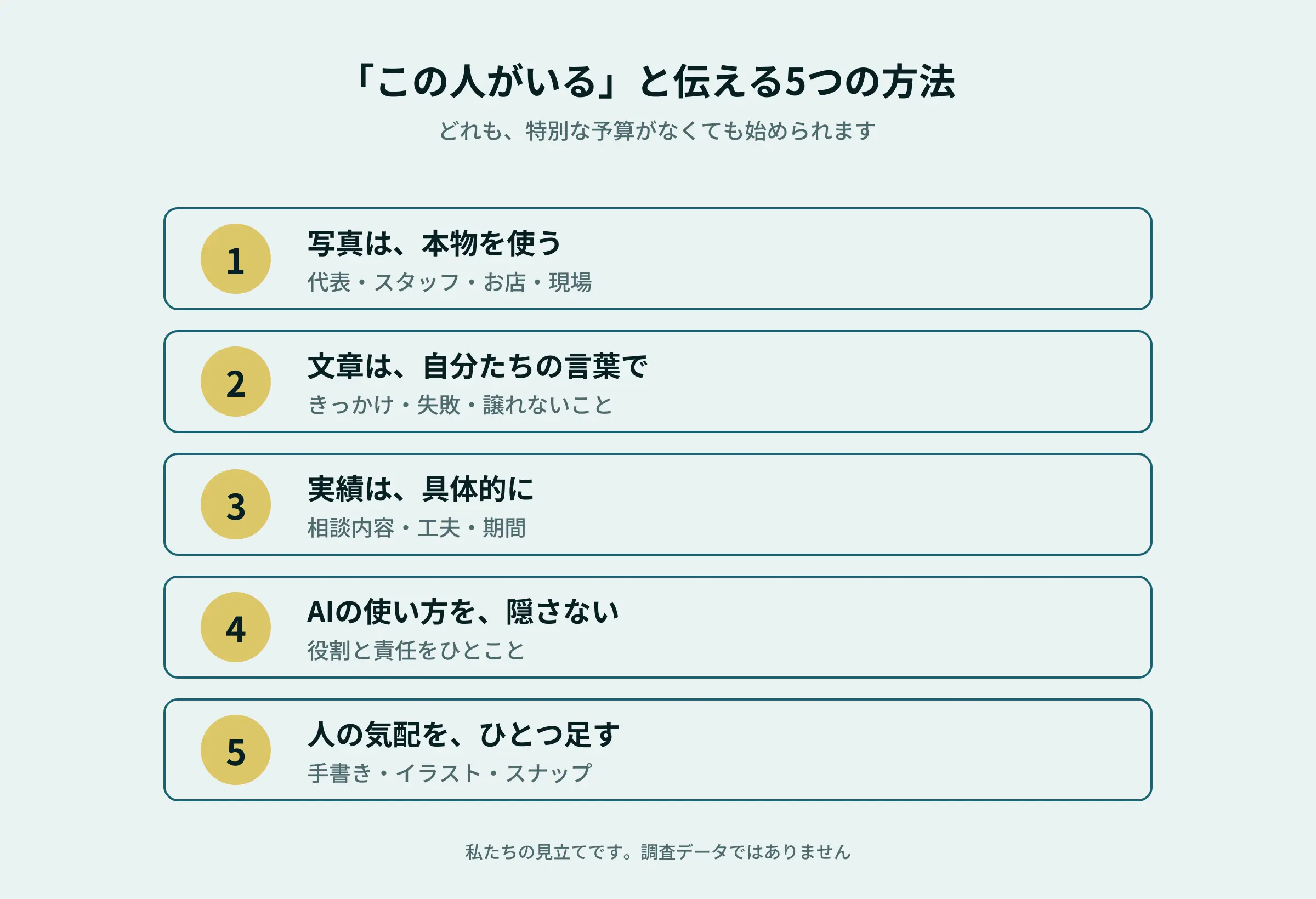
1. Use real photos
Photos are the most effective. The CEO's face, staff, inside the store, workshop and on-site, actual products. Photos as they are have a convincing power that free materials or generated images don't have.
The comment from Ajinomoto that said, "If it's our own product, you can just take a photo right away," applies just like that to small shops. You can take photos of your own products and the site yourself. If you don't take photos of what you can, it will look like you have spared the effort.
You don't need to over-tidy it. A slightly messy workbench or scratches on used tools can be proof that you are working here, which is similar to wabi-sabi (wabi-sabi). In NN/g experiments, there were cases where real photos were suspected to be AI, so it's also recommended to add a note next to the photo showing "when, where, and who is in the photo." This is our assumption.
That said, hiring a professional can really change the quality of your photos. If you can hire a photographer in Shiga, we've introduced the top 10 photographers and photographers in Shiga. If you decide in advance where and what kind of photos you'll use, your shoot will go smoothly.
2. Write in Your Own Words
AI-generated writing is beautiful, but it tends to apply to every company. Try placing something in the middle of your sentence that only you can write.
- What inspired me to start this job
- What actually happened in interactions with customers
- What didn't go well and what I changed from there.
- This is the one thing I can't compromise on, and the one thing I've decided not to do
It's perfectly fine to have AI help with drafts and structures. We do it too. Finally, leave writing that you can say, "This is my own words," as a human job. Read it again and find expressions you don't think you could say, that's where you can fix it.
3. Concrete achievements and customer feedback
Words like "courteous service" and "reliable technology" can be quickly written by AI, making them less trustworthy.
Instead, please show me an actual case study. What kind of consultation was involved, what was the problem, how was it resolved, and how long did it take? If you write as much as you can with the customer's permission, it will convey that "this company is truly doing it."
4. Use AI openly, concisely, and specifically
This is a bit tricky. Gartner recommends using AI "transparently, arbitrarily, and clearly in a useful way." On the other hand, previous research introduced by NN/g suggests that disclosing AI use can sometimes lower trust.
Combining these two points with the Japanese case, we believe this: Being thought to be hiding is more likely to damage trust later. As in the case of Kobe Fugetsudo, once it is discovered that AI images were used, the entire post's authenticity can be questioned. However, simply writing "AI is used" in large letters can cause anxiety. Therefore, it seems better to briefly and specifically state where the materials are used and where people are doing them. This is also the "good for society" of Sanpo Yoshi, which is sincerity toward society.
For example, a sentence like this:
- "AI is used for preliminary research and document organization, and the final judgment and responsibility are held by people."
- "All the photos were taken by the staff on site."
- "The representative writes each response to your inquiry one by one."
Avoid writing "AI is not used" when you are not using it. This will deepen the damage if it collapses later. If you summarize the usage in one sentence, it will be easier to answer when asked.
You can check how much your site looks 'AI-like' with our free tool, the AI Likeness Diagnosis. It tells you where your site looks AI-like, along with reasons and ways to fix it.
5. Add just one touch of someone's presence
In overseas design trends, hand-drawn illustrations, handwritten letters, and rough paper-like textures are spreading to express human hands (see the aforementioned Creative Bloq article).
However, you don't have to use that kind of expression on the entire website. If it becomes hard to read, it would be pointless. A handwritten phrase by the CEO, an illustration drawn by the staff, a quick snapshot taken on site. I think adding just one hint of human presence is just right.
Use it not to follow trends, but to convey the essence of your store. Trendy expressions may change over time, but the tactile feeling of "this person is here" remains the same.
Sample text for AI usage policy to post on your website
Even if you say "write how to use AI in one sentence," it can be hard to get lost when actually trying to write it. So, we've prepared sample sentences by pattern. Please change your wording to match your actual usage.
pattern | Sample Phrases |
I use it for research and organization | At our store, we sometimes use AI to organize information and review drafts. Text and photos posted on the website are reviewed by staff and published responsibly. |
Photos and Writings Are Made by People | All the photos are taken by staff of the actual store and products. The staff also write the text in their own words. |
Focusing on inquiries | Each inquiry is answered by the person in charge. We do not use AI-based automatic replies. |
Possible placements include company profile, footers, or small pages labeled "About AI Use." If usage changes, update the text as well. Avoid writing "Not using it" even though you are actually using it.
Our usage is described in our website creation policy of "not using AI for touchpoints." Please refer to it.
If you use AI, five human checks before publishing
I think AI is sometimes used in part of the production. We organized the points pointed out in the Japanese case as pre-release confirmation (our summary).
confirmation | Examples Referenced |
Check for any unnatural spots such as human hands, fingers, number of people, or shadows. | Sakura Craypas (pointing out the number of fingers), JAL (pointing out unnatural images) |
Check whether the logo, product name, and label text are distorted. Do you comply with the logo usage regulations? | Ajinomoto (the characters are distorted), Sakura Craypas (logo regulations) |
The depicted product has the same shape and design as the real thing. | Sakura Craypas (product shape is different) |
Checking whether AI-generated images are used as evidence of 'actual events' | Kobe Fugetsudo (The authenticity of the post was questioned) |
Who checks and who is responsible for disclosure? | JAL (It was reported that the screening system was not well established) |
Leaving it to AI, what people do
"Using AI doesn't mean it loses authenticity." AI quickly shapes people's thoughts and experiences. If you leave the content empty, the empty text will just come out faster, but if the message is clear, it helps clarify the outline.
From our perspective, this is roughly how it is divided.
Scene | Get help from AI | People do it |
Article | Preparing structures, checking for typos, organizing expressions | Experience, feelings, and deciding which words to use at the end |
Photos & Images | Brightness and color correction (manual verification of corrected text and logo) | Filming people, shops, products, and sites |
Contact | Frequently Asked Questions Guide | Individual consultations and responses to issues |
Website Development | Organizing information and identifying areas for improvement | Deciding what the site is for and what kind of stores you want to show it to. |
Review and check your website that you can do today
This is a check to apply five methods to your own website. Just by looking at each one, you will notice something.
confirmation | Guidelines for review |
Are the photos on the top page genuine? | If you have free materials or generated images, you can consider replacing them with real photos |
Are your company profile and the representative's greetings in your own words? | If the writing applies to any company, add the trigger and thoughts |
Does the track record include the consultation details, strategies, and duration? | If it's just about 'polite response,' I'll write one actual case |
If you are using AI, have you touched on how to use it? | Write in one sentence where it is used and where people will do it |
Can you see a person's name, face, or voice even in one place? | Add small items like handwritten words or snaps |
Five questions you should ask the production company
When asking a company to create your website, it's reassuring to ask about how to use AI. It may seem difficult to ask, but whether they can answer properly can also serve as a guideline for choosing a company.
Question | Reason to ask |
What tasks do you use AI for? | Once you know where you'll use it, you can see the scope of your assignment |
Who takes the photos and where? | Whether the photos of the store or products are authentic directly leads to trust |
Who writes the sentence, and who reviews it last? | You can check if the words are in the shop's language. |
Please tell me about the checks before publication and how I take responsibility. | This is to prevent problems caused by insufficient verification, as in the case of Japan |
If a problem is found later, how do you respond? | It's reassuring when the process for corrections and replacements is set |
We also consult withKototsuki Designabout how to choose a production company. We also accept production including photography, so please feel free to ask if you want to entrust the photos to us.
Kototsuki Design's Perspective | Through this article
So far, we've looked at numbers, Japanese examples, old sayings, and Google's guidance. Finally, I'll summarize my thoughts as a Kototsuki Design.
AI is reliable when you choose where you use it.
We use AI every day, and it helps us greatly. Through research, organizing information, and identifying areas for improvement, it can be a huge help behind the scenes. However, we want people to prepare the photos and words that customers see.
I think the website is like the shop's curtain.
A website is where the reputation of a shop carries its reputation. More important than being well-organized, it is important to know who runs the shop.
Never skipping the effort
Taking photos, listening to stories, choosing words. It's a lot of work, but I believe that is reflected in the shop's attitude. Even if it takes time, people do it here.
Responsibility belongs to people
Whether AI is used or not, it is people who publish it. Before publication, we always have people check and take responsibility for any production involved.
Helping to show the store's face just as it is
Small shops and companies inherently have a human face. We believe our job is to make it visible as it is, without over-creating it.
Frequently Asked Questions
Q. If there is an anti-AI movement, is it better not to use AI?
A. I don't think it's necessary to avoid it uniformly. Even in the NN/g experiment, the fact that the images were AI-powered did not result in lower evaluations. What is needed is not just not to use AI, but to be able to see people's intentions and responsibilities, and not to hide how they use it. To improve work efficiency, while using AI, it is realistic to bring forward things that only you can have, such as photos and personal experiences.
Q. I'm worried about being caught up in flames like Japanese companies
A. The case highlighted the need for confirmation, explanation, and effort before publication. We recommend not using AI in places visible to customers, or if you do, make sure someone reviews it before publication and appoints a person responsible. For small shops, even just taking photos you can take yourself greatly reduces risk.
Q. Does writing that you use AI lose trust?
A. There is research showing that prices may decrease. But that applies only to writing "AI is being used." We believe it is best to briefly and specifically state where it is used and where people are doing it. I think it is easier to undermine trust if it is hidden and only later known. This is our assumption and was not confirmed through a survey targeting Japanese consumers.
Q. Do Japanese consumers feel the same way as the rest of the world?
A. We did not find any publicly available data directly investigating impressions of AI-powered websites in Japan this time. What is known is that the experience with using generative AI has expanded to 58.8%, trust in internet advertising is 18.3%, and domestic cases have been pointed out for insufficient confirmation and explanation. While Japanese audiences have become more cautious, it is not enough to definitively evaluate AI itself.
Q. How do Japanese and Eastern perspectives relate to your website?
A. Noren refers to the reputation of the shop; 'Applying the right hand means putting in the effort'; 'Sanpo Yoshi' means sincerity toward society. I believe that all of them value 'who goes through what kind of effort and takes responsibility.' We believe that on a website, you can see the shop name, face, effort, and responsibility.
Q. Does Google lower the ranking of AI-generated pages?
A. The Google guide we checked did not mention "lowering rankings because it was created by AI." It states that a large number of pages that do not add value to users may violate spam policies, and that people should verify facts before publication. We believe that what matters more is whether the content is useful to people and whether it is clear who created it and how, rather than whether AI is used. Please check the latest information on Google Search Central before publication.
Q. Where should I post the AI usage policy on my website?
A. It is recommended to include a brief company profile or footer. If you want to write in detail, create a small page titled "About AI Usage" and link to it. For sample sentences, please refer to the "Sample AI Usage Policy" section in this article.
Q. Isn't this trend just a temporary trend?
A. Hand-drawn styles and textured looks will evolve just like other trends. However, trust in 'real people responsibly communicating' is not influenced by trends. It's recommended to prepare the content before the appearance.
Q. What should I start reviewing my current website?
A. Replace free materials or generated images with real photos. Then, rewrite the company profile and the representative's greeting in your own words. Starting from these two points makes changes easier to understand.
Conclusion
Thanks to AI, anyone can now create well-made items. That's why being well-organized alone is less likely to be a reason to choose.
68% of American consumers care about whether the product is genuine, and trust in Japanese internet advertising was 18.3%. In the Japanese case, the point raised was more about verification, explanation, and effort than simply using AI. Since ancient times, Japan has valued businesses that put the name of a shop on a noren curtain, carefully nurture it, and create a business that can be presented to the public. We believe that what viewers care about is not whether AI was used, but whether it is conveyed that "this person is here."
- Use real photos
- Writing in their own words.
- Track record and customer feedback are provided in concrete terms.
- How to use AI is straightforward and specific
- Add just one touch to someone's presence.
All of these can be started even without a special budget. Putting in effort shows sincerity to customers. We believe that is the fastest way to convey that "this person exists."
If you're unsure about "what strengths we should show," please feel free to consultKototsuki Design. Start by listening to your story and think it through together.
 Contact Form


 Related Articles