
Hello. This isKototsuki Design.
“I want to create an LP, but how much will it cost?”
We get this question all the time. When you search online, you’ll find a wide range of figures—"starting at 100,000 yen," "starting at 300,000 yen," "starting at 500,000 yen"—which can make it even harder to decide, right?
Even for the same “landing page creation,” the cost varies greatly depending on what you ask for and the scope of the work. Is it just the design? Will you work with us on the copy and structure as well? Does it include a photo shoot? And above all, what is the purpose of creating that landing page? Today, I’ll cover everything from estimated costs and the production process to the mindset needed to ensure your landing page isn’t just “created but never used.”
What’s the Going Rate for Restaurant Landing Page Production?
I imagine the first thing on your mind is the production cost. Roughly speaking, the price range for creating a landing page for a restaurant falls into the following categories.
Estimated Costs | Type of Project |
Around 100,000 yen and up | Cases where a basic, minimal-feature landing page is created using templates. This is ideal when you already have the necessary content—such as text and photos—and just need a single-page website to get started. |
Around 200,000 to 400,000 yen | Cases where we create a site with an original design, carefully considering the layout and user flow. This is ideal when you want a design that matches the atmosphere of your business or a page tailored specifically to your business. |
Approximately 400,000–800,000 yen | This involves designing the entire page—not just the layout and design, but also organizing the copy, selecting photos, and determining how to present the brand. |
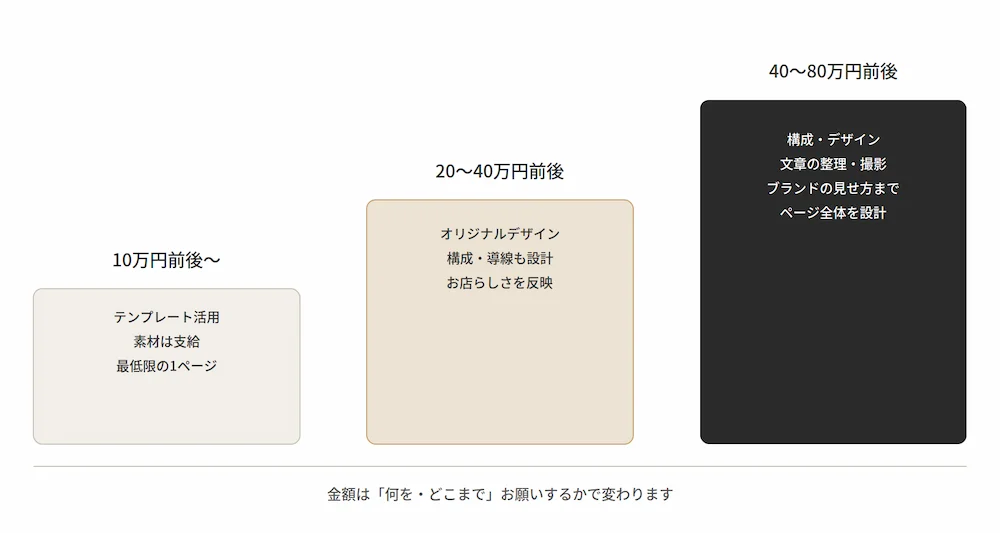
Of course, these are merely rough estimates. Pricing varies by production company and depends on the scope of work requested—such as page content, photography, copywriting, and booking systems. It’s a bit difficult to judge whether a price is “high” or “low” based solely on the amount.
7 Factors That Cause Price Variations
Some of you may have wondered, “Why is there such a big price difference for a single landing page?” One reason is that it’s not just about “what is being created,” but also “how thoroughly it is planned and executed.” Specifically, costs vary based on the following factors:
Point | Reasons Affecting Cost |
Design Direction | The time required for design varies depending on whether a template is used or an original design is created. |
Scope of Copywriting | The amount of work required varies depending on whether the text is provided by the business or developed by the design team based on discussions with the client. |
Use of Photos and Photography | Whether we use existing photos or take new ones will significantly affect the cost range. |
Level of Detail in Layout Design | The time required for design varies depending on who is responsible for planning the page structure (what content is displayed and in what order). |
User Flow Design | The level of detail in the design will vary depending on how thoroughly the user journey—leading up to bookings and inquiries—is mapped out. |
Complexity of Coding and Implementation | Costs increase as implementation becomes more complex—for example, with animations or integration with a booking system. |
Post-Launch Operations | The terms of the contract will vary depending on whether the project ends with the launch or if you require ongoing support for updates and improvements. |
The cost of a landing page isn’t simply determined by saying, “It’s one page, so it’s X ten thousand yen.” The cost reflects the extent of preparation and design required to create that single page.
Are There Grants Available for Small Restaurants?
Some of you may have heard that “using government grants can help keep landing page production costs down.” There are indeed programs, such as the Small Business Sustainability Grant, that cover the costs of creating websites or landing pages as part of efforts to expand sales channels.
However, the eligibility criteria, application periods, and subsidy rates are strictly defined for each program and may change from fiscal year to fiscal year. To be sure, check the latest details with your local Chamber of Commerce and Industry or the Small and Medium Enterprise Agency’s official website. Some production companies even offer assistance with preparing application documents, so if you’re interested, it’s a good idea to consult with them.
“Photos”—A Crucial Element in Restaurant Landing Pages
When creating a landing page for a restaurant, photos are just as important as the design. Photos of the food, the atmosphere inside the restaurant, the exterior, the staff, the cooking process, and customers enjoying their time there—there are many aspects of a restaurant that can’t be fully understood until you actually try the food.
That’s why it’s crucial that, the moment visitors see the photos, they feel, “That looks delicious,” “I like this atmosphere,” or “I’d like to eat here.” Sometimes, a single photo of a dish can convey the message more effectively than a written explanation stating, “We use carefully selected ingredients.”
You can create a certain level of visual appeal through editing and retouching. However, the atmosphere and the unique vibe that come through in the composition—the overall aesthetic—cannot be salvaged later if the photo wasn’t “good” from the very moment it was taken.The way the light falls, the balance between the plate and the negative space, and the way the steam rises—these elements are determined at the moment the photo is taken and cannot be added through editing. When considering the cost of creating a landing page, I recommend factoring in not only the production cost of the page itself but also how much you’ll spend on photography.
Will creating a “stylish landing page” attract customers?

If you’re going to the trouble of creating a landing page, you naturally want it to have a beautiful design. Of course, that’s important. However, a beautiful design doesn’t necessarily translate into bookings.
In fact, it’s common to see landing pages where—even though the business is high-end and targets an older demographic—the text is so small it’s hard to read. They use stylish Western fonts in a light gray, set in a very thin typeface.It may look stylish on a designer’s screen, but the people actually viewing it might be customers wearing reading glasses. This is what happens when you lose sight of who the design is intended for.
Customers can’t find the booking button. They can’t find the business hours. They’re unclear about the prices. If a landing page is like that, no matter how stylish it is, customers will simply leave.
What’s important is “making it easy to understand” rather than “making it stylish.” On that foundation, you can then create a design that reflects the essence of your business. We believe this order of priority is crucial.
Don’t forget how it looks on smartphones
Many customers looking for restaurants search on their smartphones and land on your landing page. It’s surprisingly common for a page that looks polished on a computer screen to have text that’s too small or buttons that are hard to tap when viewed on a smartphone.
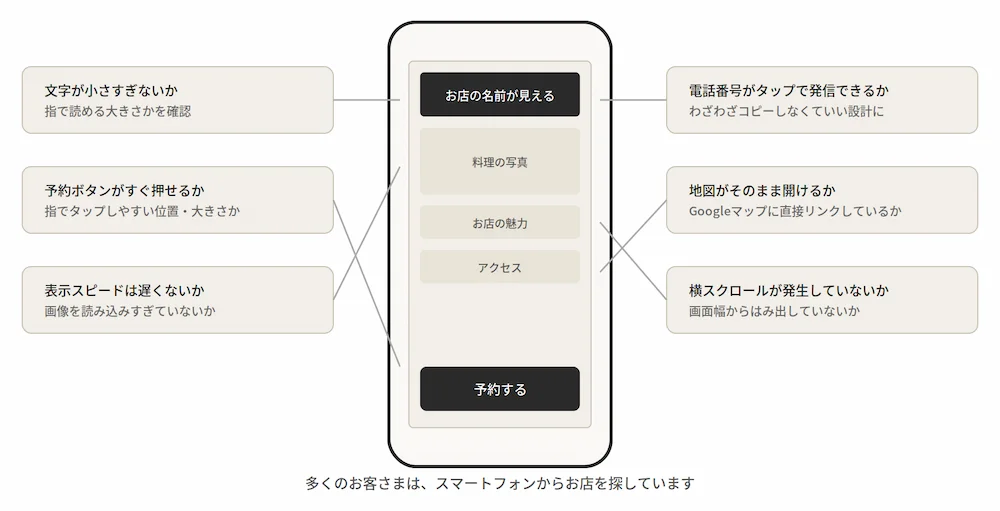
Text size, ease of tapping the reservation button, loading speed, one-tap dialing of phone numbers, ease of opening the map, and whether horizontal scrolling is required—these are all points that are easily overlooked when designing with only a computer screen in mind. Once your landing page is complete, we recommend opening it on your own smartphone and testing it by navigating with your finger.
The Landing Page Production Process | From Consultation to Launch
Many of you are probably curious about the actual process once you commission an LP. While the sequence may vary depending on your business’s specific situation, it generally proceeds in the following order.
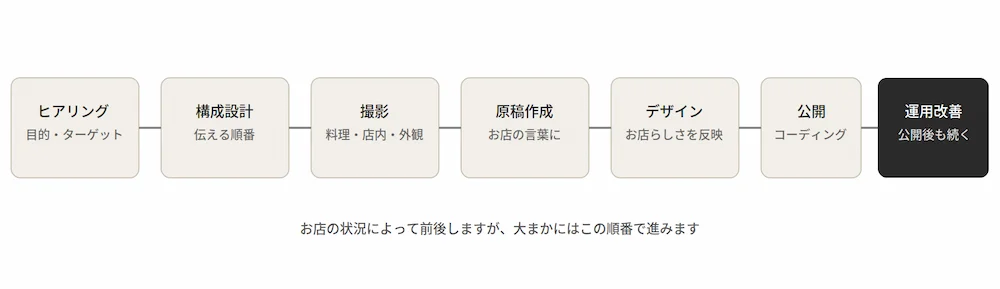
Consultation
We clarify your objectives and target audience.
Structure Design
We structure the content to determine what to communicate and in what order.
Photo Shoot
We gather photos of the food, the interior, and the exterior.
Copywriting
While the photo shoot is underway, we draft copy while drawing out the restaurant’s unique voice.
Design
Based on the organized structure and copy, we’ll create a visual design that conveys the restaurant’s unique character.
Coding
We implement the design as a fully functional website.
Launch and Ongoing Optimization
Even after launch, we’ll continue to monitor traffic and booking data and make improvements as needed.
Items to Prepare Before Placing an Order
To ensure the project proceeds smoothly, there are a few things you should have ready before placing your order. They don’t need to be perfect, but having the following will significantly improve the accuracy of our consultation.
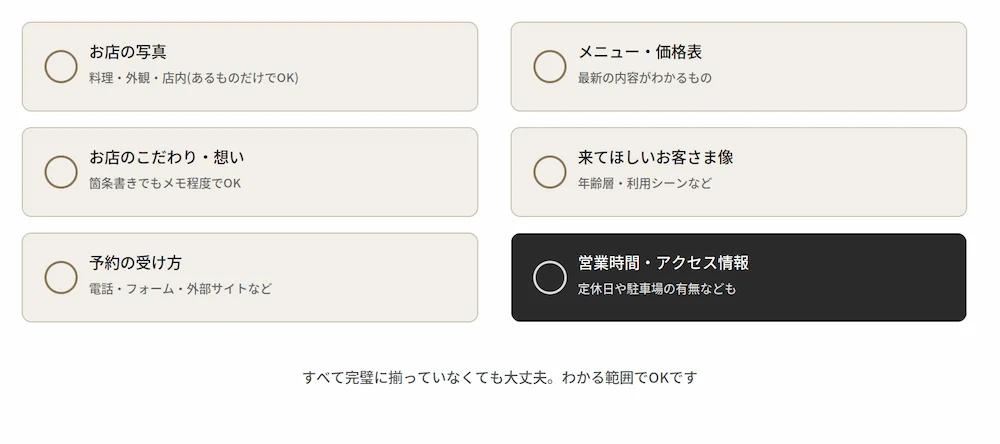
Photos of your restaurant, menus and price lists, your restaurant’s unique features and philosophy, your target customer profile, your reservation process, business hours, and location information. None of these need to be “perfect”—even rough notes are sufficient. If you bring along any materials you already have, we can work together to organize them from there.
Common Mistakes in Restaurant Landing Pages
Here are some common pitfalls to watch out for during the actual creation process.
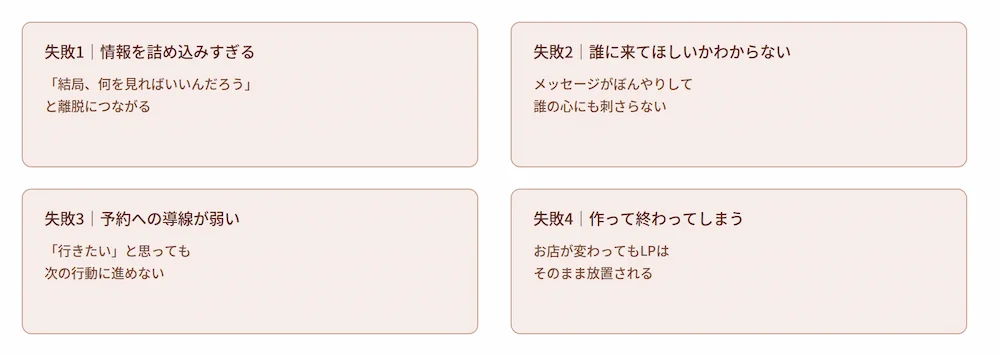
Packing in Too Much Information
“Since we’re going to the trouble of creating this, let’s include everything.” It’s common to think this way. However, if there’s too much information, visitors will end up wondering, “So, what am I actually supposed to look at?” An LP excels at organizing information toward a single goal rather than simply cramming in as much information as possible.
Not Knowing Who You Want to Attract
“I want people in their 20s to come, and I want families to come. I want tourists and locals alike.” Of course, you want to attract a wide variety of customers. However, if the target audience for your page is vague, your message will become unclear as well. By having a clear image of the specific person you want to attract—such as “I want this person to come”—it becomes much easier to choose the right photos, copy, and design.For example, it’s a good idea to think not only about “what kind of person” they are but also “what kind of experience they’re seeking”—such as “people looking for a place in Shiga where they can spend a slightly special time.”
Weak Call-to-Action for Reservations
Visitors view your landing page and think, “I’d like to go here.” But there’s no booking button to follow up. This is a huge missed opportunity. Whether it’s a phone call, a booking form, or an external booking site, it’s crucial to ensure that people who think “I want to go” can take the next step right away. It’s important to build your landing page with this in mind.
Creating the Landing Page and Forgetting About It
An LP isn’t finished once it goes live. Seasonal menus change, business hours shift, and new photos are added. As your business evolves, so should your LP, little by little. Ideally, even after launch, you should monitor the LP—asking yourself, “Is it getting the attention it deserves?” and “Is it leading to bookings?”—and make necessary adjustments as needed.
A Successful Landing Page Is Determined “Before It’s Built”
So, when you’re actually creating a landing page, where should you start? We recommend sorting out the following points before you even begin thinking about the design.
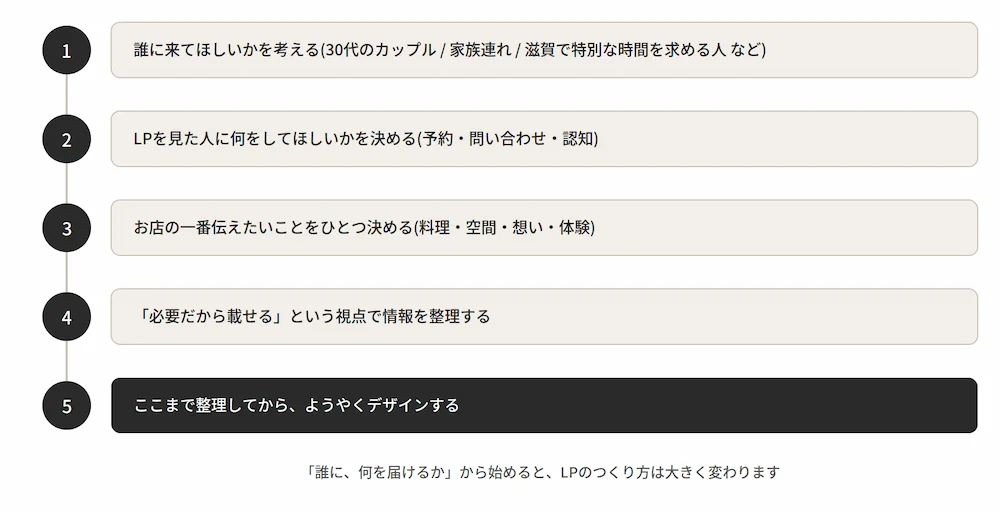
First, think about who you want to attract. Next, decide what you want people who view the landing page to do. Based on that, choose one key message your business wants to convey most. Then, organize the information not by the logic of “including it because it’s there,” but from the perspective of “including it because it’s necessary for this person.” Only after clarifying these points should you move on to the design.Don’t start with the design—start with “who you’re reaching and what you’re conveying to them.” That alone will drastically change how you approach creating a landing page.
What structure should a restaurant’s landing page have?
For example, here’s a possible structure for a restaurant’s landing page:
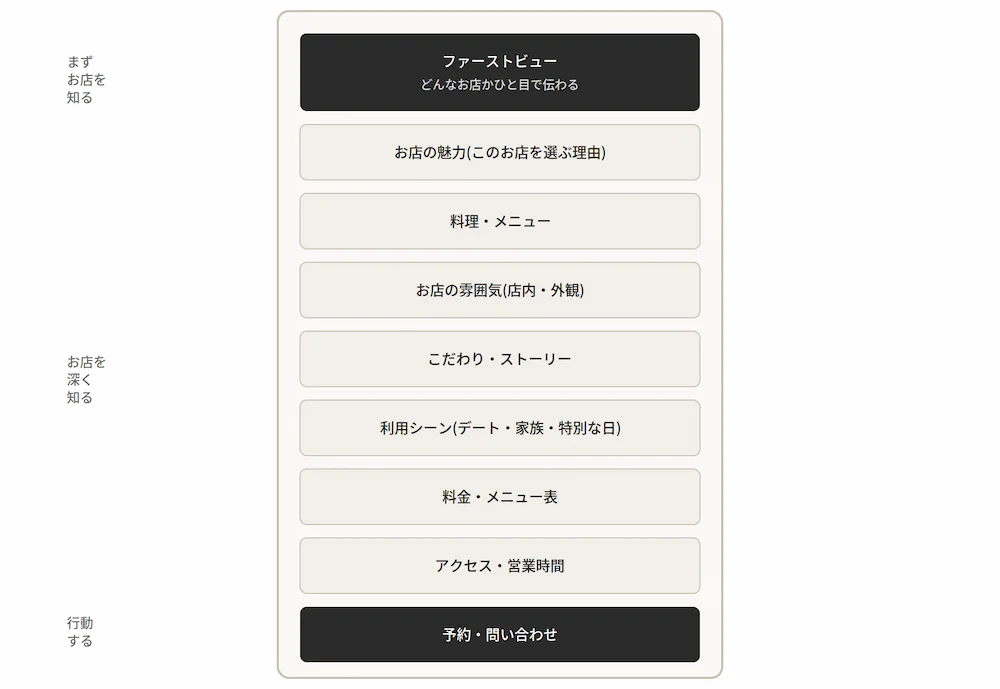
First, the “first view” that conveys “what kind of restaurant this is.” The restaurant’s appeal, which explains why someone should choose this place. The food and menu, featuring photos of dishes and recommended items. The restaurant’s atmosphere, allowing visitors to visualize the interior, exterior, and dining experience. The restaurant’s philosophy and story, conveying the passion behind the food and space.“Occasions” that indicate whether it’s for a date, a family meal, or a special occasion. “Pricing & Menu,” which alleviates concerns about cost. “Directions & Hours,” which clearly provides the information needed to visit. And finally, “Reservations & Inquiries,” which ensures visitors can move forward to the next step without hesitation.
However, this is just one example. Not every restaurant needs this exact structure.
There’s also the option to “leave things out” of the landing page
“Since we’re going to the trouble of creating this, I want to include as much information as possible.” When we hear this from clients and pack everything in exactly as requested, the result is often a website where it’s unclear what kind of restaurant it actually is. We see this all the time. The menu, the restaurant’s unique features, staff profiles, and history—they’re all important. We understand that, but if you try to convey everything at the same volume, none of it really gets across.
If you have a lot you want to convey, there’s no need to force it all onto a single-page landing page. It’s important to consider: “With this much information, a multi-page website might be a better fit than a landing page.”
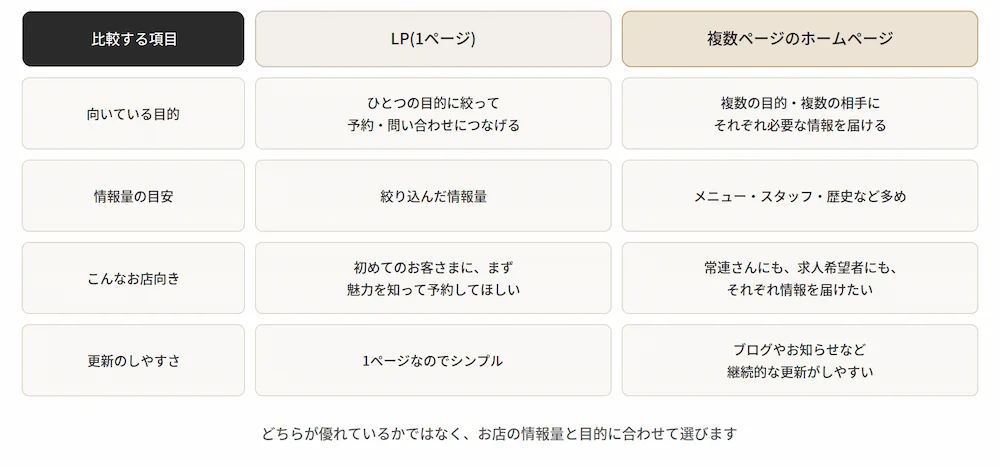
You want to showcase a wide variety of menu items. You want to provide detailed profiles of the owner and staff. You want to clearly convey the restaurant’s history and unique features. You want to feature information specific to each location. You want to keep your blog and announcements up to date. You also want to post job listings. Different customers are looking for different information. In cases like these, rather than cramming everything onto a single page, a website organized into separate pages for each type of information makes it much easier for visitors to find what they need.
Landing pages excel at organizing information toward a single goal. On the other hand, with a multi-page website, visitors who think, “I want to know more about this restaurant,” can browse while selecting the information they need—such as learning about the food, seeing the restaurant’s atmosphere, reading about the staff, or checking directions.Rather than forcing content into a single landing page by cutting it down, it’s also worth considering whether splitting the information across separate pages might be more effective for conveying your message.
What matters more than the sheer volume of information is who you want to see it and how you want them to view it. If your goal is “to help first-time customers discover the appeal of your restaurant and encourage them to make a reservation,” a single-page landing page might be the right choice.If your goal is “to provide the necessary information to first-time visitors, regulars, and job seekers alike,” then a multi-page website might be a better fit. It’s not a matter of one being better or worse than the other; rather, you should choose the format that best suits your business’s information and the visitors’ purposes. I believe this is also an important aspect of “subtraction” when building a website.
Points to Consider When Choosing a Web Design Agency
It’s difficult to make a decision based solely on price. When comparing quotes, please also check the following points:
Will they work with you to plan the structure?
Some agencies handle only the design, while others will work with you to design the structure and user flow. Even agencies that say, “Leave the design to us,” often expect the business to prepare the structural proposal.The page’s framework—what content is displayed and in what order—significantly influences the landing page’s performance, so it’s crucial to confirm in advance whether the agency will collaborate on this aspect. Asking during the initial meeting, “Who will create the structure proposal?” will clarify the scope of their services.
Will they write the copy for you?
The workload varies significantly depending on whether you, as the business owner, need to prepare all the text yourself or if the agency will draft it based on the information gathered during the consultation. If the contract does not include copywriting services, you’ll need to write everything yourself—from descriptions of the dishes and an introduction to the restaurant to the story behind your unique selling points.Writing content from scratch while running a restaurant is a time-consuming task—far more so than you might imagine. Confirming the scope of services—whether they’ll handle the writing based on your input or simply provide a rough draft—will make it easier to plan your timeline leading up to the launch.
Does the package include photography?
It’s best to confirm whether photography is a separate charge or included in the package.Even if the quoted price seems low at first glance, there are cases where photography is billed separately, resulting in unexpected additional costs later on. Conversely, even with plans that include photography, there may be limits on the number of shots or the shooting time. By confirming conditions such as “up to how many shots” or “up to how many hours,” you can more easily prevent unexpected additional costs.
Scope of Post-Launch Support
Whether the relationship ends once the site goes live or if you can consult with the company regarding updates and improvements will shape your long-term partnership.Is the system set up so you can update the site yourselves whenever your menu or business hours change, or do you need to request the production company to do it each time? Also, whether fees are charged for each update or if they’re included in a monthly support contract varies by company. Whether the company is willing to work with you to “grow” the site together after launch—rather than simply launching it and walking away—makes a surprisingly big difference when it comes to a long-term partnership.
Clarity on Deadlines and the Production Workflow
Knowing in advance how long the process will take and in what order the steps will proceed makes it easier for the client to prepare. If you only receive vague answers like “roughly 1 to 2 months,” it’s not uncommon for the actual project to take longer than expected once you place the order.By confirming before signing the contract how long each stage—from the initial consultation to the photo shoot, copy review, design review, and launch—will take, as well as how many rounds of review and revision are included, you can more easily prevent schedule slippages down the line.
Frequently Asked Questions About Landing Page Creation for Restaurants
Should I create a landing page or a full website?
If you’ve narrowed down the information you want to convey to a single point and want to lead visitors directly to making a reservation or submitting an inquiry, a landing page is the better choice.On the other hand, if the information customers want to know varies—such as menus, staff profiles, or job listings—a multi-page website is often a better fit. If you’re unsure which to choose, ask yourself, “Can I narrow down the primary action I want visitors to take on this page to just one?” This will make the decision easier.
Is it cheaper to provide our own photos?
If you use existing photos, you can keep costs down since there are no photography fees. However, the impression conveyed by a photo taken with a smartphone versus one taken by a professional can vary significantly. This is especially true for food photography, where even the slightest difference in lighting or angle can make a huge difference in whether the food looks appetizing. For this reason, many restaurants choose to keep overall costs down while still hiring a professional specifically for food photography.
How long does it take to produce a landing page?
The timeframe varies depending on the content and whether photography is required, but we generally recommend allowing approximately 3 weeks to 2 months from the initial consultation to launch. The actual time may vary depending on how long it takes to coordinate the photo shoot schedule and review the copy. If you’d like to launch the site in time for a busy season or a specific event, it’s best to start consultations early and work backward from your target date.
Can you handle updates after the site goes live?
The scope of support varies by production company. The type of support you’ll need depends on whether you simply want to request changes to your menu or business hours on an as-needed basis, or if you’d like to discuss regular improvement proposals as well. It’s a good idea to confirm before signing a contract whether a quote is required for each update or if updates are included in a monthly support plan.
Can you integrate with a reservation system?
The scope of support varies by development company, ranging from setting up links to external booking services to implementing a custom booking form using a web form. If you’re already using a booking service, checking whether the company has experience integrating with that specific service will help prevent issues after launch. If you’ve decided on a specific booking method you’d like to implement, consulting early on will ensure a smoother process.
How do I measure the effectiveness after launch?
As I mentioned earlier, launching a landing page isn’t the end of the process—but how can you verify that people are actually viewing it?
Basically, you’ll use web analytics tools to see how many people are visiting the landing page, where they’re coming from, and how far down the page they’re scrolling. Additionally, if you can track how often the booking form is submitted or the phone number is tapped, it becomes easier to distinguish whether people are “viewing the page but not booking” or “not viewing it at all.”
You don’t need to track every little detail of the numbers every day. Even if you just make it a habit to compare the current month’s results to the previous month once a month, you’ll be better able to recognize when it’s time to update your photos or revise your copy.
Ultimately, how much should you spend on a restaurant’s landing page?
If you’ve read this far, you might be thinking, “So, how much should I actually spend?” However, we don’t believe we can make a blanket statement like, “We recommend an LP costing X ten thousand yen.”
If you already have both photos and copy ready and simply want to organize the information, you may not need a very large production budget. On the other hand, if you want to organize your restaurant’s information from scratch, retake photos, have someone help craft the copy, and design the flow leading to reservations, the time required will naturally increase.
What you should focus on isn’t just “how many ten-thousands of yen the landing page costs,” but “how much planning is included in that price.” Is it just the design? Will they help with the structure? Will they write the copy for you? Is photography included? Can you consult with them even after the page goes live? When comparing prices, be sure to look at these details as well.
Summary | Creating a landing page starts with choosing the right format
If you’re creating a landing page, you’ll naturally want it to have a beautiful design. Of course, that’s important. But before you get there, you should ask yourself, “Is a landing page even the right format for this business in the first place?”
If you want to organize information toward a single goal, an LP is the right choice. If you have a lot to convey and want visitors to take their time exploring each point, a multi-page website is a more natural fit.
And no matter which you choose, it’s important to start by asking, “Who am I trying to reach, and what do I want to convey?” rather than thinking, “I’ll just put everything in for now.” Keep what’s necessary and let go of what isn’t. If you still have too much information, try not to cram it all onto a single page. That’s how you choose the format that’s just right for your business. I believe that’s also part of the process of creating a website.
 Contact Form


 Related Articles