
Hello, this is Lake and Moon Design.
We often get questions from people opening new businesses or business owners planning to establish a strong online presence, asking, “Is a website really necessary? Is a long, vertical landing page (LP) enough on its own?”
To put it simply, there’s no one-size-fits-all answer that’s “absolutely the right choice.” So, what criteria should you use to decide? While budget and the effort required to update the site are certainly important, there’s a more fundamental factor to consider first.
That is, “What kind of customers visit your business, and what are they looking for?”
In this article, I’ll discuss how restaurants should decide between a landing page (LP) and a full website—focusing on customers’ real-world behavior before delving into numbers or technical systems.
Visualize Your Customers Before Considering Your Budget

For example, even among “restaurants,” the times and experiences customers are looking for can be completely different.
- Restaurant A: Customers want to quickly fill their stomachs with a delicious fried chicken set meal during their work break.
- Restaurant B: A couple wants to spend a leisurely, relaxed time together on their wedding anniversary this weekend.
Customers at Restaurant A are looking for quick information: “Location, menu, and whether they can get a table right away.” On the other hand, customers at Restaurant B will carefully research questions like “What’s the atmosphere like? Are there private rooms? What’s the owner’s philosophy behind the food?” to determine if it’s a place worthy of their precious time before making a reservation.
A single-page landing page (LP) excels at “giving customers a quick nudge in the right direction.” A website excels at “thoroughly conveying the restaurant’s unique atmosphere to put customers at ease.”
First, try to picture what age group visits your restaurant and what they’re looking for.
Which social media platforms do your customers use? (Characteristics by age and gender)
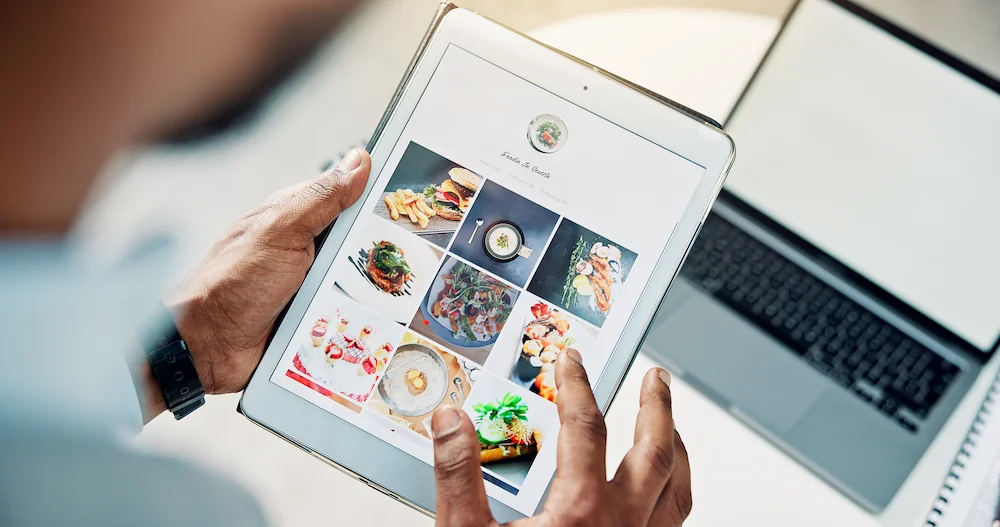
Once you have a clear picture of the customers you want to attract, next consider “where they usually spend their time (which social media platforms they use).” This is to create a flow that guides them from social media to your landing page or website.
Each social media platform has distinct differences in its “user demographics” and the “atmosphere of how people search.”
Types of Social Media | Main Age Groups | Gender Ratio Trends | Characteristics and Atmosphere When Searching for Restaurants |
20s–40s | Slightly more women | Users search visually for “delicious-looking” and “stylish” options. The current hub for finding restaurants. | |
Teens to 20s | Almost an equal mix of men and women | Short videos create the impulse to think, “I want to go there right now!” | |
20s–40s | Slightly more men | Real-time searches like “Where should I go for lunch today?” and a glimpse into the unvarnished daily lives of shop owners. | |
Ages 40–60 | Slightly more men | Strong for word-of-mouth within local communities and for finding slightly more sophisticated “adult-oriented” spots. |
For example, if your goal is to “attract women in their 20s to come and enjoy Instagram-worthy desserts,” a flow that directs them from Instagram to a landing page for a quick reservation tends to work well.
Conversely, if you want “couples in their 40s and older to enjoy our carefully selected Omi vegetables,” it would make more sense to have them visit your website via Facebook or Google search and take their time reading your restaurant’s story.
Comparison by Type: Businesses Suited for a Landing Page vs. Those Better Suited for a Website
We’ve compiled a table summarizing the “ideal web format for your business”
based on your customer demographic and the social media platforms they use.
Comparison Criteria | Businesses for Which a Landing Page Is Sufficient | Businesses Better Suited for a Full Website |
Customer Demographics | Primarily trendsetters in their teens through 30s | People in their 30s and older who want to take their time choosing a store |
Desired Experience | Quickly enjoying the “trending signature dish” | Savoring the experience—including the atmosphere, concept, and time spent there |
Entry Points for Attracting Customers | The momentum of Instagram, TikTok, and web ads | Careful searches such as “[City Name] + private room lunch” |
The Role of the Web | Guide customers directly to “booking and visiting” without confusion | Convey the restaurant’s story and foster deep “empathy” |
How Much Does the Cost Vary?
After picturing our customers’ faces and considering how the site will integrate with social media, let’s finally talk about the practicalities: the budget.
At Lake and Moon Design, our “Mini-Site Plan”—a single-page landing page-style site that conveys your vision—starts at 440,000 yen, while our “Standard Plan,” which creates a robust website featuring a homepage plus about nine pages, starts at 880,000 yen.
Rather than simply deciding on a landing page just because it’s “cheaper,” we recommend weighing what you gain with the price difference—such as the ability to include information across multiple pages, improved search engine visibility, and the time visitors spend thoroughly reading your content—before making your choice.When considering a website for your restaurant, it’s easier to make a decision if you look beyond just the initial cost and also consider “how long it will serve as an asset for attracting customers.” Do you need an update feature (like WordPress)?
Now, let’s get into some practical details.
We often hear requests like, “We want to be able to update announcements ourselves,” but depending on your specific situation, choosing not to include an update feature can also be the right decision.
Scenarios | When it’s better to include an update feature | When it’s not necessary to include it |
|---|---|---|
Operational Situation | Frequent changes, such as seasonal menus | The staff is too busy to handle website updates |
Purpose of Updates | To consistently provide the latest information and instill a sense of reassurance | The menu is fixed, so daily updates are handled sufficiently via social media |
It’s not uncommon for businesses to implement a sophisticated content management system only to find that, due to their busy schedules, no one ends up using it. In that case, it’s better to skip the system altogether from the start and rely on familiar social media platforms for daily updates. This “subtractive” approach is a crucial decision for ensuring smooth, sustainable operations.
Even if you do decide to include an update function, it doesn’t necessarily have to be a heavy-duty platform like WordPress. For tasks like updating announcements or menus, there’s also the option of “microCMS,” which is lighter and simpler to use. We at Lake and Moon Design often recommend it because frontline staff can use it without any confusion.
“Discoverability” through search actually changes, too
Another factor to consider separately from traffic from social media is “discoverability via Google search”—in other words, SEO.
Since landing pages (LP) are typically self-contained on a single page, search engines see them as having only one “entry point.” In contrast, a website composed of multiple pages—such as a menu page, a “What We Offer” page, or an “Access” page—each serves as an entry point for various customer search keywords, such as “Lunch in [City Name]” or “Private Rooms in [City Name].”
While landing pages excel at generating a sudden surge of traffic through social media buzz, when it comes to the “stamina” of being discovered gradually and consistently through search, a multi-page website has the edge. The longer your business has been open, the more this difference translates into stability in customer acquisition.
Do Restaurants Need a Website? The Philosophy Behind Lake and Moon Design
When looking for restaurant information, more and more customers these days are turning to Google Maps (Google Business Profile).
We’ve discussed how to utilize Google Business Profile (MEO strategies) in this article, but first and foremost, the basic step is to set up your restaurant’s website or landing page as an “official information hub” that customers can find via Maps.
With that in mind, here’s the simple conclusion we’ve reached:
- If you want visitors coming from social media to take a single action (make a reservation), use a “landing page”
- If you want visitors coming from search results to get a full sense of your restaurant’s atmosphere, use a “website.”
At Lake and Moon Design, we prioritize attracting customers through search by providing high-quality information—rather than relying on fleeting viral trends or aggressive sales tactics. That’s why we often propose websites that carefully convey not only the store’s atmosphere but also the owner’s vision.
What matters most is “how you want customers to find you.”
For restaurants, the most important thing isn’t the technical question of “Should we build a website or a landing page?” It’s something much more fundamental: “What kind of customers do we want to attract, and in what frame of mind do we want them to walk through our door?” Once that vision is clear, the right “web format” will naturally become apparent.
If you’re wondering, “Which format is right for my restaurant?” feel free to reach out—even if you just want to start by sorting out your current situation. Based on your current customer base and customer acquisition channels, we’ll propose a solution that works for you without any unnecessary strain.
Frequently Asked Questions
Can I attract customers with just a landing page?
Yes, it’s possible. Especially when your goal is narrowly focused—such as reservations or takeout orders via social media—a landing page alone often functions perfectly well. However, since it tends to be less effective for attracting customers through searches like “[City Name] + lunch,” this option is best suited for businesses confident in their social media management.
Do I really need a website if I already have social media accounts?
If you have a stable following on social media and new customers are coming in via those platforms, there’s no need to force yourself to have a website. On the other hand, if you want to reach customers in age groups that don’t use social media, or if you want to increase visits from Google Search or Google Maps, a website (or landing page) serves as your “official information hub.”
Can I upgrade from a landing page to a full website later on?
Yes, you can. It’s possible to start with the Mini Site Plan (equivalent to a landing page) when you first open, then upgrade to the Standard Plan when your menu expands or you need pages to highlight your unique features. You don’t have to aim for perfection from the start; it’s perfectly fine to take a phased approach and grow your site gradually as your business evolves.
Can both the landing page and the website be optimized for SEO?
While a certain level of SEO is possible for both, a landing page with fewer pages tends to have a more limited range of keywords that can rank highly, as the entry points for search keywords are restricted. If you want customers to find you using multiple keywords—such as “city name + business type”—a full website with more pages will be more advantageous.
If you’re wondering, “Which format is right for my business?” feel free to contact us—even if you just want to start by sorting out your current situation. We’ll propose a practical solution based on your current customer base and customer acquisition channels.
 Contact Form


 Related Articles